Trump Keeps Asking Americans To 'Remember' Events That Only Happened in His Own 'Made-Up' Stories
Exploring Trump's Habit of Turning Fiction into Shared Memory

The president has developed a rhetorical habit that turns his listeners into witnesses of things that never occurred: he tells an invented story, then asks the room whether they remember it too.
Donald Trump's latest example came on Thursday, when he asked Americans to recall a nationwide television blackout, supposedly caused by wind turbines falling still, that never took place.
According to an analysis by fact-checker Daniel Dale, it was the newest entry in a pattern in which the president invites the public to remember past events that exist only in his own made-up stories. The technique lets a fabrication pass as shared memory, and it has become a recurring feature of how Trump talks about his enemies, his record and the country's history.
The Television Blackout That Never Happened
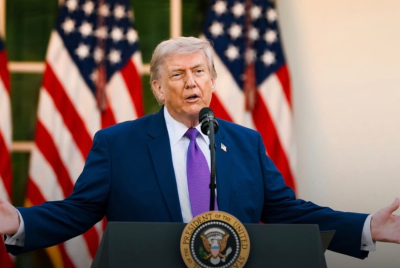
Speaking at an Environmental Protection Agency event in Washington on Thursday, Trump returned to one of his favourite targets, wind power, and dressed an old false claim as a genuine reminiscence.
Denouncing what he called 'the Green New Scam', he said Americans had wanted to watch his June 2024 debate against 'Sleepy Joe Biden' but could not, because the wind was not blowing to power their televisions. 'Remember that?' he asked.
Trump: "They were saying wind is so wonderful, except you couldn't watch your television" pic.twitter.com/mgxZU1OThV
— Aaron Rupar (@atrupar) July 23, 2026
There was nothing to remember. As Dale set out, wind is one source in a broader electricity mix rather than the sole supply, so the grid keeps running and screens stay lit even when the air is still, and batteries can store turbine power for calm spells.
Tens of millions of Americans did watch that debate: more than 51 million on television alone, according to Nielsen estimates, including viewers in Texas, then and now the country's biggest producer of wind-powered electricity.
Appearing on an interview on Sunday, Dale did not hedge. 'The president is making stuff up again,' he said, noting that Trump had asked people to recall 'this massive nationwide television outage caused by the wind not blowing' on the night of a debate more than 51 million of them had plainly seen.
A Pattern of Manufactured Memories
The wind blackout is not an isolated slip but one instance of a documented habit. Dale pointed to an earlier case in which Trump asked audiences to 'remember' that he had been at his golf course in Scotland on the day of the 2016 Brexit referendum and had correctly predicted the result.
In reality, Trump arrived at his Turnberry resort the day after the vote, making any same-day prediction impossible. The story, like the television anecdote, asks listeners to co-sign a memory that the calendar refuses to support.
The false reminiscences have extended into history as well as autobiography. Dale noted that in the same month, Trump twice recounted fabricated tales, one concerning George Washington and another about the construction of the Panama Canal, adding invented figures and anecdotes to episodes with well-documented records.
'The president making up numbers, making up anecdotes, and making up history,' Dale said, summarising the pattern.
Why the 'Remember That?' Device Works
What distinguishes these claims from ordinary political exaggeration is the explicit invitation to remember. By phrasing a fiction as a shared recollection, Trump recruits his audience into confirming it, and the comedic delivery he often uses has allowed the wind story in particular to slip past fact-checkers as a joke rather than a claim.
On Thursday, however, he told it mostly straight, as if recalling something real. 'I got it right from the beginning,' he said of his opposition to wind. 'They were saying wind was so wonderful, so wonderful, except you couldn't watch your television.' The framing matters, because a claim delivered as memory is harder to challenge in the moment than one delivered as an argument.
The substance underneath the rhetoric is checkable, and it does not match. Wind accounted for roughly 10 percent of net US electricity generation in 2024, according to federal data, operating as part of a mix alongside gas, nuclear, coal and solar rather than as a single fragile lifeline for the nation's screens.
An Old Feud Dressed as Recollection
Trump's hostility to wind power is long-standing and consequential. He has railed against turbines for years, told world leaders at the United Nations that renewable energy was 'destroying' much of the planet, and since returning to office has moved to cancel or halt major renewable projects, including billions of dollars' worth concentrated in Democratic-leaning states.
The invented blackout serves that campaign, converting a policy dispute into a folk memory of a scam the public supposedly lived through. It is an argument that needs no evidence, because it presents itself as something the audience already knows.
For the fact-checkers whose task is to keep the record straight, the challenge is no longer only correcting what the president asserts, but disproving the things he insists everyone already remembers.
© Copyright IBTimes 2025. All rights reserved.
- Recommended For You