'He Eats His Young': Anthony Scaramucci Warns Marco Rubio to Resign Before Donald Trump Boots Him
Former White House Communications Director Advises Rubio to Leave on His Own Terms
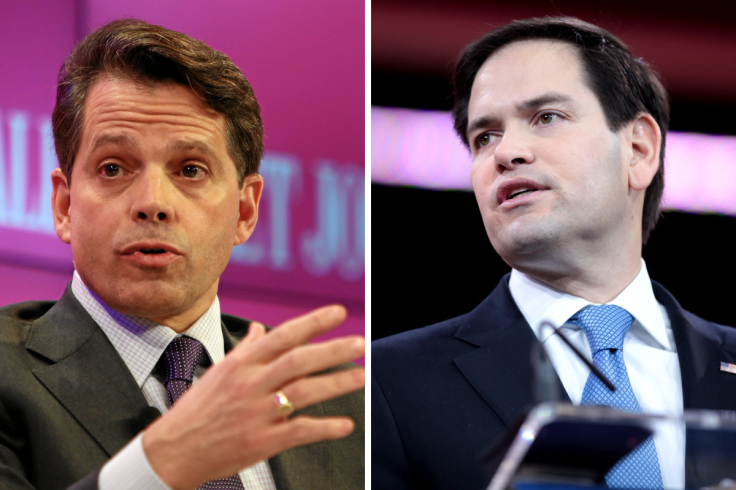
Anthony Scaramucci has urged Marco Rubio to resign before Donald Trump 'does it for him', arguing that the president has repeatedly turned on some of his closest political allies once they were no longer politically useful. The former White House communications director said Rubio should leave on his own terms rather than risk becoming the latest senior figure to fall out of favour.
The warning is the latest in Scaramucci's long-running criticism of Trump since leaving the White House in 2017. While the two were once allies, Scaramucci now argues that loyalty offers little lasting protection inside Trump's political orbit, where even trusted advisers can quickly become expendable.
Warning Rubio To Leave First
Scaramucci delivered the message in a post on X on Sunday.
'There's one thing every rising star in Trump's orbit eventually learns the hard way,' he wrote. 'He eats his young. And if you don't believe me, ask Pence, ask Pompeo, ask Nikki Haley.'
There’s one thing every rising star in Trump’s orbit eventually learns the hard way.
— Anthony Scaramucci (@Scaramucci) July 26, 2026
“He eats his young. And if you don’t believe me, ask Pence, ask Pompeo, ask Nikki Haley.”
So I think if Rubio’s smart, he resigns on his own terms — before Trump does it for him. pic.twitter.com/IciBiaqPR8
The reference was to former Vice President Mike Pence, former Secretary of State Mike Pompeo and former UN ambassador Nikki Haley, all of whom later experienced public breaks or political distancing after serving as some of Trump's most prominent allies.
Scaramucci then turned directly to Rubio.
'So I think if Rubio's smart, he resigns on his own terms — before Trump does it for him,' he wrote.
Although Rubio remains a senior figure in Trump's administration, Scaramucci argued that previous examples suggest even high-profile allies can quickly lose the president's confidence.
A Familiar Warning
The latest remarks echo a theme Scaramucci has repeated since his brief stint as White House communications director.
Earlier this month, he described Trump's latest tariff proposals as 'more dizzying distractions on top of ever-spiralling failures'. He has also argued that increasingly polarised politics and heavily gerrymandered districts have left politicians with little incentive to seek compromise.
Trump's third tariff tantrum piles more dizzying distractions on top of ever-spiraling failures | Fortune @jeffsonnenfeld https://t.co/VeGo9kCvJP
— Anthony Scaramucci (@Scaramucci) July 22, 2026
His comments about Rubio also mirror remarks he made during a Newsnight interview earlier this year, when he predicted Trump would ultimately 'destroy the careers' of both Rubio and Vice President JD Vance before the administration's term ends.
Taken together, the comments reinforce Scaramucci's broader view that political loyalty is rarely enough to secure a lasting place within Trump's inner circle.
Beyond Rubio
Scaramucci has made similar arguments while discussing other controversies involving the administration.
He publicly commented on allegations involving a White House teleprompter operator accused of using advance knowledge of one of Trump's speeches to trade on prediction markets.
According to Scaramucci, the employee was unlikely to receive meaningful protection.
'I think the problem with what's happening with the teleprompter guy — he probably heard the president say that he was going to pardon everybody inside 200 to 250 feet of the White House, as reported in Regime Change by Jonathan Swan and Maggie Haberman,' he said.
'But he doesn't qualify, the poor kid, because he doesn't make enough money. He's not influential enough, and his last name isn't Trump. So the kid's obviously in a lot of trouble, and he's going to pay the price while the president's going to go on to make several billion dollars for himself.'
The comments reinforced Scaramucci's wider argument that influence and political value often determine who receives support inside Trump's orbit.
Questions Over Loyalty And Power
Scaramucci has also criticised Trump's approach to ethics and financial disclosure, arguing that the president views personal financial gain differently from many previous officeholders.
'He sees it as incredibly smart: "Look how smart I am. The other people that held his position, they couldn't do this. Look how great I am,"' Scaramucci said while discussing allegations of insider trading.
He contrasted Trump's financial disclosure filings with those of former President Barack Obama, arguing they reflected very different approaches to public office and personal financial interests.
Trump has consistently denied wrongdoing relating to his financial affairs, but Scaramucci continues to cite those issues as evidence of what he considers a leadership style driven more by personal advantage than institutional responsibility.
Rubio's Political Future
Scaramucci's latest remarks may appear to be another instalment in his long-running feud with Trump, but they also carry a direct message for officials still serving in the administration.
His advice to Rubio is not simply to oppose the president. Rather, he argues that senior advisers should recognise what he sees as a recurring pattern in Trump's relationships with prominent allies and leave before circumstances change.
Whether Rubio takes that advice remains uncertain. There has been no indication that he intends to resign, nor has the White House suggested his position is under threat.
For Scaramucci, however, the lesson is clear. In Trump's political orbit, today's trusted ally can quickly become tomorrow's discarded one—a pattern he believes Rubio should heed before it is too late.
© Copyright IBTimes 2026. All rights reserved.
- Recommended For You