

'He Embarrasses the Country': Political Analyst Claims Donald Trump Cannot Think Straight
Political analyst David Rothkopf has launched a critique of Trump's mental fitness after the president's rambling comments on Iran at Joint Base Andrews.

Donald Trump's thinking is so muddled that he 'cannot think straight' and now poses a constant risk to his own presidency and the country, political analyst David Rothkopf claimed on an episode of The Daily Beast Podcast, after the president gave a rambling answer about his war on Iran to reporters at Joint Base Andrews on Sunday.
Trump had just returned from the FIFA World Cup final, where he was booed twice by the crowd, according to the report. On the tarmac, he was asked about his strategy toward Iran. His reply, intended to reassure Americans that his administration was preventing Tehran from acquiring nuclear weapons, instead raised questions about whether he could follow his own train of thought.
'What we're doing now is we're ending any chance where they can have a nuclear missile,' Trump told reporters. Then his remarks veered off. 'If you look at it, after a week and a half... not four weeks, a week and a half, two weeks, we stopped them from, probably but I don't want to have the word 'probably.' Thank you very much, everybody.'
On the podcast, host Joanna Coles asked Rothkopf to decode what Trump might have meant. He refused to pretend there was a coherent message buried in the jumble. Instead, he offered a blunt diagnosis of the performance: Trump's brain, Rothkopf said, is 'pure porridge at this point.'
Donald Trump, the Iran Answer, and a 'Porridge' Brain
Rothkopf, a veteran commentator on US foreign policy, did not soften his language. He suggested that what the public saw at Joint Base Andrews was not an isolated gaffe but an increasingly familiar pattern whenever Trump faces unscripted questions about high-stakes issues such as Iran and nuclear weapons.
'It is even more porridgey, it's a more watery porridge,' he added, arguing that Trump's mental functioning appears to deteriorate visibly when he is tired. 'When you get to the end of a long day, he's just exhausted, and he can't think straight.'
He painted a picture of a president whose answers, on Iran or anything else, now come out as fragments rather than arguments. In Rothkopf's telling, Trump appears to reach for a collection of familiar phrases that have served him politically nuclear threats, toughness, 'bad guys,' swift victory but can no longer line them up in a logical sequence.
'He's asked about the war, and he goes, in his brain: I know, I have an answer,' Rothkopf said, imagining the internal monologue. 'Something about nuclear, something about I had to do this, something about they're the bad guys, something about this'll be over soon.' The problem, he argued, was that Trump's mind then 'misfired,' spitting those elements out in 'random order.'
According to Rothkopf, this is not just a matter of style or Trumpian improvisation. 'There's no file retrieval going on in his brain anymore at this point,' he said. In his view, the president is no longer able to summon facts and arguments on cue. The words arrive, but as a scattershot, not a briefing.
A President Who 'Embarrasses the Country'
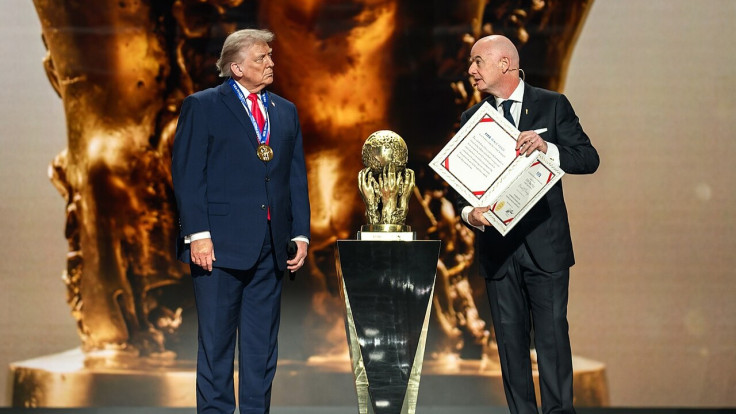
The Iran remarks were not the only moment under scrutiny. Rothkopf also seized on Trump's behaviour in the stadium after Spain lifted the World Cup trophy. Trump lingered on stage during the ceremony, clapping among the victors while FIFA president Gianni Infantino tried, apparently in vain, to usher him away.
It was a small breach of protocol, but to Rothkopf it spoke to something larger about Trump's basic judgement and awareness in public. He argued that Trump increasingly has to be hustled away from cameras because his unscripted appearances have become a liability.
'They lead him away to the plane because he obviously can't be exposed to the public,' he said, invoking reporting on how restricted the president's diary has become. 'His public schedule is next to zero because any time he gets in front of a camera, he embarrasses himself, he embarrasses the country, he offends somebody, he says something he shouldn't say. And it happens when things are planned, when they're not planned, around the clock.'
That is not a gentle critique. Rothkopf's conclusion is that Trump is now 'his own greatest liability,' a man whose instinct for self-promotion has curdled into self-sabotage.
He did not stop at questions of cognition. The analyst argued that Trump is 'extraordinary' among world leaders for another reason: a supposed absence of empathy. Pointing to what he characterised as Trump's indifference to the loss of US servicemembers in his war on Iran, Rothkopf claimed the president 'has no heart' and 'no empathy.'
'He cannot relate to human beings in the way a human being does,' Rothkopf said, framing Trump's response to casualties and sacrifice as not just politically hard-edged, but emotionally hollow.
None of Rothkopf's claims about Trump's mental state or inner life can be independently verified, and they are presented as his analysis, not medical fact. The White House 'did not immediately return' a request for comment, leaving his depiction of a president with a 'porridge' brain and a 'hollow core' unchallenged on the record and very much contested in the court of public opinion.
© Copyright IBTimes 2026. All rights reserved.