

Trump's Judicial Nominee Can't Recall What 22nd Amendment Says, Then Refuses to Say Trump Is Ineligible for Third Term
James P. Sullivan said commenting on Donald Trump's 2028 eligibility could breach judicial conduct rules during a Senate hearing
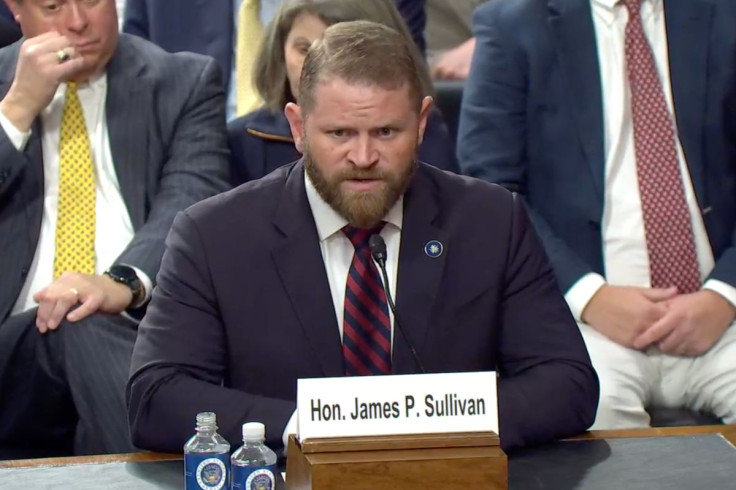
A judicial nominee picked by US President Donald Trump could not recall what the 22nd Amendment says, then refused to say whether the Constitution would bar the president from being elected to a third term in 2028.
James P. Sullivan, a Texas Supreme Court justice nominated to the US District Court for the Western District of Texas, was questioned by Democratic Senator Chris Coons during a Senate Judiciary Committee hearing on Wednesday, 18 November.
'Oh Boy': Nominee Needs Help Recalling Amendment
Coons began by asking Sullivan what the 22nd Amendment says. The amendment, ratified in 1951, restricts how many times someone can be elected president.
Sullivan hesitated. He told the senator he carried a copy of the Constitution over his heart because 'sometimes it isn't in my brain'.
'Oh boy, oh boy!' he said, struggling to recall the provision.
Coons offered the opening words: 'No person shall be elected...'
OMG -- Trump judicial nominee James P Sullivan (a Texas Supreme Court justice!) reveals he doesn't know what the 22nd amendment says, but then after Chris Coons explains it to him, he refuses to say it'd be illegal for Trump to serve an illegal third term 🤦 pic.twitter.com/YwkDcVa70C
— Aaron Rupar (@atrupar) November 18, 2026
Sullivan then thanked him and completed the central point, saying no person could be elected president more than twice.
Asked whether Trump had already won two elections, Sullivan acknowledged that the president had been certified as the winner in 2016 and 2024.
Sullivan Calls Third-Term Question 'Political Debate'
Coons followed with a direct question: 'Is he eligible to run for president again in 2028?'
Sullivan declined to give a yes-or-no answer. He argued that commenting on the question could violate Canon 5 of the federal judicial code of conduct, which restricts judges' political activity.
He described Trump's eligibility as a 'subject of ongoing political debate' and said he could instead explain how he would approach interpreting the Constitution.
'That's a very disappointing answer,' Coons replied, arguing that the amendment's wording was unmistakable.
The senator said the issue appeared unresolved only in Trump's mind, citing the president's repeated remarks about another term. Sullivan maintained that he would examine the constitutional text and its original public meaning, including the historical circumstances in which it was adopted.
What the Constitution Says About a Third Term
The 22nd Amendment states: 'No person shall be elected to the office of the President more than twice.' It followed Franklin D. Roosevelt's unprecedented victories in four presidential elections.
Trump won in 2016 and 2024, meaning the amendment bars him from being elected president again. Its precise language concerns election, however, and scholars have debated hypothetical routes to the presidency through succession.
Trump himself has fuelled the discussion. In March 2025, he told NBC News he was 'not joking' about a third term. The following month, he told Time magazine that potential 'loopholes' had been discussed, while saying he did not believe in using them.
Nomination Follows Texas Election Defeat
Sullivan was appointed to the Texas Supreme Court in 2025 but lost his bid for a full term to Democrat Chari Kelly in the 3 November election. Trump announced his federal nomination a week later.
Before joining the state Supreme Court, Sullivan served as general counsel to Texas Governor Greg Abbott. Republican Senator John Cornyn has publicly backed his nomination.
If confirmed by the Senate, Sullivan would receive a lifetime appointment to the federal bench. His exchange with Coons has placed his approach to a basic constitutional restriction under scrutiny before that decision.
© Copyright IBTimes 2026. All rights reserved.