

Trump Reduced to Begging China, the UK, and Allies He Once Scorned to Send Warships as Hormuz Crisis Spirals
Scorned Allies now hold the cards
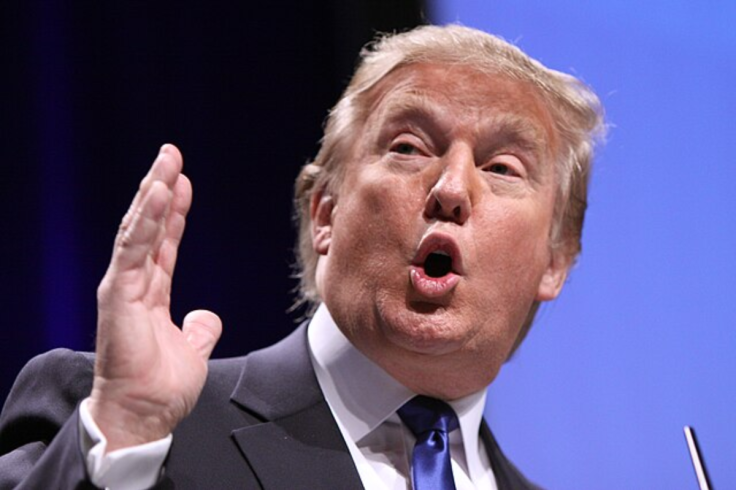
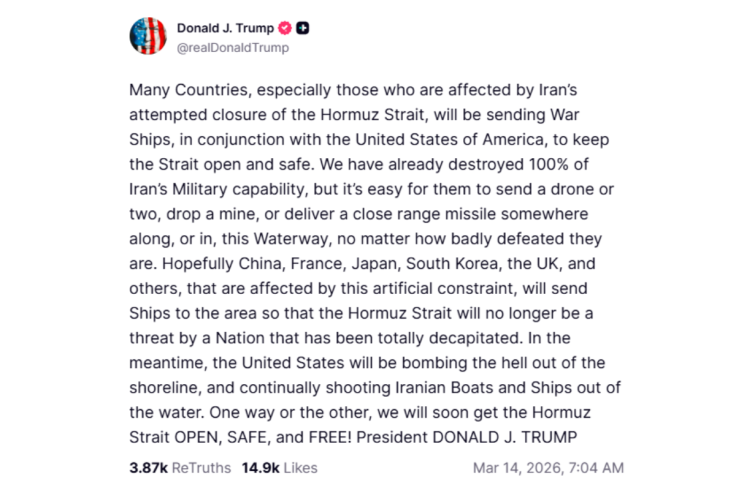
Donald Trump has turned to the very nations he spent years belittling, publicly urging China, the United Kingdom, France, Japan and South Korea to deploy warships to the Strait of Hormuz as Iran's blockade of the critical waterway pushes the global economy toward crisis. The appeal, posted on Truth Social on Saturday, laid bare the scale of Washington's predicament — and the cost of a foreign policy built on alienating allies.
'Hopefully China, France, Japan, South Korea, the UK, and others, that are affected by this artificial constraint, will send Ships to the area so that the Hormuz Strait will no longer be a threat by a Nation that has been totally decapitated,' Trump wrote on Truth Social. The appeal, framed as hopeful rather than commanding, stood in contrast to the muscular unilateralism Trump had championed since returning to office.
A Crisis Years in the Making
On 4 March 2026, Iranian forces declared the Strait 'closed,' threatening and carrying out attacks on ships attempting to transit the waterway. The blockade followed the launch of joint US-Israeli strikes on Iran on 28 February, which killed Iran's Supreme Leader and plunged the Middle East into war, virtually halting traffic through the Strait — a key transit point for oil and gas, the vast majority of which is destined for Asia.
The Strait usually sees 138 ships a day pass through, but that figure has declined to approximately five due to the threat of attack. A fifth of the world's oil and liquefied natural gas runs through the waterway, leaving customers worldwide facing shortages and rising prices. Iran has predicted oil will surpass $200 (approx. £150) a barrel, double its current levels and well above pre-war levels of $72 (approx. £54).
Planning Failures at the Top
The scale of the disruption has exposed what multiple sources describe as a critical intelligence and planning failure inside the Trump administration. The Pentagon and National Security Council significantly underestimated Iran's willingness to close the Strait in response to US military strikes, according to multiple sources familiar with the matter.
Trump's preference for relying on a tight circle of close advisers in national security decision-making had the effect of sidelining interagency debate over the potential economic fallout if Iran were to respond by closing the strait — and it may now be weeks before the administration's efforts to alleviate the intensifying fallout take hold. Naval historian Sal Mercogliano of Campbell University was blunt in his assessment. 'The United States completely blew this,' he said. 'How they didn't know this was going to happen is really mystifying... they should have been prepared.'
@hal_for_ny__ Donald Trump got into Iran with zero preparation and we are watching him crumble. #trump #donaldtrump
♬ original sound - Hal_for_NY__
Allies Reluctant, Iran Defiant
Despite Trump's public appeal, the response from allied governments has been cautious. US allies have been reluctant to provide military support for the US-Israeli strikes on Iran, though they have mobilised warships in response to the widening conflict. France's President Emmanuel Macron described any potential allied naval role as strictly 'defensive.'
Iran, meanwhile, has shown no sign of backing down. The Islamic Revolutionary Guard Corps (IRGC) said the Strait remained under its navy's control following the Kharg Island strikes. 'American aggressors and their allies have no right of passage,' an IRGC spokesperson said. 'Any attempt to move or transit will be targeted,' the IRGC added in a statement carried by Iranian state media. Experts warn that a military solution alone may not be sufficient. 'Without putting troops on both sides of the Strait of Hormuz and ensuring that you're able to prevent drones and mine attacks, I just don't see a military solution,' Mercogliano said.
The Hormuz crisis is no longer just a military standoff — it is a stress test of an entire diplomatic posture. Trump built his second term on the premise that America did not need its allies, and the Strait of Hormuz has forced a very public reckoning with that assumption. The world's energy markets are bearing the cost while Washington waits to see whether the nations it once alienated will answer the call.
© Copyright IBTimes 2026. All rights reserved.
- MOST POPULAR IN World


