Iran War Shock Leaves UK Policymakers Trapped Between Inflation and Recession Risks
NIESR warns of potential recession as energy prices soar due to Iran conflict

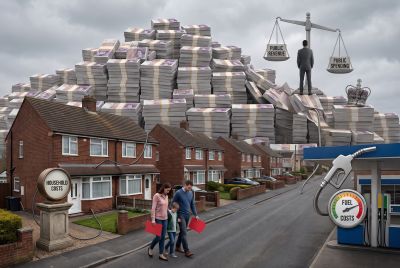
The United Kingdom economy is facing renewed turbulence as the Iran conflict drives a surge in global energy prices, reviving fears of stagflation-like conditions, where inflation stays high while growth weakens.
According to a leading think tank, the National Institute of Economic and Social Research (NIESR), the shock could significantly undermine UK output while tightening financial conditions for households and businesses.
With the current economic threat brought about by the continued fighting in the Middle East, NIESR has revised downwards the country's growth forecast for 2026 by 0.5 percentage points to 0.9%, and by 0.3 percentage points to one percent in 2027, reflecting weaker investment and household spending, The Guardian reported.
£35 Billion Blow Raises UK Recession Risk Amidst Iran War Shock
NIESR estimates the UK could suffer an approximate £35 billion ($40,970,300,000) loss in output over the next two years as a result of the energy shock linked to the Iran war.
It also warned that the UK may risk experiencing a recession in the second half of 2026 if, under adverse scenarios, the global oil price hits $140 (£119.581) per barrel, which could lead to much higher inflation in the country.
On Tuesday, Brent crude oil was trading at $111 (£94.8104) per barrel.
If this happens, the think tank said UK inflation could rise above five percent, forcing the Bank of England to raise interest rates by 1.5 percentage points.
Inflation Pressures Clash With Weakening UK Growth Outlook

The International Monetary Fund (IMF) earlier warned that the UK is particularly exposed to the shock, stating: ' ... the war and a slower pace of monetary easing mean that growth is projected to decline from 1.3% in 2025 to 0.8% in 2026, a downward revision of 0.5-percentage-point relative to the October 2025 forecast'.
The IMF also expects inflation to remain above target well into 2027, driven by persistent energy costs and secondary effects in wages and services prices.
This puts policymakers in a tough spot: raising interest rates could lower inflation but slow the economy more, while cutting rates could keep prices rising.
On Thursday, the Monetary Policy Committee of the Bank of England is set to decide whether to increase interest rates or keep them at their current level of 3.75%.
NIESR expects the Bank to keep interest rates steady, but there is a possibility that they could increase in July by four percentage points and are more likely to remain at that level throughout the year.
However, it warns that if severe conditions arise, resulting in greater inflationary pressure, rates could be increased to as high as 5.25%, Irish News reported, citing the Press Association.
'This is a serious blow to the government's mission to get the UK economy growing again. The Middle East conflict has laid bare the fact that the UK remains highly exposed to global energy shocks', said Niesr director David Aikman.
'Even if hostilities ease rapidly, higher energy prices will leave households poorer, businesses facing higher costs, and the economy materially smaller than we expected only a few months ago', he added.
The government has earlier warned that prices will stay high for eight months even after the Iran war ends.
© Copyright IBTimes 2026. All rights reserved.
- Recommended For You