'Good Stuff is Coming Back With Us,' Says Artemis II Crew—Coming Home Reveals Lunar Craters, Lava Plains
After smashing a 56-year-old distance record, the Orion spacecraft is racing back to Earth with 'unseen' photos of the Moon's far side and vital geology samples

The Artemis II mission has officially entered its final phase as the Orion Spacecraft begins the treacherous journey back to Earth after smashing a record that stood for more than half a century.
At 13:56 EDT on Monday, the four-person crew travelled further into deep space than any human in history, surpassing the 248,655-mile mark set by Apollo 13 in 1970. While the distance is a landmark achievement for NASA, the crew remains focused on the treasure trove of information they are bringing back.
Pilot Victor Glover teased that, while the world has seen striking imagery of the lunar surface, the 'good stuff' is still locked away in the spacecraft's data banks.
'We have to get back. There's so much data that you've already seen, but all the good stuff is coming back with us,' he said during a live exchange with the media.
He spoke of 'many more pictures' and 'many more stories', suggesting that what has been released so far barely scratches the surface, reflecting a mission that understands its symbolic weight but is also aware of the appetite waiting on the ground.
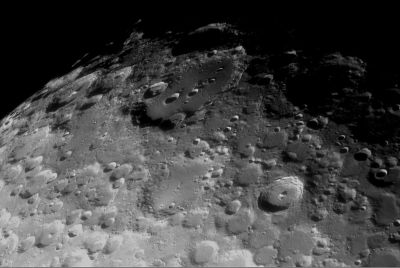
This NASA lunar flyby represents the first time humans have laid eyes on the lunar far side photos without the mediation of a satellite lens. The crew is now preparing for a high-speed return, with the Orion re-entry speed expected to push the vehicle's thermal protection systems to the limit. According to mission control, the spacecraft remains in peak condition for its scheduled San Diego splashdown.
The official live broadcast can be seen here.
Silence, Distance And A Different Kind Of View
For roughly 40 minutes during the lunar flyby, Orion slipped behind the Moon and lost all contact with Earth. The moment, often described in technical briefings as routine, takes on a different quality when heard from those who experienced it.
Commander Reid Wiseman described it as a period of intense work paired with something more reflective. The crew focused on what he called 'probably the most critical lunar observations for our geology team', yet they also carved out a brief pause. Maple cookies were shared, and conversation slowed. The enormity of their position settled in.
It is an oddly human detail in a mission defined by engineering precision. That mix of routine and reflection reveals something essential about deep space travel. It is not continuous awe. It is work punctuated by flashes of realisation.
Glover pointed to one of those flashes. Watching a lunar eclipse from beyond the Moon's far side, he said, was the 'greatest gift' of the mission. The phrasing carries weight. It suggests that even within a tightly scripted operation, there are moments that resist measurement.
Personal Moments That Cut Through The Mission
Not all of the mission's defining experiences were scientific. Some were unmistakably personal.
Wiseman spoke of naming a lunar crater after his late wife, Carroll, who died of cancer in 2020. The moment unfolded quietly during the flight, yet it has become central to how he describes the mission.
'I think when Jeremy spelt Carroll's name ... I think for me that is when I was overwhelmed with emotion,' he said, recalling how fellow astronaut Christina Koch was also moved to tears.
Koch, when asked what she would miss about space, did not point to the view or the novelty. She spoke about 'the camaraderie'. The answer feels revealing. Isolation, risk and distance create a kind of closeness that is difficult to replicate on Earth.
On what she would not miss, she offered no complaint. 'We can't explore deeper unless we are doing a few things that are inconvenient, unless we're making a few sacrifices, unless we're taking a few risks,' she said. 'And those things are all worth it.'
The Return That Tests Everything
The journey is not over. Far from it.
Orion is expected to re-enter Earth's atmosphere at nearly 25,000 miles per hour before deploying parachutes and splashing down in the Pacific off the coast of San Diego at around 20:00 Friday US EDT, which is 01:00 BST. The descent will test the capsule's heat shield and recovery systems under extreme conditions.
Between now and then, the crew face quieter days filled with system checks and ongoing experiments. There is also, as Glover noted, little time yet to process what they have experienced. 'I'm going to be thinking about and talking about all of these things for the rest of my life,' he said.
That sense of delayed understanding is familiar in missions like this. The significance often arrives later, once the noise fades and the data is unpacked.
President Donald Trump has already framed the mission in historic terms, telling the crew after their flyby: 'Today, you've made history and made all America really proud, incredibly proud.'
The spacecraft is heading home. What it carries is not just data, but a version of the Moon that few have ever seen and no one has described quite like this.
© Copyright IBTimes 2026. All rights reserved.
- Recommended For You