'I Applied for 500 Jobs': Why Young Britons Say Breaking Into the Workforce Feels Impossible
Young Britons describe months of rejection, hundreds of applications and shrinking opportunities as the jobs crisis deepens


When Theo Dal Pozzo graduated from the University of Exeter with a first-class postgraduate degree in computer science specialising in machine learning, he believed he had done everything employers asked of him.
Instead, he spent an entire year applying for work.
More than 500 applications later, he finally secured a position as a junior data analyst.
'I think the main thing is I did not have any work experience. So, the masters is important but I think the work experience is just as important.' he said.
When asked whether he felt the hiring process was fair, Dal Pozzo was blunt.
'No, honestly, I don't think so. There were a couple of roles that I applied for where I got feedback saying there were over a thousand applicants for one role. They can't realistically read every application at that point.'
Even after earning one of the UK's most sought-after qualifications, Dal Pozzo said many applications disappeared into automated recruitment systems without any meaningful feedback.
The experience left him questioning whether the hiring process was fair.
'There is a demoralisation that comes with it. I felt like I was doing everything right and I wasn't getting the results.'
His story has now become the reality of thousands of young Britons entering the labour market.
More Than One Million Young People Now NEET
Official figures released by the Office for National Statistics show that 1,012,000 young people were not in education, employment or training (NEET) between January and March 2026.
The figure represents 13.5% of all young people and marks the highest level recorded in more than a decade.
Surprisingly, 6 in 10 young people who are NEET today have never had a job, up from 4 in 10 in 2005.
Nearly 60% of young people classified as NEET are economically inactive rather than actively seeking work.
The figures were published alongside an interim review led by former Labour minister Alan Milburn, who warned Britain risks creating a 'lost generation' disconnected from work and opportunity.
'We are at risk of a lost generation,' Milburn said.
'The problem is that for too many young people, opportunities are not growing, they're shrinking.'
You Need To Learn How To Beat The System
For Olivia, who holds a biomedical sciences degree and a Master of Research qualification from Aston University, entering the workforce proved equally difficult.
Despite months of applications and more than 50 job submissions, she secured only a single interview.
Rather than demonstrating scientific ability, she believes graduates are increasingly forced to learn how automated recruitment systems operate.
So, it's not about skills and qualifications of candidates but their ability to play with the system.
Olivia believes automated recruitment systems are causing talented young people to be overlooked.
'I feel like me along with other generation who are interested in science jobs. We don't have a chance. Like, we have so much talent. We are so eager to do something. We could really make a difference to the world, but we just have no chance.'
Repeated rejection eventually affected her confidence too.
'My confidence dropped. I started believing I wasn't intelligent enough to do the job. I think young people's confidence is being destroyed right now.'
Her experience reflects one of the review's central findings: that repeated rejection is no longer simply an employment issue but increasingly a mental health one.
The First Step Into Work Is Disappearing
The interim review argues that Britain's traditional pathways into employment are steadily eroding.
Part-time jobs, apprenticeships and entry-level positions that once provided a bridge between education and employment have become increasingly scarce, competitive and automated.
Young people interviewed for the review frequently reported submitting dozens, or even hundreds, of applications without receiving any response.
Milburn said such experiences have become commonplace.
'You put in applications, dozens at a time, you hear nothing back, you just get rejected,' he said.
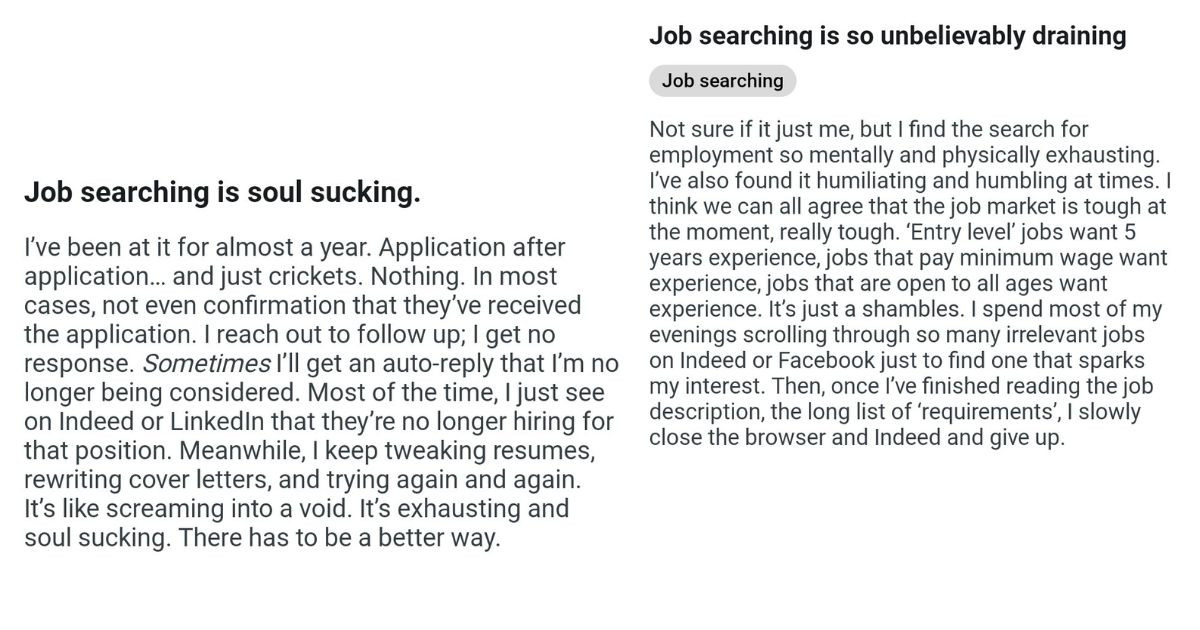
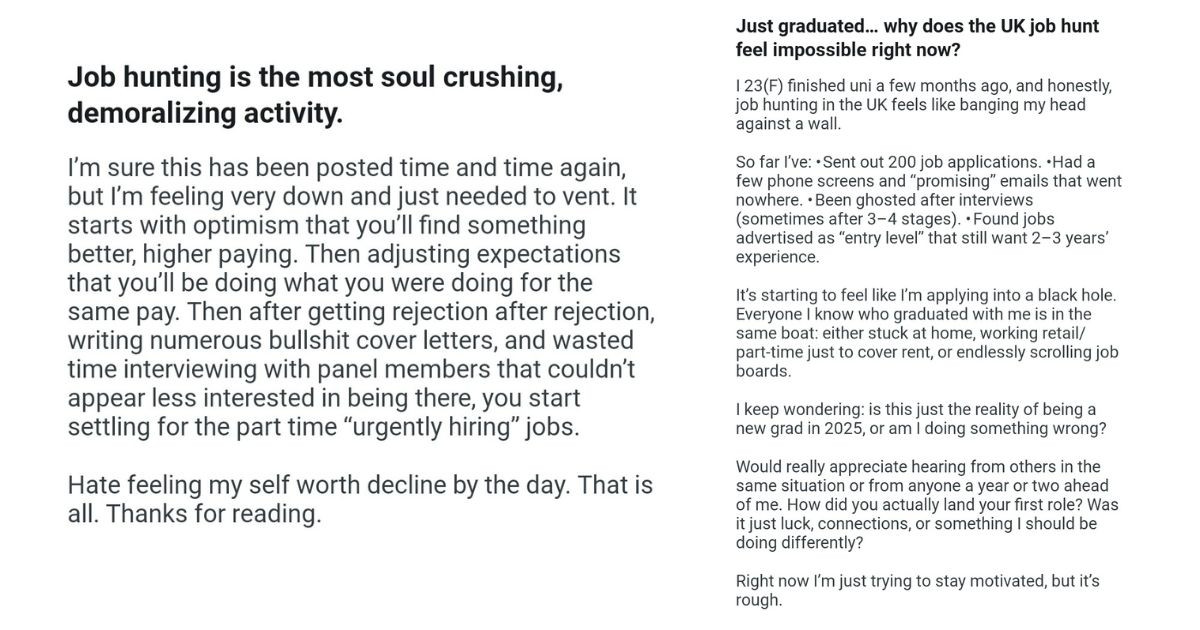
The frustration of not finding a job has sparked heated debates across online forums and social media. Many young graduates have been venting about their soul-crushing job-hunting experiences on Reddit.
In one discussion, a 23-year-old graduate said they had submitted more than 200 job applications, been ghosted after multiple interview rounds, and repeatedly encountered entry-level vacancies requiring two to three years of experience.
'It's starting to feel like I'm applying into a black hole. Everyone I know who graduated with me is in the same boat.'
Automated Hiring Is Leaving Young Applicants Behind
Many employers now rely on Applicant Tracking Systems (ATS) that filter CVs before a human recruiter ever sees them.
Researchers argue that these systems may unintentionally favour candidates who already possess experience, confidence and familiarity with professional recruitment processes.
For first-time applicants, the process can feel impersonal and, as one participant described it, 'soul-sucking'.
Another said the most frustrating aspect was never knowing why applications were rejected.
'The main issue is you're not getting responses,' a young woman from Cardiff told researchers.
'You don't know what to improve on.'
A Mental Health Crisis Is Feeding The Problem
Over the past decade, the number of young people who are NEET because of a health condition has risen sharply. Mental health conditions now account for more than four in ten disabled NEETs who are outside both work and education.
Anxiety, depression and neurodevelopmental disorders are increasingly common. Experts warn that once young people leave work or education for health reasons, it can be difficult for them to return.
The number of young people outside education and employment because of a health condition has risen by around 70% over the past decade.
The Economic Cost Could Reach Billions
The consequences extend beyond individual careers.
Research cited by employment organisations suggests early-career unemployment can leave lasting wage 'scars', reducing earnings years—and sometimes decades—later.
Periods outside employment can also lead to skill deterioration, making workers less competitive over time.
The wider economy pays a price too.
Research from PwC has estimated that youth unemployment costs the UK economy up to £26 billion annually through lost productivity and reduced economic output.
Britain's Youth Employment System Faces A Reckoning
Milburn argues that the problem extends far beyond the labour market.
'The easiest thing is to reach for failed solutions,' he said.
He believes the UK's education, welfare, health and employment systems are all contributing to an entrenched problem that has persisted for decades.
'The NEET rate has barely fallen below 10% over the last 25 years.'
'These young people are now on the frontline of a perfect storm.'
The former minister argues that meaningful reform must address schools, healthcare, welfare support and employment pathways simultaneously.
For every £25 spent by the Department for Work and Pensions on benefits for young people, around £1 is spent helping them move into employment.
'Should the benefits bill be lower? Yes,' Milburn said.
'The way to do it sustainably is to get young people into work—which is what 84% of these young people want.'
For graduates like Dal Pozzo and Olivia, the crisis is not about a lack of ambition, but a labour market that demands experience before offering opportunity.
And with more than one million young people now locked out of education, employment or training, the question facing Britain is no longer whether there is a problem.
It is whether the country can rebuild the first rung of the career ladder before an entire generation is left behind.
© Copyright IBTimes 2026. All rights reserved.
- Recommended For You