

Jailing Shoplifters Is Punishing People for Having a 'Biological Need', Progressive Lawmaker Claims
When a tube of toothpaste becomes a political battleground, it reveals just how far apart people are on what society owes those who have nothing

Jailing people for shoplifting basic items such as toothpaste and soap amounts to punishing them for meeting a 'biological need', a New York state lawmaker has argued, as she urged fellow progressives to resist calls for tougher penalties for low-level offences.
Emily Gallagher, a Democratic state assemblywoman who represents parts of northern Brooklyn and is affiliated with the Democratic Socialists of America, has emerged as an outspoken advocate of criminal justice reform.
Her comments resurfaced after footage of her remarks circulated online, reigniting debate over shoplifting, poverty and how New York should punish low-level theft. In the footage, Gallagher pointed specifically to people accused of stealing basic hygiene products.
'People who were stealing things like toothpaste, people who were stealing things like soap,' she said. 'And that means if you're stealing those things, you need them. And we are choosing to protect billion dollar companies like CVS and Walgreens over the people who are struggling to get by.'
Gallagher has also argued that 'no one should be arrested much less jailed for stealing toothpaste', framing such offences as 'crimes of poverty' and advocating alternatives to incarceration.
Emily Gallagher Says Shoplifting Can Reflect 'Biological Need'
Gallagher argued that the underlying problem was not simply theft but the economic circumstances that can drive people to steal necessities.
'I would say that the true crime is that there is such incredible wealth disparity in this city,' she told the crowd. 'That there are people who can be thrown in jail simply for having a biological need.'
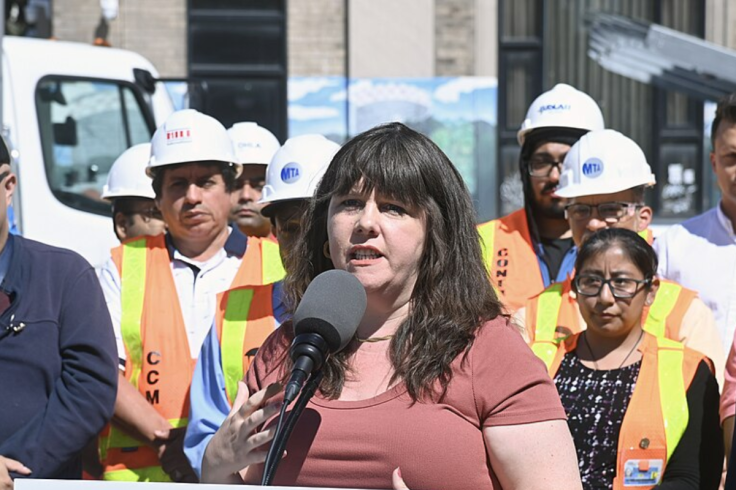
Her argument places the emphasis on poverty and economic inequality rather than punishment, but critics say it overlooks other forms of retail theft, including organised operations targeting everyday products because they can easily be resold.
That distinction matters. Toothpaste, detergent and other necessities are not exclusively stolen for personal use. Brooklyn retailers have previously reported organised thieves targeting toothpaste, soap, skincare products and other easily resold goods.
Retailers have responded by putting some everyday products behind locked cases, a practice that has also frustrated paying customers who must wait for employees to retrieve relatively inexpensive goods. Gallagher nevertheless urged allies to 'hold the line' on criminal justice reforms and accused right-wing media of using crime fears to push for tougher policies.
Backlash Over 'Consequence-Free' Shoplifting
Her remarks quickly attracted criticism from users who argued that treating theft primarily as a symptom of poverty risks minimising its impact on businesses, workers and customers.
Journalist Leighton Woodhouse challenged Gallagher's assumption that people stealing toiletries necessarily intend to use the products themselves, arguing that some thieves instead sell stolen goods through resale markets.
'People steal toothpaste and soap to sell them to fences who then sell them on Amazon and Facebook Marketplace,' he wrote. 'I don't know if it's that lawmakers are this dumb, or that they think the rest of us are this dumb.'
That criticism reflects a genuine distinction missing from Gallagher's short remarks. Individual theft driven by immediate need and organised retail theft for resale are not necessarily the same problem and may require different policy responses.
Other critics took a harder line, arguing that failing to punish theft adequately undermines property rights and could encourage repeat offending.
Others took a more openly hostile tone. An X user calling themselves Snapperhead said: 'Shoplifting is a crime and should be fully punished. If more people were held accountable for their actions, we would have a better society, but you liberals who want to save everybody are destroying the society we live in.'
Another user, Six String, warned that 'a consequence free society results in anarchy,' adding that 'most sane people don't' want to live that way.
Underneath the name-calling sits a very old question about how far the law should bend when poverty is involved. Matt van Swol, another critic, argued that the line cannot realistically be moved as far as Gallagher suggests.
'The entire foundation for a civilized society rests on private property, ownership, and not stealing,' he wrote. 'If you legalized stealing, society would literally crumble overnight. Stealing should face SEVERE punishment.'
Some opponents took a more sardonic tack, suggesting Gallagher open her own shop and invite people to steal from it if she is so convinced the current system is unjust.
Others warned that if her shoplifting rules were applied in full, pharmacies and supermarkets would simply shutter outlets in high-theft areas, hollowing out the very neighbourhoods she says she wants to protect.
Gallagher's position also recalls comments made in 2021 by former New York gubernatorial candidate Cynthia Nixon, who criticised CVS for locking up basic products and argued that people struggling financially should not be treated as criminals for taking necessities.
What remains difficult to establish from Gallagher's remarks alone is how frequently theft of toiletries in New York is driven by immediate personal need rather than resale, organised retail crime or other motives.
Her comments therefore touch on a broader policy dispute rather than settling it, whether low-level theft involving necessities should primarily be addressed through criminal punishment or through interventions aimed at poverty, addiction and other underlying causes.
For Gallagher, the answer clearly leans towards the latter. Her critics argue that approach risks shifting too much of the cost onto retailers, workers and customers.
© Copyright IBTimes 2026. All rights reserved.