

Maine Federal Shooting Update: Video Shows SUV Ramming Car Before Agent Kills Driver
Security footage captures dramatic moments leading to a fatal federal shooting in Biddeford, Maine.
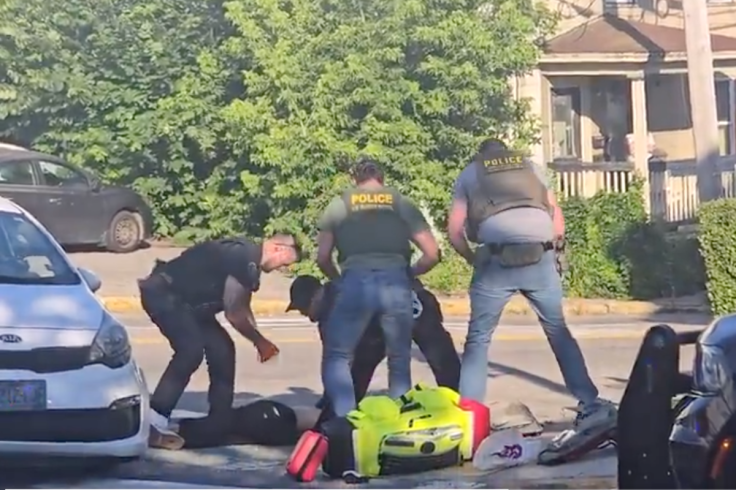
A security camera has captured the moments before a man was shot dead by a federal agent in Biddeford, Maine, on Monday, offering a stark Maine Federal Shooting Update: Video Shows SUV Ramming Car Before Agent Kills Driver at a busy intersection in the coastal city.
The footage, obtained from a nearby business, shows a white SUV with flashing lights repeatedly ramming a smaller white sedan before armed individuals identified as federal agents confront the driver.
The shooting unfolded at the junction of Hill and Pool streets, an everyday crossroads that suddenly turned into the centre of a deadly federal operation. According to the video, the white sedan can be seen circling the intersection in what looks like an erratic loop, drifting aimlessly in the middle of the road.
Moments later, the larger white SUV appears, accelerates into the sedan and strikes it at least twice, pinning the car and bringing it to a stop.
Maine Federal Shooting Update: SUV Slams Sedan Before Fatal Shot
The security footage, which the business provided to the Globe, then shows two people getting out from behind the SUV wearing what appear to be bulletproof vests, the sort routinely used by law enforcement.
They move directly towards the driver's side window of the trapped sedan. At least one appears to reach to his waistband and pull out an object, which he then points at the driver's side window.
The crucial second, the actual firing of the fatal shot, is not clearly visible in the description of the footage. What is clear is the sequence that follows.
The agents open the sedan's door and drag a man from inside, pulling him out towards the passenger side. The body appears limp as it hits the street. Agents then crouch over him and remain surrounding the man as more agents run in, forming a tight ring around the body.
The report does not give the victim's name, nor does it specify whether local police or the US Department of Homeland Security have formally identified him. It also does not state whether the agents in the video were Immigration and Customs Enforcement officers, though the operation is described as involving an ICE agent.
At the time of writing, there is no additional official account of what preceded the ramming or what prompted the use of lethal force. It cannot be independently verified, so take everything lightly.
The absence of sound and the limited vantage point of the security camera mean several crucial details remain unclear. Viewers cannot hear any verbal commands, warnings or gunshots. Nor does the video show what, if anything, the man in the sedan was doing inside the car as it circled the intersection, or whether he posed an immediate threat to agents or bystanders.
That silence, literal and figurative, is exactly what tends to fuel anger when federal shootings occur in small cities that are not used to seeing this level of force on their streets.
Maine Federal Shooting Update Raises Questions Over Use Of Force
The Maine Federal Shooting Update: Video Shows SUV Ramming Car Before Agent Kills Driver has already raised basic but unavoidable questions. Why did the agents choose to ram the car at least twice rather than box it in or wait it out.
What risk, assessed in real time, convinced one of them to draw what appears to be a weapon and point it at the driver's window. And once the driver was down, was there any visible attempt at life-saving treatment before more agents arrived.
The short clip cannot provide all those answers, of course. It shows action, not motive. But ramming a smaller vehicle with a larger SUV is a serious use of force in itself, the kind of tactic law enforcement usually insists is reserved for situations in which a suspect is deemed a serious danger.
Federal agencies typically argue that rapid, aggressive intervention can prevent something worse from happening, particularly if they suspect a driver is armed, impaired or likely to flee into a more crowded area.
Critics counter, with some justification, that this kind of hard stop can escalate a tense but containable situation into something fatal in seconds. Watching the Maine footage, that debate stops being theoretical and becomes uncomfortably real.
Law enforcement agencies, when they do respond, often lean heavily on the language of procedure, referring to 'standard tactics' and 'perceived threats.' Those phrases may appear soon in Maine.
What the camera has already offered, though, is the sequence most people will remember, and it is blunt. A circling car, a hit, another hit, armed figures advancing, a body pulled out, a knot of agents around it on the road.
The remaining gaps, including who authorised the operation, what the underlying investigation was about, and whether the agent who fired has been placed on leave, will either be filled by formal statements and court records or, if that process drags, by speculation online. Anyone who has watched similar cases unfold knows which of those two tends to move faster.
© Copyright IBTimes 2026. All rights reserved.