

Netflix Turns Your Subscription Into a $45 Billion Business: Spends Less Than Half on Content
The streaming giant made record profit last year, but programming took a shrinking slice, and subscribers paid more for it
Netflix pulled in $45.2B (£33.8B) in 2025, its biggest year ever, and less than 40% of that went back into the shows and films its subscribers pay to watch. The rest is the machinery of a business that runs on your monthly fee, your price rise and, increasingly, the adverts in front of your programmes.
Revenue rose 16% to $45.2B, according to the company's shareholder letter filed with the US Securities and Exchange Commission. Against that, Netflix booked $16.4B (£12.3B) in content amortisation, the cost of the programming it put on screen. Half of the revenue would have been $22.6B. Content came to roughly a third.
That gap is the whole story, and the reason the service keeps getting more expensive.
Where the Other Two-Thirds Goes
Strip out content, and what remains is profit and the cost of chasing it. Netflix reported operating income of $13.3B (£9.9B) for 2025 and net income of $11.0B (£8.2B), per the same filing. Operating margin climbed to 29.5%, up from 26.7% a year earlier. The way that the dollar divides is starker on a chart than in words, as the graphic below shows.
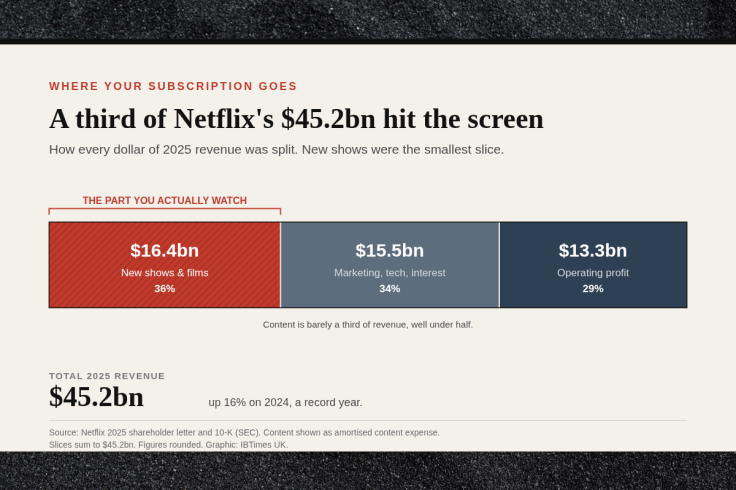
Put plainly, close to 30p of every pound Netflix takes is operating profit before tax. Marketing, technology, salaries, and debt interest account for much of the rest. The programming that draws people in is the smaller half.
Netflix has said for years it would widen margins, and it has. The question for a subscriber is simpler: the bill went up, so did profit, and spending on new shows did not keep pace.
Your Price Rise, Their Margin
British subscribers felt the shift directly. In February 2025, Netflix raised UK prices across the board, with the Standard plan up £2 to £12.99 a month and Premium up £1 to £18.99, according to the company's published pricing. Over a year, Standard now runs to £155.88 and Premium to £227.88.
A second global increase followed in 2026, pushing the top US tier to $26.99 (£20.17) a month. The pattern is consistent: raise the price, hold content growth below revenue growth, bank the difference.
Advertising is the newest lever. In 2025, only its third year selling ads, Netflix grew ad revenue more than 2.5 times to over $1.5B (£1.1B), and expects that to double again in 2026, per the shareholder letter. The subscriber who chose the cheaper £5.99 ads plan to save money is now the product sold to advertisers.
Why Viewers Are Getting Restless
The trade-off has not gone unnoticed. On Reddit, a post arguing that Netflix cancels strong series on cliffhangers while renewing weaker ones drew about 5,700 likes and more than 980 comments, with subscribers saying they no longer trust the platform enough to start a new original. One wrote that they would never forgive the cancellation of a favourite show.
When the 2026 price rise landed, cancellation screenshots spread across the same forums. One user said they cancelled not to hurt Netflix, but to stop Netflix from hurting their budget. Another baulked at paying close to $30 a month for a service whose best titles, they felt, had dried up.
Netflix can absorb the grumbling because the numbers keep climbing. It passed 325 million paid memberships in 2025, having stopped reporting subscriber counts each quarter at the end of 2024.
The Bigger Bet
The strategy nearly had a dramatic next chapter. Netflix spent late 2025 trying to buy the studio and streaming arm of Warner Bros Discovery, which would have handed it HBO and decades of films without producing them. For a company already spending a minority of revenue on content, buying a catalogue outright was a logical extension.
It lost. Paramount Skydance outbid it, and on 26 February 2026, Netflix declined to match, calling the deal no longer financially attractive, per its own statement. When Warner walked, Paramount paid Netflix a $2.8B (£2.1B) break fee on Warner's behalf, which Netflix booked as a one-off gain, per its SEC filing. It ended up richer by billions without adding a show.
The subscriber sits at the bottom of all this. Every price rise, every advert, every cancelled show feeds a business that has learned it can charge more while spending proportionally less on the reason anyone subscribed. Whether that holds depends on one thing the spreadsheets cannot predict: how long people keep paying.
© Copyright IBTimes 2026. All rights reserved.