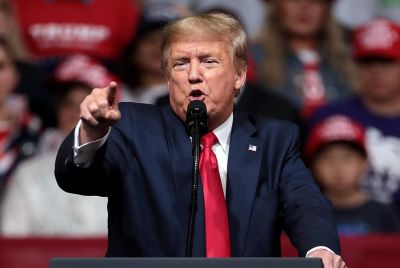
Donald Trump Is 'Calling for Nuclear Strike', Ex-Aide Warns—Revelation Sparks 'Removal From Office' Calls
Former insiders and political figures urge action after Trump's controversial remarks on Iran

A former White House insider has warned that President Donald Trump's rhetoric towards Iran signals a potential nuclear threat, prompting renewed discussion about his leadership.
The controversy follows Trump's Truth Social post warning that 'a whole civilisation will die tonight' unless Tehran meets US demands. Critics interpret the statement as an escalation tied to ongoing tensions over Iran's nuclear programme and regional activities. The remark has alarmed political observers amid reports of stalled diplomatic efforts.
Wake up: he is calling for A NUCLEAR STRIKE. Seek his removal immediately.
— Anthony Scaramucci (@Scaramucci) April 7, 2026
Escalating Rhetoric and Nuclear Fears
Trump's statement centres on demands for regime change and compliance over the Strait of Hormuz, where Iranian actions have disrupted shipping. Observers note the language suggests catastrophic consequences, though the president did not specify nuclear weapons. Such rhetoric risks heightening tensions with a long-standing adversary.
Shortly after, former White House communications director Anthony Scaramucci posted on X: 'Wake up: he is calling for A NUCLEAR STRIKE. Seek his removal immediately.' His intervention reflects broader concern about presidential rhetoric during conflict.
Axios reports internal administration sources describe Trump's stance on Iran as more aggressive than that of Defence Secretary Pete Hegseth or Secretary of State Marco Rubio. One official called the president 'the most bloodthirsty' figure in the group.
Calls for the 25th Amendment Intensify
The fallout has not been limited to former aides. In a striking development, Marjorie Taylor Greene also called for the invocation of the 25th Amendment, underscoring the breadth of concern. Greene condemned the rhetoric as 'evil and madness', writing: 'Not a single bomb has dropped on America. We cannot kill an entire civilisation.' Her comments mark a rare moment of alignment between figures from different factions, amplifying the urgency of the debate.
The 25th Amendment provides a constitutional mechanism to remove a sitting president deemed unable to fulfil their duties. It allows the vice president and a majority of Cabinet members to declare the president unfit, transferring power temporarily. Congress may then intervene, requiring a two-thirds majority in both chambers to sustain the decision.
Despite growing calls, there is currently no indication that members of Trump's Cabinet are preparing to invoke the amendment. Historically, such measures have been considered only in extreme circumstances, and political analysts caution that the threshold for action remains exceptionally high.
Inside the White House: 'Mad Dog' Allegations
Further intensifying the situation are claims from unnamed officials describing Trump's approach as unusually aggressive. One source, cited by Axios, likened the president to a 'mad dog', asserting that even figures such as Defence Secretary Pete Hegseth and Secretary of State Marco Rubio appear comparatively restrained.
'Those guys sound like the doves compared to the president,' the official reportedly said, suggesting a significant divergence in tone within the administration itself.
Such characterisations, while unverified, contribute to a growing narrative that Trump's foreign policy posture—particularly regarding Iran—has become increasingly hardline. Observers warn that this perception alone could influence diplomatic dynamics, regardless of actual policy decisions.
Global Implications and Political Fallout
Trump's rhetoric carries risks beyond domestic debate. Suggestions of escalation in a volatile region could prompt miscalculations. He frames his position as advancing 'complete and total regime change', while noting the uncertainty of outcomes.
Trump, for his part, has framed his statements as part of a broader push for 'complete and total regime change,' though he has provided no evidence to support claims that such a transition is underway in Iran. His remarks concluded with a note of uncertainty, stating that events could mark 'one of the most important moments in the long and complex history of the world'.
© Copyright IBTimes 2026. All rights reserved.
- Recommended For You