Donald Trump Can't Stop Praising Xi Jinping in China Despite Previous Claims That Beijing Rips Off the United States
In a striking diplomatic shift, Trump lauds Xi Jinping during a state visit, contrasting years of harsh rhetoric against China.

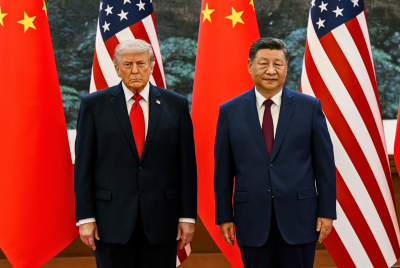
Donald Trump is heaping praise on Chinese President Xi Jinping in Beijing this week, calling him a 'great leader' days after the pair's countries emerged from the most punishing trade war in modern American history.
The US president arrived in China's capital on 13 May 2026 for a two-day state visit, met Xi at the Great Hall of the People, and promptly declared the pair have had 'a fantastic relationship' and that he holds 'such respect for China.' The diplomatic warmth stands in direct contrast to a decade's worth of accusations, formal White House statements, and campaign speeches in which Trump characterised Beijing as an economic predator that had 'ripped off the United States like no one has ever done before.'
The visit is the highest-profile diplomatic engagement between Washington and Beijing in years, arriving less than 12 months after Trump imposed 145 per cent tariffs on Chinese imports in what economists described as the largest American trade escalation of the past century.
'A Great Leader': Trump's Open Praise of Xi Jinping at the Great Hall
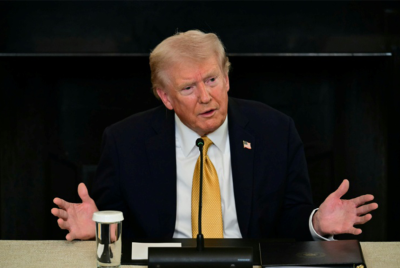
At opening remarks before bilateral talks on 14 May 2026, Trump told Xi directly: 'You're a great leader. I say it to everybody.' He described the bilateral bond in the warmest of terms. 'We've had a fantastic relationship. We've gotten along — when there were difficulties, we worked it out,' Trump said during the session, according to reports from the press pool inside the hall. He went further: 'Whenever we had a problem, we worked it out very quickly, and we're going to have a fantastic future together.'
After a subsequent tour of the historic Temple of Heaven, Trump offered reporters his summary of the talks in two words: 'It's great.' He added: 'Great place. Incredible. China's beautiful.' Trump also introduced the business leaders he had brought along and encouraged them to 'expand cooperation with China,' according to a Chinese Foreign Ministry readout of the session.
The US delegation reads as a who's who of American tech and industry. Apple chief executive Tim Cook, Tesla chief executive Elon Musk, and Nvidia chief executive Jensen Huang all accompanied Trump to Beijing.

Chinese Premier Li Qiang met the group separately and urged them to help maintain the 'healthy development' of US-China relations. For many in that room, China remains an indispensable manufacturing base and one of the world's largest consumer markets — regardless of what either government's tariff schedules say.
Years of Calling China an Economic Predator, on the Record
The effusive tone is a striking departure from what Trump himself put in writing during both his presidencies. In a formal address in May 2020, archived by the White House, Trump stated explicitly: 'For decades, they have ripped off the United States like no one has ever done before. Hundreds of billions of dollars a year were lost dealing with China... China raided our factories, offshored our jobs, gutted our industries, stole our intellectual property, and violated their commitments under the World Trade Organisation.'
Does that mean @realDonaldTrump won't say China 'raped' the US, ripped it off like no one has ever done before; Covid was the 'China Virus'; calling China a 'hellhole'; accusing Chinese immigrants of bringing 'filth' & 'litter'
— Amazonia - Kaua e tautohetohe ki nga riwai (@Jandal_It) May 14, 2026
He really IS kissing arse. Loser. https://t.co/NOFC1cVSR2
His campaign-era statements were even harsher. Speaking at the Detroit Economic Club in August 2016, Trump described China as engaged in 'illegal export subsidies, prohibited currency manipulation, and rampant theft of intellectual property.' In a Good Morning America interview in 2015, he called China's practices 'the greatest theft in the history of the world.' During that same period he wrote in his book Crippled America that China had 'destroyed entire industries' and was 'an economic enemy.'
Critically, this is not the first time Trump has moderated his tone while standing on Chinese soil. During his 2017 state visit to Beijing, the last by a sitting US president before this week, he told reporters: 'I don't blame China.'
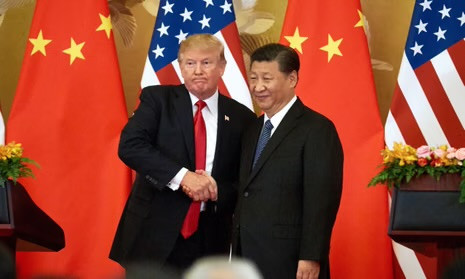
He redirected blame to his predecessors for 'allowing this out-of-control trade deficit to take place.' He resumed his confrontational posture upon returning to Washington. The pattern has now repeated itself almost identically nine years later.
The context behind Trump's warm words is a trade conflict of historic scale. After returning to office in January 2025, Trump escalated tariffs on Chinese goods to a cumulative rate of 145 per cent by April of that year, the highest level imposed by any US administration in the modern era, according to the Tax Foundation's tariff tracker. China retaliated with a minimum 125 per cent tariff on American goods and weaponised its dominance over rare earth minerals, twice threatening to bring the US automotive supply chain to a halt.
The fallout was severe on both sides. According to analysis by the Peterson Institute for International Economics, US imports from China fell to roughly half their previous year's levels by June 2025, reaching depths not recorded since the 2009 financial crisis. US goods exports to China dropped 26 per cent in nominal terms over the full year. An eventual truce brought rates down to 30 per cent on the American side and 10 per cent on China's, though formal talks on a longer-term arrangement remain unresolved. China's economy expanded 5 per cent in 2025 despite the pressure, and continued that pace into the first quarter of 2026.
Xi's Taiwan Warning and the Strategic Weight Behind the Ceremony
China arrived at the summit with its own list of demands. Chinese Foreign Ministry spokesperson Mao Ning confirmed after the first round of talks that Xi had told Trump directly: 'The Taiwan question is the most important issue in China-US relations.' Mao's statement warned that mishandling Taiwan would cause 'clashes and even conflicts, putting the entire relationship in great jeopardy.' The American readout of the same meeting made no mention of Taiwan at all, centering instead on trade and the ongoing US war with Iran.
Iran shapes the entire summit's subtext. Trump arrived in Beijing partly seeking Xi's support, or his credible neutrality, as Washington pushes for a resolution to the conflict threatening the Strait of Hormuz. Defense Secretary Pete Hegseth announced in April that Beijing had provided high-level assurances it would not transfer weapons to Iran. That concession helped clear the path for the summit to happen at all. Xi, for his part, declared that the two countries had agreed to pursue 'constructive strategic stability' as the framework for bilateral relations over the next three years, a formulation that carries Beijing's clear preference for managed, predictable competition over open confrontation.
Whether Trump's lavish praise of Xi will produce the diplomatic returns Washington is seeking, on Iran, on Taiwan, on trade, on technology, remains to be seen when the summit concludes on 15 May.
For a president who built a political identity on depicting China as America's most ruthless economic adversary, the sight of Donald Trump touring the Temple of Heaven alongside Xi Jinping and calling him a 'great leader' is not a contradiction his base has so far been asked to explain.
© Copyright IBTimes 2026. All rights reserved.
- Recommended For You