

Cash ISA Limit Falls to £12,000 in April 2027: Why Savers Under 65 Should Act This Tax Year
The £20,000 total remains the same; what changes is how much of it can sit in a savings account
Savers under 65 have less than a year to make full use of the cash ISA as it works today. From 6 April 2027, the amount that can go into a cash ISA each year falls from £20,000 to £12,000 for anyone below that age. The overall ISA allowance stays at £20,000, but £8,000 of it will have to go somewhere other than cash.
The change was announced in the Autumn Budget in November 2025. The government has since confirmed the finer details, including a new charge that closes off the most obvious way around the cut.
What Is Changing and When
Every UK adult receives a fresh £20,000 ISA allowance when a new tax year begins. All of it can currently be held as cash, where the interest is tax-free and is ignored by other tax allowances.
From April 2027, under-65s can hold a maximum of £12,000 of that allowance in cash. The rest can still be used, but only in a stocks and shares ISA, an innovative finance ISA or a Lifetime ISA. Savers of 65 and over keep the full £20,000 cash entitlement, and that entitlement starts in the tax year in which someone turns 65. The split is set out below.
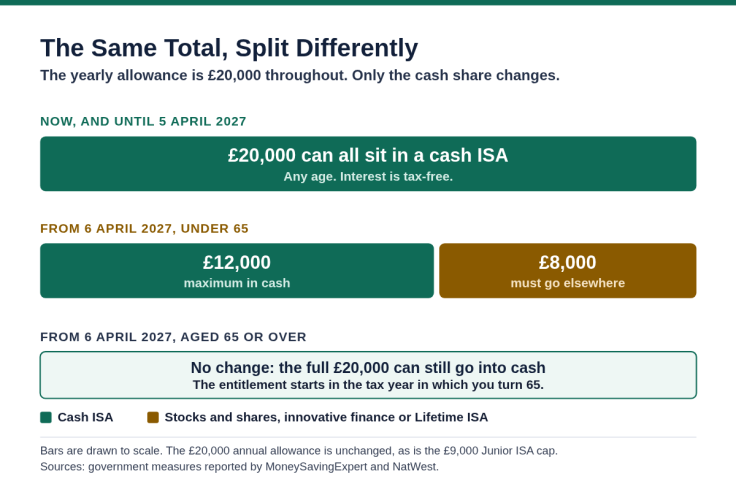
The limits on the other accounts are unchanged. Stocks and shares and innovative finance ISAs keep their £20,000 ceiling, and the Junior ISA stays at £9,000 per child. Only the cash portion is being squeezed.
The stated aim is to push more people, particularly younger savers, towards investing. Martin Lewis, who founded MoneySavingExpert, has said the goal is a good one but that a carrot would have worked better than a stick.
The Charge That Closes the Loophole
The obvious response to a lower cash limit is to hold cash inside a stocks and shares ISA instead. The government has moved to stop that.
From the same date, interest earned on cash sitting inside a non-cash ISA will be charged at 22%. That covers stocks and shares ISAs and innovative finance ISAs, and similar returns from Sharia-compliant accounts. It is a separate thing from the tax on savings held outside an ISA. It also applies at every age, so it does not lift at 65. The rules are set out below.
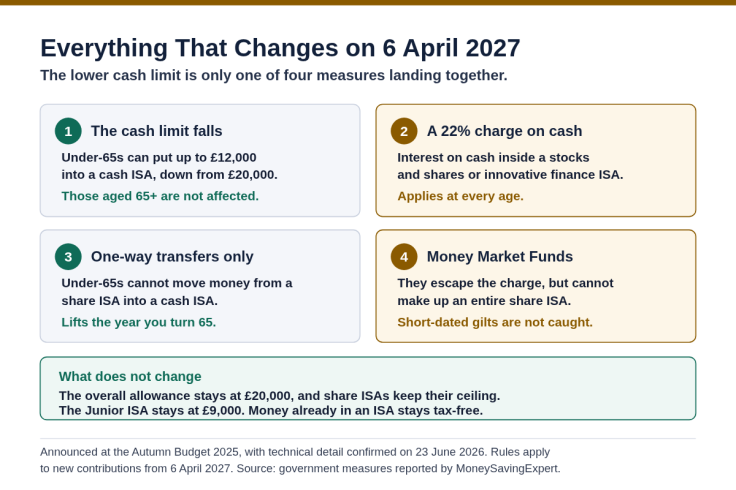
There are two further restrictions. Under-65s will not be able to move money from a stocks and shares ISA into a cash ISA, though moving in the other direction is still allowed. That restriction lifts in the tax year someone turns 65.
Money Market Funds, which invest in short-term debt, escape the 22% charge. But savers will no longer be allowed to hold all of a stocks and shares ISA in them. Short-dated government bonds, which some had expected to be caught, have not been included in the definition of cash-like assets.
What Savers Can Do Before April 2027
The practical point is that the current tax year and the next one are the last in which an under-65 can put the full £20,000 into cash. Allowances do not roll over, so any part of this year's £20,000 that goes unused is gone for good.
Anyone with savings sitting outside an ISA can move them in before the deadline. That shelters the interest for good, because money already inside an ISA keeps its tax-free status. The cut applies to new money paid in from April 2027, not to what is already there.
Anyone considering the investment side should treat it as a separate decision rather than a reaction to the deadline. Stocks and shares ISAs carry the risk of losing money, which cash does not. The government-backed MoneyHelper service and regulated advisers can set out the options for a particular situation.
Disclaimer: Our digital media content is for informational purposes only and does not constitute investment advice. Please conduct your own analysis or seek professional advice before investing. Remember, investments are subject to market risks, and past performance does not guarantee future returns.
© Copyright IBTimes 2026. All rights reserved.