

Saudi Arabia's US Nuclear Deal Aims to Free Up Oil Reserves as Economy Leans Beyond Crude
Exploring the Implications of the US-Saudi Nuclear Cooperation Agreement
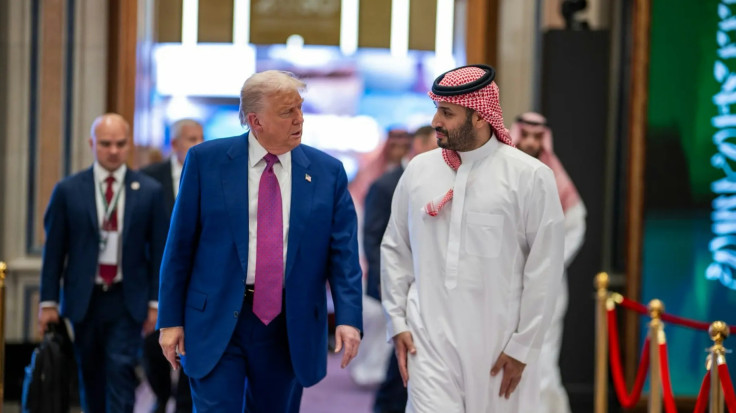
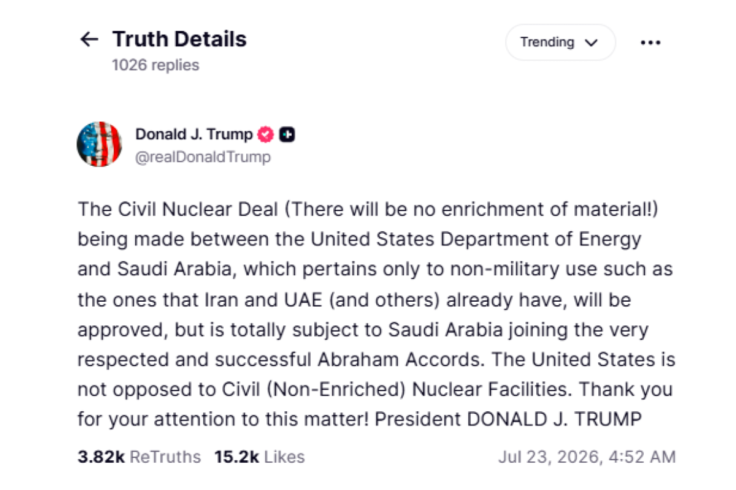
The Trump administration signed a nuclear cooperation agreement with Saudi Arabia this week, giving the kingdom a pathway towards enriching nuclear fuel and committing it to buying reactor technology from American firms. Congress now has 90 days to review the deal before it can take effect.
For Riyadh, the appeal goes beyond energy security. Crude oil made up 40 per cent of Saudi Arabia's gross domestic product in 2022, and the kingdom has posted a budget deficit in nine of the past ten years despite its vast reserves. A domestic nuclear programme would let Saudi Arabia power its economy at home while keeping more of its oil free for export.
What The Deal Actually Allows
Before any enrichment work could begin, a joint US-Saudi team would first assess commercial viability — and American firms would build the facility without transferring the underlying technology.
The agreement also bars Saudi Arabia from developing its own enrichment capability, or buying it from another country, for ten years.
Not everyone in the US government agrees on what the deal actually covers. Energy Secretary Chris Wright said the agreement was strictly about civilian power generation in an interview with Fox News. 'It's not about enrichment,' he said. 'It's not about anything related to weapons.'
But officials speaking to Reuters and the Associated Press on condition of anonymity have suggested the terms leave the door open to enrichment in the longer term — a split that has already drawn scrutiny in Washington.
An Economy Trying to Outgrow Oil
Saudi Arabia's push to diversify dates back to 2015, when Crown Prince Mohammed bin Salman unveiled the Vision 2030 plan to end the kingdom's dependence on crude. The plan promised sweeping financial reforms, cultural changes and construction projects.
Climate targets were part of that pitch too. Saudi Arabia pledged in 2021 to generate half its electricity from renewable sources by 2030. Today, solar and wind supply less than 1pc of the country's power, with gas and oil accounting for almost everything else.
A civilian nuclear programme offers a way to close that gap without abandoning the modernisation narrative Saudi leaders have sold to investors and foreign governments.
The Weapons Question Hangs Over It
The kingdom's nuclear ambitions cannot be separated entirely from regional security. Prince Mohammed has not ruled out pursuing nuclear weapons if Iran, Saudi Arabia's longtime rival, builds its own arsenal — a position he stated publicly in a 2018 CBS '60 Minutes' interview and has reiterated since.
The prospect worries nonproliferation experts. Kelsey Davenport, director for nonproliferation policy at the Washington-based Arms Control Association, has warned that congressional documents reviewed by her organisation raise concerns the Trump administration 'has not carefully considered the proliferation risks' of the agreement.
Saudi Arabia also used its leverage during years of negotiations, repeatedly signalling it could pursue nuclear technology with China or Russia instead. Neil Quilliam, a Middle East energy policy expert at Chatham House, told the New York Times in a March 2025 interview that Saudi leadership ultimately held out for a US partner because of 'the young Saudi leadership's confidence in the US remaining the dominant geopolitical player for decades to come.'
A civilian nuclear programme would not just diversify Saudi Arabia's power grid. It would let the kingdom keep selling more of its oil abroad instead of burning it domestically, at a moment when war-driven volatility in the Strait of Hormuz has already shown how exposed an oil-dependent economy can be.
Whether Congress approves the deal within its 90-day review window will determine how quickly, and how far, that shift can go, and it will shape how Washington balances Gulf energy partnerships against decades-old nonproliferation policy.
© Copyright IBTimes 2026. All rights reserved.