

Argentina Stars Taunt England With 'Falklands Are Argentine' Banner After World Cup Victory
FIFA Faces Pressure Over Political Display After Argentina's Semi-Final Victory
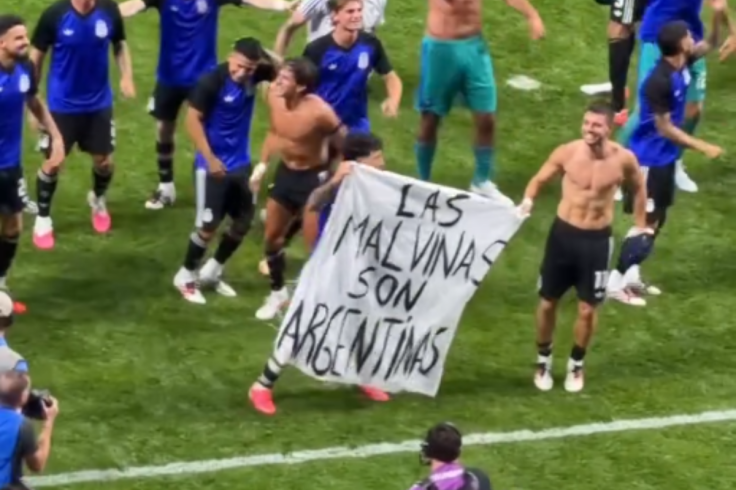
Argentina's World Cup semi-final victory over England has been overshadowed by controversy after several players were seen celebrating with a banner declaring the Falkland Islands belong to Argentina.
The incident took place after the final whistle in Atlanta, where Argentina came from behind to secure a 2-1 victory and book their place in the World Cup final. Footage from inside the stadium showed players celebrating alongside the banner despite FIFA's reported ban on political displays linked to the Falklands.
The scenes prompted criticism from British politicians and renewed calls for football's governing body to take disciplinary action. While FIFA has yet to comment publicly, the governing body is facing pressure to investigate whether its regulations were breached.
The controversy added to England's disappointment after Thomas Tuchel's side surrendered a late lead, with the debate over the players' celebrations quickly becoming one of the main talking points following the match.
Players Face Criticism Over Banner
Argentina players, including Tottenham captain Cristian Romero, Manchester United defender Lisandro Martinez and former Tottenham midfielder Giovani Lo Celso, were seen celebrating with a banner reading 'Las Malvinas son Argentinas', using Argentina's name for the Falkland Islands.
Video from the stands showed members of the squad shushing supporters before lifting the banner into the air. Lo Celso later placed it on the pitch as celebrations continued, while captain Lionel Messi was also seen dancing alongside it.
The display has prompted criticism because FIFA had reportedly banned flags and banners referring to the Falkland Islands due to their political nature. Although FIFA has not yet commented, there have been growing calls for disciplinary action against both the players and the Argentine Football Association.
Business and Trade Secretary Peter Kyle described the display as 'entirely inappropriate' and praised England for acting with dignity in what he called 'real contrast with what we saw with the Argentina team'.
Shadow minister Andrew Griffith also criticised the celebrations, saying: 'Labour's Chagos surrender has made us look weak, and British territory up for grabs. The Falklands are British. Whoever won the football. This idiotic display from the Argies was clearly against FIFA rules. They should be punished.'
Labour’s Chagos surrender has made us look weak, and British territory up for grabs.
— Andrew Griffith MP (@griffitha) July 16, 2026
The Falklands are British. Whoever won the football.
This idiotic display from the Argies was clearly against FIFA rules. They should be punished. pic.twitter.com/2S0WrPJbl7
Supporters on X also called for action against Romero and Martinez, with some urging Tottenham to remove Romero as captain and Manchester United to sanction Martinez. Others demanded suspensions, although many acknowledged that such punishments would be unlikely.
The incident is not without precedent. In 2014, the Argentine Football Association received a £20,000 fine after players displayed an almost identical 'Las Malvinas Son Argentinas' banner before a friendly against Slovenia.
This time, however, the incident took place on the World Cup stage in front of England supporters after FIFA had reportedly warned against political banners. Authorities are said to be treating the matter more seriously because of the scale of the occasion.
Defeat Compounds England's Frustration
The banner controversy came after England suffered a painful 2-1 defeat despite leading with only minutes remaining.
Anthony Gordon gave England the advantage before Thomas Tuchel introduced defensive changes, replacing Gordon with Ezri Konsa before later withdrawing Declan Rice and Reece James.
Argentina responded through Enzo Fernandez with five minutes left before Lautaro Martinez headed the winning goal in stoppage time to send Argentina into the final against Spain.
Tuchel defended his decisions after the match and rejected suggestions that his tactical approach had cost England a place in the final.
'There are a million coaches after the game who know what to do better. If it doesn't end up well, it's easy to say that my decisions were wrong,' he said.
He added: 'After the goal, we dropped back and waited too much, and the crosses and chances kept coming. I tried to help the team.'
'It doesn't help if we don't have the ball. We couldn't get out, of course we wanted to go for the second goal.'
The result marked another painful World Cup exit for England after they had come within six minutes of reaching their first final since 1966.
Political tensions surrounding the Falkland Islands had already featured before the match. Argentina players had previously been filmed singing a chant claiming the islands belonged to Argentina after their last-16 victory over Egypt. Foreign Minister Pablo Quirno questioned the legitimacy of the 2013 referendum, while Vice-President Victoria Villarruel posted after the victory: 'The Falklands are Argentine.'
She added: 'It wasn't just another match.' 'They banned bringing them to the stadium and forgot that we carry them in our blood and our hearts.'
The sovereignty dispute remains sensitive. According to the information provided, Britain has maintained a permanent presence on the islands since 1833, while a 2013 referendum saw 99.8 per cent of Falkland Islanders vote to remain a British Overseas Territory.
Meanwhile, England received messages of support after the defeat. King Charles III wrote: 'Commiserations to Harry and the team.'
Outgoing Prime Minister Sir Keir Starmer also praised the squad, writing: 'Gutted. Tonight wasn't the result we all hoped for, but this England team has given it their all.'
As attention turns towards the World Cup final, questions remain over whether FIFA will respond to the celebrations and whether the banner display will result in disciplinary action.
© Copyright IBTimes 2026. All rights reserved.