

Spain Had No Need for Heroes as Their Team-First Football Crushed France's Stars
Spain's tactical mastery and teamwork secure a 2-0 victory over France, advancing to the 2026 FIFA World Cup final.
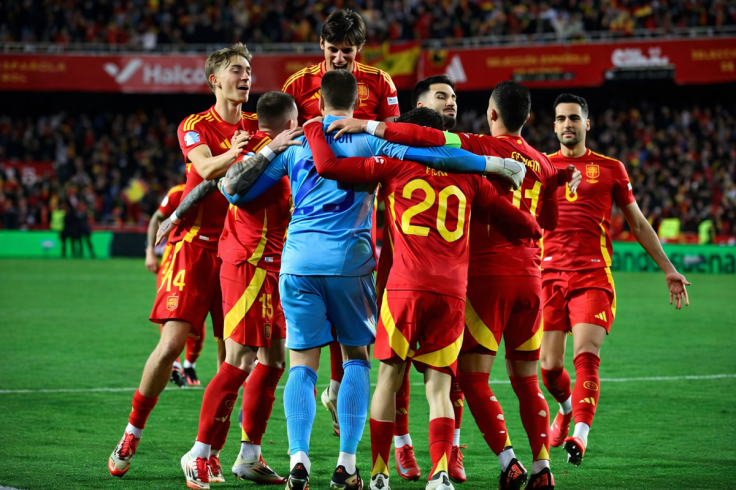
Spain reached the 2026 FIFA World Cup final with a commanding 2-0 victory over France in Arlington, Texas, producing a performance that highlighted the power of collective football over individual brilliance.
Much of the build-up focused on France's star-studded squad, led by captain Kylian Mbappe and supported by some of Europe's most accomplished attacking players. Yet when the semifinal unfolded, it was Spain's organisation, discipline, and teamwork that ultimately made the difference.
Goals from Mikel Oyarzabal and Pedro Porro secured the victory and ended France's hopes of reaching a third consecutive World Cup final. Spain, meanwhile, extended an unbeaten run that has become one of the defining stories of their recent resurgence.
Spain's Collective Approach Delivers Again
Spain's success throughout the tournament has been built on a simple principle: every player contributes to the system.
Against France, midfielders constantly rotated positions, defenders stepped confidently into possession, and attackers pressed aggressively whenever the ball was lost. Rather than depending on a single superstar, Spain spread responsibility across the pitch.
That approach allowed them to control large portions of the match. Passing sequences regularly pulled France out of shape, while coordinated pressing prevented their opponents from building sustained attacks.
The semifinal demonstrated why Spain has become one of the most balanced teams in international football. Their strength lies not in individual moments but in the way each player complements the others.
France's Talent Unable to Find Space
France entered the match with one of the most feared attacking units in the World Cup.
However, Spain's defensive organisation restricted opportunities for Mbappe, Ousmane Dembele, and Michael Olise to influence the contest. Whenever France attempted to accelerate the tempo, Spanish players closed spaces quickly and forced turnovers.
Mbappe produced occasional flashes of danger, but Spain's structure ensured those moments remained isolated rather than becoming sustained pressure.
The contrast between the two teams became increasingly apparent as the match progressed. France relied on individual quality to unlock opportunities, while Spain repeatedly created openings through movement, positioning, and teamwork.
It was a reminder that elite tournaments are often won not by the team with the biggest stars, but by the side with the clearest identity.
A Statement Performance on Football's Biggest Stage
Spain's victory was about more than reaching another World Cup final.
The performance reinforced their reputation as one of the most tactically sophisticated teams in the competition. Every player appeared comfortable within the system, allowing Spain to maintain control even against opponents filled with elite talent.
Their defensive record has been equally impressive. The semifinal marked another shutout in a tournament where Spain have consistently limited scoring opportunities for opponents. That balance between attack and defence has become a hallmark of their campaign.
Eyes on the Final
Spain now moves within one victory of lifting the World Cup trophy, their first since 2010.
The semifinal against France showed exactly why they are considered one of the favourites to win the tournament. While other teams have relied on individual heroes, Spain has built success on collective excellence.
Against one of football's most talented squads, they demonstrated that a well-drilled team can still overcome a collection of stars. As the World Cup final approaches, Spain's greatest weapon may not be a single player at all—it may be the unity that has carried them this far.
© Copyright IBTimes 2026. All rights reserved.