

Republicans Stall AOC's Paris Hilton-Backed Bill Letting Deepfake Porn Victims Sue Their Abusers
Republicans are accused of blocking the DEFIANCE Act, a bipartisan bill backed by Paris Hilton that would let deepfake porn victims sue their abusers.
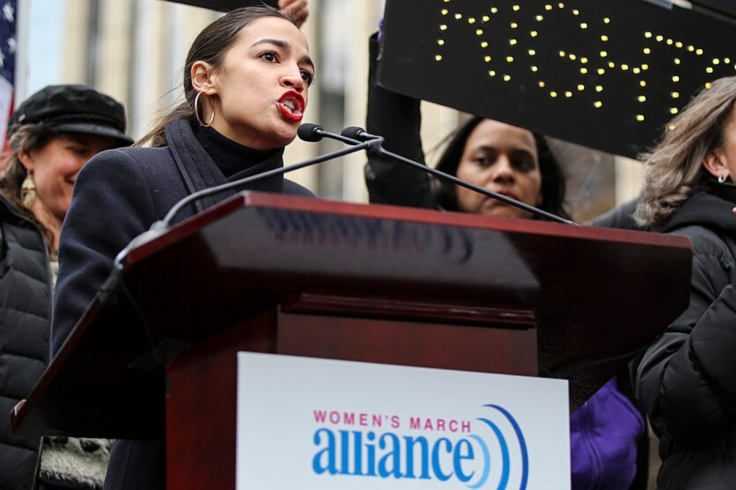
A bill that would let victims of AI-generated sexual imagery sue the people who create it has cleared the Senate, drawn a celebrity champion and won nearly 60 co-sponsors across both parties, and it is going nowhere, for a reason that has little to do with its contents.
Republican leaders in the House are keeping the DEFIANCE Act off the floor rather than hand Representative Alexandria Ocasio-Cortez a signature legislative win, according to people close to the effort, leaving a measure with rare bipartisan backing stranded weeks before the August recess.
The bill, publicly championed by Paris Hilton, would give victims of non-consensual deepfake pornography the right to take their abusers to civil court. Its supporters say the only real obstacle left is the identity of the Democrat whose name is on it.
The Bill Republicans Support but Refuse to Schedule
The legislation is not stalled on the merits, which is what makes the impasse unusual. It passed the Senate by unanimous consent, carries close to 60 bipartisan co-sponsors in the House, and is led there by Ocasio-Cortez alongside Republican Representative Laurel Lee of Florida. What it lacks is a floor vote, which only Republican leadership can grant.
Four people working closely on the bill told Politico that party leaders were 'scuttling' it rather than deliver a win to a rising Democratic star. 'It's a shame that this bill isn't law because they are unwilling to give AOC a win,' one said. 'When you look at it, everything is aligned for it to pass, except that they don't want her to have this.'
A second put it more bluntly, saying the delay deprived 'many, many people of the ability to set their lives right just to prevent one member of Congress from being able to pass a bill'.
The reporting frames the calculation in explicitly electoral terms, noting the measure 'would look splashy on a potential 2028 presidential résumé' and burnish Ocasio-Cortez's standing as a tough-on-Big-Tech Democrat.
Ocasio-Cortez told the outlet this week she is 'not ruling out' a 2028 run. Republican leadership has not confirmed that motive on the record, and Speaker Mike Johnson publicly voiced support for the bill earlier this year.
What the DEFIANCE Act Would Do
The Disrupt Explicit Forged Images and Non-Consensual Edits Act would create a federal civil right of action for people depicted in sexually explicit digital forgeries made without their consent. It would allow them to sue those who knowingly produce, distribute, solicit, or possess such material with intent to distribute it, and to recover damages of up to £187,000 ($250,000) in cases connected to sexual assault, stalking, or harassment.
It is meant to complete a job an earlier law left unfinished. The Take It Down Act, signed by President Donald Trump in May 2025 and championed by First Lady Melania Trump, made it a federal crime to share non-consensual explicit images and required platforms to remove them, but it offered victims no route to compensation.
Ocasio-Cortez has drawn the line between the two repeatedly. 'It is not enough to take down content; we have to give victims a civil right of action,' she said at the January press conference. 'Take It Down gave us removal, and DEFIANCE will give us recourse and restitution.'
She has cited research indicating that the overwhelming majority of deepfake imagery online is non-consensual pornography, and that women are its targets in roughly nine cases out of ten.
Paris Hilton and a Coalition of Survivors
The bill's most recognisable advocate brought her own history to the cause. Hilton appeared at the Capitol to press for its passage, telling reporters that intimate footage of her had been spread online when she was 19. 'People called it a scandal,' she said. 'It wasn't. It was abuse. There were no laws at the time to protect me.'
Hilton described deepfake abuse as an epidemic supercharged by technology, arguing that where a violation once required someone to betray a victim's trust, it now takes only 'a computer and a stranger's imagination'. She stood alongside lawmakers and other survivors, including a New Jersey teenager who was targeted by fabricated images while at school.
Lee, the bill's lead Republican, has voiced her own frustration at the delay. She said she had 'growing concern' about the stall and rejected the notion that its sponsor's politics should determine its fate. 'I do not think, on any level, that should be a barrier to us getting a vote on this bill,' she said.
A Test of Whether Politics Outweighs a Bipartisan Win
The standoff has become a small case study in how a narrowly divided House metabolises even its points of agreement.
With Republicans clinging to a paper-thin majority and eyeing the midterms, the arithmetic that would ordinarily carry a popular, Senate-passed bill to the president's desk has been overridden by the politics of who gets the credit.
Advocates warn the cost is measured in real cases that cannot yet be brought. Every week the bill sits unscheduled is a week that victims of fabricated pornography have no federal avenue to sue, a gap that grows as the tools to generate such images become cheaper and more widespread.
The bill that everyone claims to want may ultimately be decided not by whether it can pass, but by whether one party can bear to let the other's standard-bearer be the one to pass it.
© Copyright IBTimes 2026. All rights reserved.