

Blood Moon 2026: Why This Total Lunar Eclipse Will Not Be Seen Again for Years
A rare celestial event, Blood Moon 2026 will captivate skywatchers as the Moon turns a deep red hue

Skywatchers and casual observers alike are preparing to turn their eyes to the night sky on 3 March as a spectacular celestial event unfolds. The total lunar eclipse of 2026, widely known as a blood moon, will bathe the Moon in a deep reddish hue as it passes through Earth's shadow. With this event not expected to recur until late 2028, millions worldwide have a rare chance to witness one of the most striking natural displays in the sky.
What Is the Blood Moon and When Is It Happening?
A total lunar eclipse occurs when Earth moves directly between the Sun and the Moon, casting its shadow across the lunar surface. During totality, the Moon does not disappear entirely. Instead, sunlight filtered through Earth's atmosphere bends and scatters, casting a red glow across the lunar surface. This dramatic effect is what gives the phenomenon its popular name, blood moon.
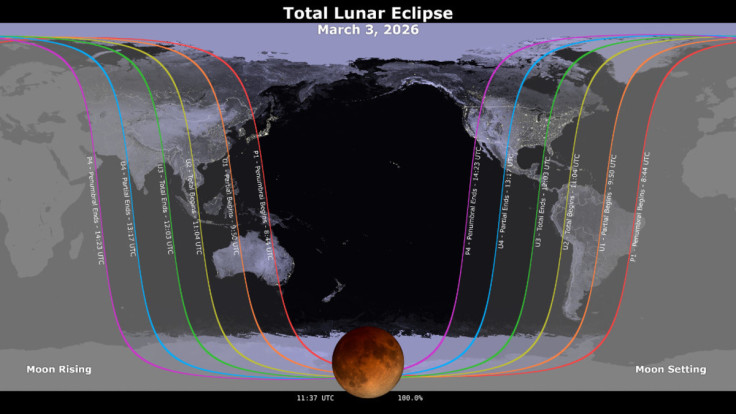
The eclipse begins with the penumbral phase at 08:44 UTC on 3 March. The Moon will enter the darker umbral shadow at 09:50 UTC, reaching totality at 11:04 UTC. Totality lasts approximately 58 minutes, ending at 12:02 UTC. Including the partial and penumbral phases, the eclipse will span more than five hours in total.
Where It Will Be Visible
The blood moon will be visible across large parts of the globe. Observers in Asia, Australia, and North and South America will see at least part of the eclipse. Clear skies will provide the best views, while some regions will witness the Moon rising or setting during the eclipse, creating particularly dramatic sightlines.
Why This Eclipse Is Unusual
Based on Time and Date's data, total lunar eclipses are not uncommon, but their visibility from any given location can be unpredictable. The Blood Moon 2026 stands out because of the long interval until the next total eclipse. After March 2026, the next total lunar eclipse visible from Earth will not occur until 31 December 2028 into 1 January 2029, meaning many enthusiasts will have to wait almost three years to see a similar event.
The gap arises from the precise alignment required between the Sun, Earth, and Moon. Partial and penumbral eclipses may happen more frequently, but they do not produce the full red colouring seen during totality, per Space.
Viewing Tips and Public Interest
According to The Times of India, unlike solar eclipses, lunar eclipses can be safely viewed with the naked eye, making them ideal for families and amateur astronomers. A dark, unobstructed horizon will improve visibility, while binoculars or a small telescope can enhance the experience. Astronomy clubs and public observatories are expected to host viewings, bringing communities together to enjoy the spectacle.
Astrophotography enthusiasts are particularly eager to capture the deep red Moon. Depending on the location, the Moon will be visible in the early evening in parts of Asia and Australia, and during the early morning hours across the Americas, offering varied photographic opportunities.
Historical and Scientific Context
Total lunar eclipses have fascinated humans for centuries, appearing in the records of ancient civilisations long before modern science explained the phenomenon. Today, the Blood Moon 2026 offers both educational and aesthetic value, demonstrating the complex dance between Earth, Sun, and Moon. According to NASA, this rare celestial event continues to inspire public interest in astronomy while providing a unique opportunity to observe the Moon at its most vivid.
© Copyright IBTimes 2026. All rights reserved.