Blood Moon March 3 Time: See the Full Timeline as the Total Lunar Eclipse is Visible in North America, Central Asia, and South America
This rare 'Blood Moon' eclipse will last 58 minutes.

If you are awake in the early hours of Tuesday, 3 March, you will be rewarded with one of the most striking astronomical events of the decade. A total lunar eclipse will transform the full moon into a vivid copper-red disc, widely referred to as the 'Blood Moon.'
This rare spectacle will be visible across large parts of North America, Central Asia, and South America. Observers in Australia and eastern Asia can catch the show on Tuesday night, while Africa and Europe will unfortunately miss out this time.
This will be the last total lunar eclipse visible on Earth until New Year's Eve 2028 and the last visible in North America until June 2029.
What Is It, and Why Is It Called the 'Blood Moon'
The so-called 'Blood Moon' will grace the Earth with over 40% of the world's population positioned to see at least a portion of the eclipse. Its distinctive red hue comes from stray bits of sunlight filtering through Earth's atmosphere. During the event, Earth sits directly between the Sun and the Moon, casting a shadow that covers the lunar surface. However, the Moon doesn't go completely dark; instead, our atmosphere acts like a lens, bending (refracting) sunlight and filtering out blue wavelengths, producing a coppery glow.
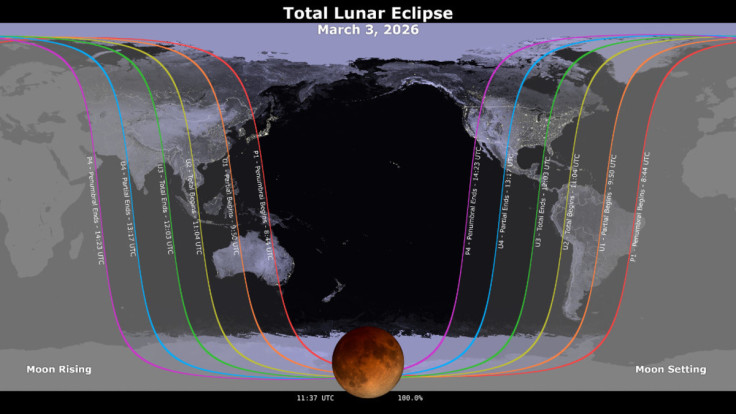
The 'Blood Moon' this year will last 58 minutes, while the entire eclipse — including partial and penumbral phases — will span 5 hours and 38 minutes. Unlike a solar eclipse, which requires special protective eyewear, a lunar eclipse is completely safe to view with the naked eye. As long as the sky is clear, observers can simply look up and enjoy the show. Binoculars or a telescope can make the colours pop, but they're optional.
As Catherine Miller of Middlebury College's Mittelman Observatory notes, the experience is much different than the high-stakes intensity of a solar event. Miller said, 'The lunar eclipse is a little more of a relaxed pace.'
Five Phases of the Total Lunar Eclipse
This total lunar eclipse consists of five distinct stages. It begins with the penumbral and partial phases, reaches its peak during totality, and then reverses through those first two stages as the moon exits Earth's shadow.
The penumbral phase is the event that begins as the Moon enters Earth's faint outer shadow, called the penumbra. During this stage, the Moon simply looks a bit dimmer or 'smudged,' but is still clearly visible.
The partial eclipse is when the moon moves into the umbra — the darker central shadow. The outline of Earth's shadow can be seen moving across the lunar surface, gradually darkening and reddening it.
Finally, the totality, is when the entire lunar surface sits within the umbra and is bathed in a deep reddish-orange glow. While the Moon is technically in Earth's darkest shadow, this is paradoxically when it reveals its most vibrant, 'Blood Moon' colour.
The 'Blood Moon' Timeline Across the Americas
In the US, the appearance of the 'Blood Moon' varies depending on the location. If observers want to witness the phases, they have to wake up earlier.
- Eastern Standard Time (EST): Totality at 6:04 a.m.
- Central Standard Time (CST): Totality at 5:04 a.m.
- Mountain Standard Time (MST): Totality at 5:17 a.m.
- Pacific Standard Time (PST): Totality at 3:04 a.m.
- Alaska: Totality at 2:04 a.m.
- Hawaii: Totality at 1:04 a.m.
Global Viewing Times
The eclipse occurs simultaneously worldwide but in the Eastern Hemisphere, the event begins Tuesday evening; in New Zealand, it starts just after midnight on Wednesday, 4 March.
Oceania & New Zealand
- NZ (NZDT): 12:04 a.m. – 1:02 a.m. (Wed, 4 March)
- Sydney (AEDT): 10:04 p.m. – 11:02 p.m.
- Adelaide (ACDT): 9:34 p.m. – 10:32 p.m.
- Brisbane (AEST): 9:04 p.m. – 10:02 p.m.
- Darwin (ACST): 8:34 p.m. – 9:32 p.m.
- Perth (AWST): 7:04 p.m. – 8:02 p.m.
East & Southeast Asia
- Tokyo/Seoul: 8:04 p.m. – 9:02 p.m.
- Beijing/HK/Manila: 7:04 p.m. – 8:02 p.m.
- Bangkok/Jakarta: 6:04 p.m. – 7:02 p.m. (Moonrise occurs during eclipse)
Central Asia
- Astana/Almaty: 5:04 p.m. – 6:02 p.m.
- Tashkent: 4:04 p.m. – 5:02 p.m. (Low on the horizon)
- New Delhi: 4:34 p.m. – 5:32 p.m. (Moon rises as totality ends)
South America (Morning of 3 March)
- Lima/Bogotá: 6:04 a.m. – 7:02 a.m. (Totality visible low in the West)
- Santiago/La Paz: 7:04 a.m. – 8:02 a.m. (Moon sets during totality)
- Buenos Aires/Rio: 8:04 a.m. – 9:02 a.m. (Moon set; only partial phases visible)
For those in Africa and Europe, where the eclipse is not visible, live streams and coverage are available online:
© Copyright IBTimes 2026. All rights reserved.
- MOST POPULAR IN World