

Donald Trump's 'Holy War': 'Chinese Nostradamus' Claims US Leaders Believe Iran Conflict Is Armageddon
China's 'Nostradamus' Jiang Xueqin warns Donald Trump's Iran war could fracture Europe, sideline NATO and reshape global power.

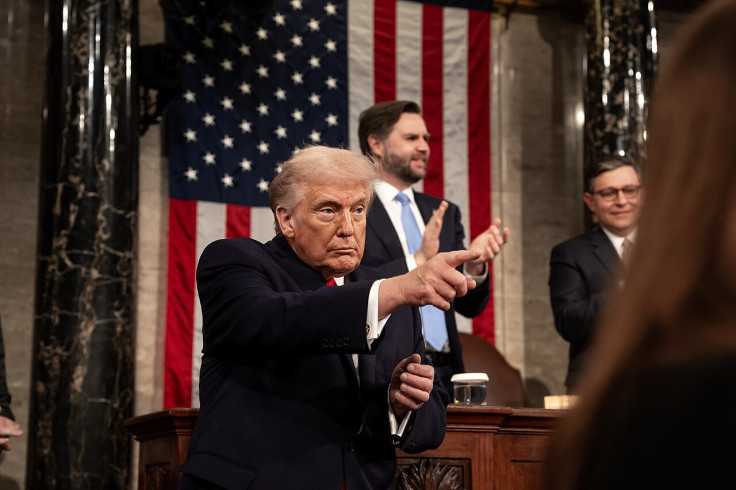
Donald Trump's 'holy war' with Iran will spiral into a global crisis that could destroy Europe and shatter America's alliances within a decade, according to Beijing‑based academic Jiang Xueqin, the commentator nicknamed 'China's Nostradamus' by his online followers. His forecast is based on historical analysis and speculative reasoning rather than verified data and has gained viral attention online amid rising US‑Iran tensions.
Jiang has built a small but fervent international audience by claiming to fuse close reading of history with game theory to anticipate geopolitical shocks. In the material shared by his supporters, he is credited with predicting Donald Trump's victory in the 2024 US election and warning that a Trump return to the White House would make a US–Iran war 'very likely.' Both of those developments, they say, have now come to pass, and Jiang has moved on to a darker set of forecasts about how that conflict unfolds.
'Holy War' Language and the Iran Conflict
In a recent video, Jiang argues that Trump's Iran campaign is not simply another Middle East intervention, but the opening chapter in what some inside the US military purportedly see as a biblical showdown. Citing unverified accounts, he says certain American troops have been told by commanders that Trump has been 'anointed by Jesus' to wage a holy war against Iran, a mission framed as potentially triggering Armageddon and Christ's return.
Jiang believes this apocalyptic mindset is not fringe but common among evangelical Christians who, in his view, now wield significant influence around Trump and across Washington. He uses the theological term 'eschatology' for this obsession with the End Times and suggests it shapes strategic decisions in ways that secular analysts have been slow to understand.
That religious framing, he contends, feeds directly into his first major prediction. The United States, he says, will be forced to deploy ground forces into Iran, a country four times the size of Iraq and far more mountainous. Air strikes and proxies will not be enough to control the terrain. Once American boots are on the ground, he warns, the US will confront a Vietnam-style backlash at home as 'a lot of young people' refuse to fight, mass protests erupt and the National Guard is mobilised to contain unrest.
The result, in his view, is not simply a foreign war, but a lurch towards internal conflict inside the US itself.
China's Nostradamus Warns of Europe and GCC Collapse
From there, Jiang's forecast widens out. He claims the Iran war will devastate the Gulf Cooperation Council, the bloc that includes Saudi Arabia, the UAE, Qatar, Kuwait, Bahrain and Oman and has long operated as a broadly US-aligned economic and security hub.
'What's happening in this war is that the economies of the GCC are being destroyed and that's part of the plan,' Jiang alleges, arguing without documentary evidence that Washington is willing to sacrifice Gulf partners in pursuit of a larger religiously freighted agenda. Officials in GCC states have not commented on his theory and there is no confirmation that such a plan exists.
He then sketches a second phase in which Turkey and Saudi Arabia are drawn directly into the fighting against Iran. That expansion, he suggests, serves a domestic purpose for hardline US evangelicals by weakening any political resistance to their End Times beliefs. For Turkey and the Gulf states, though, he predicts severe economic and military damage.
As the conflict grinds on, Jiang expects escalation around Jerusalem. One of his most incendiary predictions is that the Al-Aqsa mosque, Islam's third holiest site, will be badly damaged or destroyed. He notes that it sits at the centre of competing Israeli and Palestinian claims and recalls that in April 2024, during Iranian attacks on Israel, then-supreme leader Ali Khamenei posted in Hebrew that 'Al-Quds will be in the hands of the Muslims.' Jiang offers no concrete mechanism for Al-Aqsa's destruction, but treats it as a likely flashpoint in an Iran–Israel confrontation.
He links this to a revival of Iran's ancient name, predicting that as the war drags on and the country digs in, its leadership will deliberately re-embrace the term 'Persia.' In his narrative, that symbolic shift foreshadows a broader script in which Persian and Russian forces are cast as the armies that eventually face Israel at Armageddon, identified with Tel Megiddo in northern Israel.
Jiang then pivots to economics. With the US bogged down in Iran and NATO strained by disagreements over the Strait of Hormuz, he argues that Russia will seize the moment to deliver a decisive military victory in Ukraine. At the same time, he says, major technology and finance companies will start shifting operations from America to Israel because 'that is where the power will rest,' singling out firms such as Nvidia, Oracle, Microsoft and Google. None of those corporations has announced such plans and his claim remains speculative.
The most dramatic element is his eighth prediction. Europe, he says, ends up crushed between an emboldened Russia on one side and an Iran that either dominates or partly controls Turkey on the other. Given the advances in drones and cyber warfare held by both Moscow and Tehran, Jiang concludes bluntly: 'We can expect the destruction of Europe — the end of NATO basically.'
Again, there is no independent evidence for such a chain of events. Jiang's reputation as 'China's Nostradamus' rests heavily on anecdotes shared by admirers rather than formal forecasting records, and his claims about NATO's collapse run counter to the alliance's current public posture.
He does, however, offer an alternative pathway that sounds more familiar to foreign policy professionals. Trump, he suggests, could at some point declare victory, pull US troops out of the region and tell his base that America's goals in Iran have been met. The twist in Jiang's story is what happens next.
In that scenario, he argues, Iran would turn to the Gulf monarchies and demand compensation for the damage they helped inflict, using its leverage over the Strait of Hormuz, the channel through which around a fifth of the world's crude oil passes. Rather than petrodollars flowing into US markets via Gulf investment, he imagines them redirected to Tehran, funding a massive reconstruction and modernisation push that leaves Iran as the dominant regional power 'in five to 10 years.'
For the United States, whose economy he describes as heavily reliant on 'the stock market, on finance, on AI, on investment from the GCC,' that would be a profound blow. It is, in Jiang's telling, the true trap: either commit to a grinding ground war in Iran with unpredictable domestic costs, or step back and watch the financial underpinnings of American influence erode.
Across all of this, his central contention about Trump's 'holy war' is stark. What horrifies conventional politicians, Jiang says, may appeal to the evangelical figures around the president who read catastrophe not as failure but as a way to speed up the Second Coming. With Iran itself ruled by religious hardliners, he sees little chance of a calm diplomatic climbdown, and he paints the late 2020s as an extraordinarily hazardous stretch for the world if his projections hold.
© Copyright IBTimes 2026. All rights reserved.
- MOST POPULAR IN Trending


