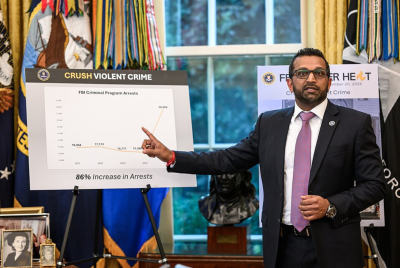
A Court Just Ruled That Calling Kash Patel a 'Nightclub Regular' Is 'Rhetorical Hyperbole' to Count as Defamation
The judge described the comment as 'provocative and amusing' but ultimately found it fell under the category of protected speech media law

FBI Director Kash Patel has suffered a legal defeat after a federal judge in Houston summarily dismissed his defamation lawsuit against former FBI official and MSNBC analyst Frank Figliuzzi.
The case centred on a May 2025 television appearance where Figliuzzi quipped that Patel was more visible in nightclubs than on the prestigious seventh floor of the FBI's Washington headquarters.
In a decision that safeguards the boundaries of political commentary, US District Court Judge George Hanks Jr ruled that the remark was 'rhetorical hyperbole' and could not be interpreted by any reasonable person as a literal statement of fact. This high-profile rhetorical hyperbole defamation ruling is a significant win for First Amendment protections, highlighting the difficulty public officials face when attempting to sue for reputational damage arising from media banter.
Patel claimed the comments were a fabricated attack on his professional conduct and leadership. However, the court found that the 'exaggerated and provocative' nature of the speech placed it firmly within the realm of protected opinion rather than actionable slander.
As the FBI Director defamation case collapses in Texas, legal experts are pointing to the ruling as a reinforced shield for media organisations and pundits who engage in sharp-tongued critique of government figures.
The Houston federal court ruling underscores the principle that in the theatre of public discourse, officials must develop a thick skin against metaphors and jabs that an ordinary viewer would recognise as mere padding for a larger political point.
Kash Patel's 'nightclubs' lawsuit against news analyst is thrown out
— Simo Saadi (@Simo7809957085) April 22, 2026
FBI director had sued MS NOW pundit Frank Figliuzzi for suggesting he spent more time on nights out than in the office, a remark a Texas judge ruled was not defamatory because it had clearly been ia joke pic.twitter.com/SdIlXHSme8
The Comment That Triggered The Lawsuit
The dispute began after Senior National Security and Intelligence Analyst, Frank Figliuzzi, appeared on MSNBC's 'Morning Joe' on 2 May 2025. During the broadcast, Figliuzzi commented that Patel had reportedly been 'visible at nightclubs far more than he has been on the seventh floor' of the FBI headquarters in Washington, D.C.
Patel filed a defamation lawsuit in June 2025, alleging the remark was false, damaging, and made with clear animosity towards him. His legal complaint argued that Figliuzzi had fabricated a specific claim about his conduct since becoming the FBI Director.
The filing also pointed to broader critical statements made by Figliuzzi about Patel's leadership and competence, which Patel's team cited as evidence of bias.
Congrats to my friend Frank Figliuzzi on winning the defamation lawsuit brought against him by FBI Director Kash Patel. Frank said Patel had “been visible at nightclubs" more than at FBI HQ. Patel sued Frank to intimidate others into not criticizing him. Judge ruled case was…
— (((DeanObeidallah))) (@DeanObeidallah) April 22, 2026
Court Says No Reasonable Viewer Would Take it Literally
In his ruling, Judge Hanks found that the statement, when read in context, would not be interpreted by a reasonable person as a literal claim about Patel's whereabouts or habits.
The court stated that no ordinary listener would understand the comment to mean Patel had actually spent more time in nightclubs than at FBI headquarters.
Instead, the judge concluded that the wording was exaggerated and rhetorical. The decision described the remark as 'exaggerated, provocative and amusing', and classified it as rhetorical hyperbole, which is not actionable under US defamation law.
The ruling made clear that the legal test depends on how an ordinary person would interpret the statement, not how the subject of the comment perceives it.
Judge DROPS defamation lawsuit by Kash Patel vs ex-FBI Frank Figliuzzi
— RT (@RT_com) April 22, 2026
Figliuzzi’s claim that Patel spent 'more time in nightclubs than at FBI HQ' was 'rhetorical hyperbole' — Judge pic.twitter.com/9UCNy3ZTSu
What Counts As Defamation In US Law
Under US defamation law, a claimant must generally show that a false statement of fact was made, that it was published to others, and that it caused reputational harm. For public figures such as Patel, the threshold is higher, requiring proof of actual malice.
In this case, the court found that the nightclub comment did not qualify as a factual assertion, meaning it could not proceed with a defamation claim regardless of intent.
The judge's reasoning focused heavily on context, tone, and the nature of political commentary in public discourse.
The judge described the comment as 'provocative and amusing' but ultimately found it fell under the category of protected speech media law.
Kash Patel suing The Atlantic is peak hilarious. He'll never be able to go through with discovery.
— Elizabeth (@alluringmedia) April 20, 2026
Also, other news outlets have reported on his partying all night long at clubs and not going into work. It was reported on last year 👀https://t.co/Y8wkFEHz4L
Anti-SLAPP Argument Raised, but Fees Denied
Figliuzzi's legal team also sought attorneys' fees under Texas's anti-SLAPP law, which is designed to prevent lawsuits that may discourage public participation or free expression.
While the court agreed to dismiss Patel's lawsuit, it denied the request for legal fees under that statute.
The anti-SLAPP framework is often used in cases involving public commentary, particularly when the speech is directed at public officials or concerns matters of public interest.
Background To The Wider Dispute
The lawsuit forms part of a broader series of legal and reputational disputes involving Patel. According to court records referenced in the same reporting context, Patel has also filed a separate defamation lawsuit in federal court in Washington, D.C. against The Atlantic magazine over an article that alleged alcohol abuse.
In the Figliuzzi case, Patel's filing also referenced earlier public remarks by Figliuzzi questioning his professional record and political alignment. Figliuzzi is a former assistant director for counterintelligence at the FBI.
Reaction From Legal Representatives
Following the ruling, Frank Figliuzzi's attorney, Marc Fuller, told CNBC that the decision represented a victory for press freedom and the First Amendment.
Fuller said Patel's claim was baseless and that the court had correctly dismissed the case.
Patel's legal representatives did not immediately respond to a request for comment.
What The Ruling Means Going Forward
The court's decision ultimately rested on a narrow but significant legal distinction, whether the nightclub remark could reasonably be understood as a statement of fact.
By concluding that it could not, the court dismissed the case in full.
The ruling reinforces how US courts continue to protect exaggerated or rhetorical language in public commentary, particularly when it involves high-profile figures and political or institutional criticism.
© Copyright IBTimes 2026. All rights reserved.
- Recommended For You