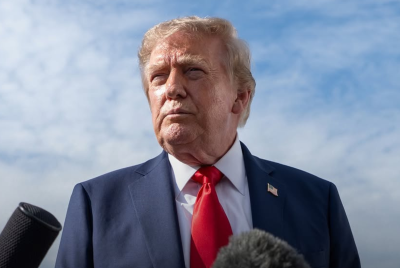
The Democratic Party's Money Is a Mess: A $2M-in-Debt DNC Asks Vendors to Wait as Trump Holds $400M
Republicans have more than $128M ready for the campaign, but the chairman says spending early on state parties will pay off

The Democratic Party's national committee begins the last 90 days before the midterms owing more than it holds: about $2.2M (£1.6M) in deficit, with $18.5M (£13.7M) of debts against $16.3M (£12.1M) of cash. The Democratic National Committee (DNC) has asked suppliers to hold their invoices until after polling day, while a fundraising vehicle allied to Donald Trump sits on $400M (£297M).
The cash and debt figures sit in the committee's own returns to the Federal Election Commission (FEC) for the end of June. The invoice arrangement surfaced in an investigation The New York Times published on 26 July, and the 10 days since have been consumed by a public argument Chairman Ken Martin is still fighting.
What the Filings Actually Show
The federal returns give the gap its scale. The Republican National Committee (RNC) closed June with $128.5M (£95.5M) in cash and no debt at all. The biggest outside vehicle behind Trump, a super political action committee (PAC), holds the $400M reported to the newspaper.
The committee's own history sharpens the contrast, because the same organisation finished the last midterm cycle, in 2022, with $30.5M (£22.7M) in hand against about $420,000 (£312,000) owed, as the chart below shows.

The pressure shows in unusual places. The committee borrowed $15M (£11.1M) against its own Washington headquarters last year and is skipping the transfers it usually sends the party's congressional campaign arms. This is also the organisation that lost $22,000 (£16,300) to an email impersonator in February 2025. Executive director Roger Lau rejects the darkest reading, calling the invoice talks 'standard negotiations with vendors over contracts and payment processes.'
Martin, who won a contested election for the chair in February 2025, carries the personal weight of it. Around two dozen Democrats described his position to the newspaper. One episode in early July, in which he threw a phone while berating a junior aide, ended in a complaint to the committee's human resources office. Some activists want him gone; most elected Democrats have stayed quiet or backed him.
The Case for the Defence
Headquarters tells a different story about the same ledger. The committee says it has raised $117M (£86.9M) from grassroots donors this cycle, deliberately pushed money into organising and state parties, and delivered record early fundraising for a chair in Martin's position. 'When we organise everywhere, we can win anywhere,' Martin argued on a podcast appearance last week, defending even his spending in island territories that elect no member of Congress.
Set against the alarm, parts of the defence hold up, as the comparison below sets out.

Borrowing is not new for either wing of the party. The committee ran credit lines under a previous chair, and the party's House campaign arm pledged all of its assets for a $20M (£14.9M) facility in 2024. Party debt can also lawfully be carried across years and paid down slowly.
The heavier inheritance is the last presidential race. The committee absorbed about $20.5M (£15.2M) of bills left by a campaign that spent $1.5B (£1.1B) in 15 weeks. Defenders describe that arrangement as an investment in the nominee's future fundraising; critics call it the hole the party is now standing in.
Ninety Days to Prove Somebody Right
The timing is the sting. The president's approval has sagged, petrol has stayed dear through the row engulfing the White House, and the war with Iran polls badly. Yet the machine built to convert that weather into seats is negotiating its own bills, and the word itself has become the frame, as the post below shows.
JUST NOW: President Trump declares that the Democratic Party “is a mess.” pic.twitter.com/zTtqxuBFy7
— WORLD NEWS (@_MAGA_NEWS_) August 5, 2026
The post above, from an anonymous aggregator account, presents a clip as breaking news. Whether the footage is new cannot be established, but the sentence is not: an official White House transcript records Trump saying the Democratic Party 'is a mess' in June 2019. Money pays for the field offices, advertising, and data that turn discontent into votes, and filings, not phrasing, will decide whether the old line fits in 2026.
The next federal returns, due through the autumn, will show whether the grassroots case or the creditors' case is winning. Until then, the midterm contest can be read in two numbers: a committee $2.2M short, and a rival operation $400M deep.
© Copyright IBTimes 2026. All rights reserved.
- Recommended For You