Trump Claims He Discussed Bombing Iran With Former President — Bush, Obama, Clinton and Biden Teams All Deny Contact
Trump's assertion of past presidential support for Iran bombing is refuted by all living former US presidents.

Every living former US president denied on Monday that they had spoken to Donald Trump about his decision to bomb Iran, hours after Trump publicly claimed one of them had told him, in private, that they wished they had done the same.
Trump made the assertion on 16 March 2026, twice, first during a Kennedy Center board luncheon at the White House, and again in a separate appearance in the Oval Office. Aides for George W. Bush, Bill Clinton, Barack Obama and Joe Biden each told NBC News and other outlets that no such conversation had taken place. The White House did not respond to press queries about the denials before publication.
The claim landed on day 17 of Operation Epic Fury, the US-Israeli military campaign against Iran that began on 28 February 2026. Trump used the moment to frame the conflict as a decision his predecessors lacked the will to make, a characterisation that all four living former presidents, through their representatives, flatly rejected.
What Trump Said — And Where He Said It
The first assertion came during Trump's remarks at the Kennedy Center lunch in the White House's East Room, attended by Attorney General Pam Bondi, House Speaker Mike Johnson and outgoing Kennedy Center board president Richard Grenell.
Speaking about the Iran campaign, Trump said: 'I've spoken to a certain president — who I like, actually. A past president, former president, he said: 'I wish I did it. I wish I did.' But they didn't do it. I'm doing it. Yeah?' Later that afternoon, in the Oval Office, he returned to the claim unprompted: 'I spoke to one of the former presidents who I actually like. I actually speak to some, I do like some people, it'd be shocking. And he said, 'I wish I did what you did.''
When reporters pressed him on the identity of this person, Trump's answer grew slippery. He confirmed it was not George W. Bush. Asked whether it was Clinton, he looked down and said, 'I don't want to say.' He added: 'I don't want to say because a member of a party, a member of a party, they have Trump derangement syndrome, but it's somebody that happens to like me, and I like that person, who's a smart person, but that person said, 'I wish I did it.' OK, but I don't want to get into who. I don't want to get him into trouble.'
The pronoun 'him' narrowed the pool. Jimmy Carter, the only other living former president at the time Trump previously discussed foreign policy with, died on 29 December 2024, leaving Bush, Clinton, Obama and Biden as the four living former occupants of the Oval Office at the time of Trump's claim.
Four Flat Denials — Each Coming Within Hours
NBC News, the Associated Press, and CNN each contacted representatives for all four former presidents on Monday evening. The responses were unambiguous. An aide for George W. Bush told NBC News that Bush and Trump 'haven't been in touch.'
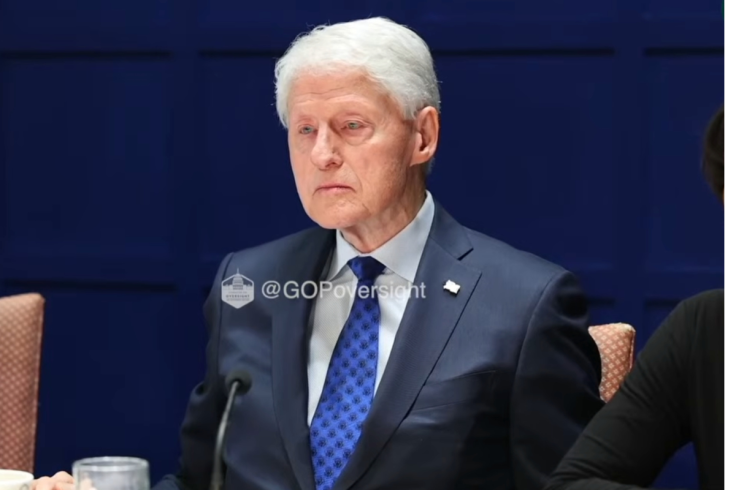
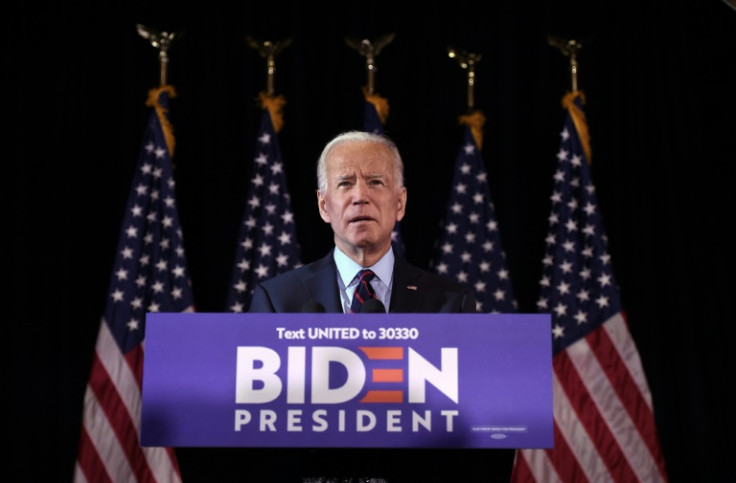
A spokesperson for Bill Clinton told NBC News that whoever Trump was describing was not Clinton. An aide for Barack Obama confirmed there had been 'no recent conversations' between Obama and Trump. A source familiar with the matter told NBC News that the person Trump referenced was not Joe Biden.

The AP separately reported that representatives for all four former presidents confirmed the same, telling the wire service there was no record of any recent communications with Trump on the matter. The White House did not respond to any of these outlets' requests for comment.
The denials covered every living person the claim could plausibly describe. Trump and all four former presidents were last in the same room together on 20 January 2025 — Inauguration Day, nearly six weeks before Operation Epic Fury began on 28 February 2026, according to HuffPost's reporting.
There is no public record of any private contact between Trump and any former president in the period since.
The Broader Context: Trump's Iran Narrative and His Predecessors
Throughout the Iran campaign, Trump has leaned heavily on the argument that previous administrations were too passive in confronting Tehran. At the Kennedy Center lunch, he told reporters: 'They've been a terror for 47 years. And now, I guess, the world through the United States with the help of Israel is doing what should have been done many years ago.'
The White House published a fact sheet the same week cataloguing Iranian-linked attacks on American citizens going back to 1995, framing the operation as a response to decades of inaction by the executive branch.
The relationship between Trump and his predecessors is, at best, lopsided. He has routinely described Joe Biden as 'the worst president in the history of our country' and has accused Barack Obama of striking a 'horrible deal' with Iran, a reference to the 2015 Joint Comprehensive Plan of Action, which Trump withdrew from during his first term. His relationship with George W. Bush has been publicly cool since at least 2016, when Trump blamed the Iraq War on Bush's decisions.
Bill Clinton is the outlier. In a 4 February 2026 interview with NBC News, Trump said: 'I liked Bill Clinton. I still like Bill Clinton. I liked his behavior toward me. I thought he got me, he understood me.' He made similar remarks in January, expressing that it 'bothers' him to see Clinton drawn into a congressional deposition over his alleged links to convicted sex offender Jeffrey Epstein. Trump's hints — the downward gaze, the 'I don't want to say,' the use of 'him' — pointed toward Clinton as the likeliest candidate. Clinton's office denied it flatly.
A Pattern of Unverifiable Claims in Wartime
This is not the first time Trump has made a wartime claim that proved impossible to verify. In earlier remarks about Operation Epic Fury, documented by NBC News's running tracker of administration statements on Iran, Trump variously described the conflict as a 'short-term excursion' on 9 March, then suggested its objectives were still expanding days later.
At the Kennedy Center event, he told reporters Iran's air force, navy and missile manufacturing capacity had been 'literally obliterated,' claimed more than 7,000 targets had been struck across Iran and described a 90% reduction in Iranian ballistic missile launches, figures provided without independent verification or cited source material.
Speaking at the same event, Trump also indicated he was unsure whether Iran's new supreme leader, Mojtaba Khamenei, who succeeded his father Ayatollah Ali Khamenei after the latter was killed in US-Israeli strikes, was alive or dead.
'We don't know if he's dead or not,' Trump said, according to CBS News reporting. That admission, made casually alongside the unverified claim about a former president, illustrated the administration's general approach to wartime communication: assertive in tone, loose in verifiable detail.
The White House has yet to name the former president. Four former presidents say it was not them. Someone is wrong.
© Copyright IBTimes 2026. All rights reserved.
- MOST POPULAR IN World