Greta Thunberg Named 'Second Most Dangerous Antisemite' After Using Terms Like 'Mass Starvations'
Thunberg challenges accusations of antisemitism, calls for action on Palestinian issues.

Greta Thunberg has hit back after being labelled by the Israeli government as one of the world's most dangerous antisemites, a designation she says rests on her language about Gaza.
On her Instagram, Thunberg addressed the claim, saying she said she had been named the 'second most dangerous antisemite in the world' because she used terms such as 'genocide, siege and mass starvation' to describe conditions in Gaza.
'Anyway, the genocide continues, and just weeks ago, Israel passed a new law, to impose the death penalty based on race, only for Palestinians,' she said. 'This is apartheid.'
She also referred to what she described as a new Israeli law imposing the death penalty 'based on race,' calling it apartheid and urging mobilisation around Palestinian Prisoners' Day on 17 April.
Thunberg's Response And Escalating Rhetoric
In the same video, she reiterated her description of Israel's actions in Gaza and called for sanctions, divestment, and boycotts.
'We must activate all parts of civil society to demand imposing sanctions, divestments, boycotts, accountability for war criminals, and cutting ending our complicity with genocide and apartheid,' she stated on the video. 'It is the bare f-cking minimum. So get organized and show up on Palestinian Prisoners' Day, April 17th.'
The ministry points to her repeated use of terms like 'genocide' and 'mass starvation' as proof of antisemitic framing. Critics of the report argue that condemning state actions, however forcefully, does not in itself constitute hostility towards Jewish people.
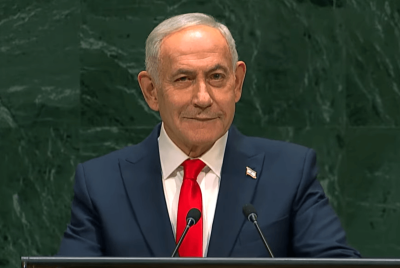
Israel has acknowledged a growing challenge in shaping international opinion, particularly online. Benjamin Netanyahu has described this as an 'eighth front,' distinct from military theatres, where influence is measured in reach rather than firepower. Social media, he has said, has become one of the most consequential battlegrounds.
In that framework, Thunberg's global profile elevates her from activist to perceived strategic threat.
Online Reaction And A Polarised Audience
Some users dismissed Thunberg's ranking as implausible, questioning how a climate activist could be framed as a leading global threat. Others defended Thunberg, casting her as a prominent voice drawing attention to civilian suffering.
'It's wild how Greta Thunberg has become almost a litmus test for how shitty a person or entity is. This one woman inspires such a disproportionate amount of hate and rage, you can almost ask a person what they think of Greta and their response will tell you everything you need to know. She's a stronger person than I am for all the hate she has to absorb,' one user replied.
'So let me get this straight... the two most "dangerous" antisemites are Greta Thunberg and *checks notes* Miss Rachel...? Two small women? Most dangerous??? Really, Israel??' replied another.
There is also a more pointed critique emerging. For some observers, the episode illustrates how accusations of antisemitism are deployed in political argument, particularly in relation to Gaza. For others, it shows how influential figures can shape narratives in ways that have real-world consequences.
'This woman is a global hero. Period.'
What cannot be ignored is how quickly the debate shifts from substance to identity. The report, Thunberg's response and the reaction it has generated all point to a communications landscape where language itself becomes contested territory.
From Climate Protests To Gaza Advocacy And Arrests
Thunberg's involvement in pro-Palestinian activism did not emerge in isolation.
On 20 October 2023, Greta Thunberg shared images from her weekly protest, holding a 'climate justice now' sign alongside placards supporting Palestinians in Gaza. She also directed followers to solidarity accounts, urging them to 'find information on how you can help'. The reaction was immediate. Critics pointed to her initial failure to condemn the 7 October attacks.
She responded the next day, stating she opposed 'the horrific attacks by Hamas' and called for a ceasefire and justice for 'all civilians affected.' Israel's education authorities subsequently removed references to Thunberg as a role model from parts of the national curriculum, a move that revealed how quickly her image had shifted in official eyes.
By 2024, she was detained at protests in Malmö during the Eurovision Song Contest 2024 and later in Copenhagen after blocking access to a university building. Within days, Swedish police carried her out of a student encampment in Stockholm. She described the response as 'repression,' language that only deepened the divide.
Speaking at a rally in Mannheim, she delivered a blunt condemnation of Germany and Israel, 'F-ck Germany and f-ck Israel,' prompting accusations from German politician Manuel Hagel that she was edging towards antisemitism. She has argued that climate justice inherently includes human rights, rejecting attempts to separate environmental activism from geopolitical issues.
Aid Missions And International Fallout
In 2025, she joined efforts by the Freedom Flotilla Coalition to deliver aid to Gaza, challenging Israel's blockade imposed after the October attacks. Israeli authorities maintain such measures are intended to prevent weapons smuggling, while groups including Amnesty International have described the restrictions as collective punishment.
In June 2025, Thunberg boarded the UK-flagged vessel Madleen. It was intercepted by the Israel Defense Forces in international waters and diverted to Ashdod. She was deported shortly after, saying it remained unclear why she was released while others were held. Later flotilla efforts ended with dozens of vessels seized and hundreds detained, marking one of the largest civilian attempts to breach the blockade.
Her claims of mistreatment during detention were firmly rejected by Israeli officials, adding another contested layer to an already polarised narrative. The controversy did not end there. A social media post following her deportation, which mistakenly used an image of an Israeli hostage to illustrate Palestinian suffering, drew condemnation and calls for its removal.
A Ranking That Raises Eyebrows
The designation originates from a report by Israel's Ministry of Diaspora Affairs, which set out to identify ten 'prominent influencers in the global anti-Semitic and anti-Zionist arena in 2025.' The methodology blends reach with what it calls a 'risk score,' measuring both influence and frequency of statements deemed hostile to Israel.
Thunberg appears second on the top of that list, placed above figures such as Nick Fuentes, who has a documented history of explicitly antisemitic rhetoric. At number one is influencer Dan Bilzerian, who has publicly called for violence against Israelis. The inclusion of names across the political spectrum, from comedian Bassem Youssef to broadcaster Tucker Carlson, underscores the breadth of the report's framing.
© Copyright IBTimes 2026. All rights reserved.
- Recommended For You