

'It's Fantastic to Keep Killing Hamas Leaders': Fetterman Says He'd Quit Democrats Over Israel
Pennsylvania Senator John Fetterman warns of leaving the Democratic Party if it turns against Israel.
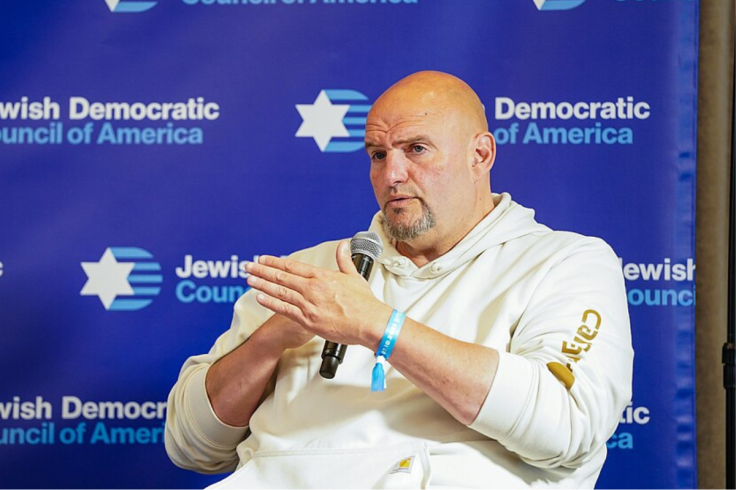
John Fetterman has named the one issue that would drive him out of the Democratic Party, and it is not taxes, immigration or the filibuster, but Israel.
The Pennsylvania senator declared on Thursday that he would leave the party if it formally turns against the Jewish state, delivering his bluntest ultimatum yet in an escalating war with the progressive left.
Speaking a day after a record number of House Democrats voted to block billions in military aid to Israel, Fetterman celebrated the targeted killing of Hamas and Hezbollah leadership and accused his party of abandoning an alliance it was once proud of.
The warning lands as the 2028-bound senator faces open primary danger at home and as the Democratic base, led by its younger voters, shifts decisively against Israel's conduct in Gaza and the Iran war.
A Red Line Drawn In A Corridor Interview
Fetterman set out his position in an interview with journalist Manu Raju on Thursday. 'That's my red line,' he said, adding that if the party becomes officially anti-Israel, that is what 'would force me out'. The framing was deliberate: not a defection to the Republicans, but an expulsion he would blame on his own side's drift.
Senator John Fetterman threatens to leave the Democratic Party unless it pledges to fully support Israel financially by sending it more U.S. taxpayer dollars.
— Shadow of Ezra (@ShadowofEzra) July 16, 2026
Fetterman complains that too many of his colleagues voted to cut off funding to Israel.
Fetterman is a traitor to this… pic.twitter.com/Guy5kn4pdY
He paired the ultimatum with an unapologetic defence of Israel's decapitation campaign against its enemies. 'I think it's fantastic to keep killing Hamas leadership,' Fetterman said, extending the sentiment to Hezbollah before lamenting that Democrats 'were proud to stand with Israel' and asking where the party stands now.
The language echoed his remarks last September, when he said he 'absolutely' supported killing Hamas operatives wherever they are found, after Israel's strike on the group's leadership in Doha. He has also described himself as possibly the only Democrat who backed Israeli strikes inside Iran.
A Record House Vote That Sharpened The Ultimatum
The timing of Fetterman's warning was no accident. On Wednesday, more than 100 House Democrats voted to block billions of dollars in military aid to Israel, the largest such defection ever recorded. The vote failed, but its scale confirmed how far the party's centre of gravity has moved since the Gaza war began and the Iran conflict deepened it.
Polling has tracked the same migration for two years, with sympathy for Israel collapsing among Democratic voters and especially among the under-30s who powered recent progressive primary wins.
For a senator who won statewide office as a hoodie-wearing populist with the left's enthusiastic backing, the ground has moved beneath his feet, and Fetterman has responded by planting himself more firmly rather than following it. The result is a politician increasingly beloved by the other party's voters and increasingly endangered by his own.
He has made the divergence personal. In the same interview he attacked Vermont Senator Bernie Sanders for backing insurgent candidates, demanding, 'Ask Bernie, why did he push that trash?' He also dismissed Graham Platner, the progressive Senate candidate in Maine, as 'a piece of s***', language that guarantees the intra-party feud will follow him into the midterms.
A Senator Increasingly At War With His Own Base
Israel is the sharpest edge of a broader estrangement. Fetterman has taken a hard line on immigration enforcement, split with Democratic leadership over shutdown strategy, and cultivated a working relationship with President Donald Trump that infuriates his former allies. Each break has fed speculation about his future, which he has previously answered by insisting he will not become a Republican.
The arc is remarkable for a politician who entered the Senate as the left's favourite son. Fetterman campaigned in 2022 as a populist progressive, railed against centrist Democrats like Joe Manchin, and drew national sympathy after surviving a stroke on the campaign trail. Four years later he reserves his harshest language for the movement that elected him, while the moderates he once scorned have become his closest analogues.
Thursday's formulation was different in kind. By defining a single-issue trigger for his departure, Fetterman effectively handed the party's activist wing a map of exactly which fight would cost Democrats a Senate seat, since a Fetterman exit in a chamber this closely divided would carry arithmetic consequences well beyond Pennsylvania.
His personal standing at home complicates the calculus. Fetterman is up for re-election in 2028 and faces the near-certainty of a serious primary challenge from the left, where his approval among Democratic voters has sagged even as Republicans view him more warmly. Leaving the party before then would trade a difficult primary for a near-impossible three-way general election, which is why allies read the red line less as an exit plan than as leverage.
What An Official Anti-Israel Turn Would Actually Require
The scenario Fetterman describes remains hypothetical. The Democratic Party has no mechanism for becoming 'officially' anti-Israel short of rewriting its platform, and its congressional leadership continues to back military aid, as Wednesday's failed vote demonstrated.
But platforms are written at conventions, and the 2028 gathering will be shaped by a base and a bench of presidential hopefuls markedly cooler towards Israel than any in the party's modern history.
Nor is Fetterman entirely alone in his warnings, even if he is loudest. A cohort of pro-Israel Democrats in both chambers has watched the same drift with alarm, and Republican strategists have openly courted the senator as proof that the Democratic coalition is shedding its centre. Every public red line he draws makes their recruitment pitch for them, whether or not he ever intends to cross it.
That is the collision Fetterman is betting on, and pre-positioning for. Whether the wager makes him the conscience of a vanishing Democratic tradition or a senator negotiating his own exit will be decided not by him but by the party he is daring to change.
For now, the man his party once celebrated as its most unlikely winner has told it, on the record and in a single sentence, the price of losing him.
© Copyright IBTimes 2026. All rights reserved.