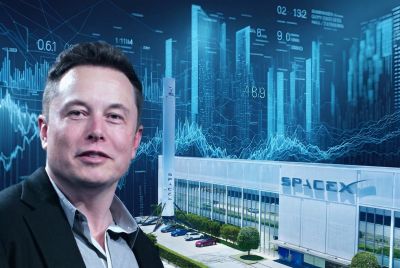
SpaceX Rally Adds More to Elon Musk's Wealth in a Day Than Buffett or Gates Built in a Lifetime
SpaceX's IPO raises $75 billion, valuing the company at $2.1 trillion, with shares surging and Musk's net worth skyrocketing

SpaceX priced its initial public offering (IPO) at $135 per share, raising $75 billion and debuting on public markets at a $2.1 trillion valuation, the largest IPO in history. Shares traded under the ticker SPCX surged 19% on the first day, touching an intraday high of $176.52. By the second trading day, the stock climbed another 20%, briefly pushing SpaceX's market capitalization past $3 trillion as shares reached as high as $229.40.
Forbes reported the two-day rally added $165 billion to Musk's personal fortune, bringing his net worth to approximately $1.3 trillion. A separate estimate from Celebrity Net Worth placed the figure at $1.35 trillion. Musk holds roughly 43% of SpaceX, meaning each percentage-point move in the company's stock price carries an outsized effect on his personal balance sheet.
For context, Warren Buffett's net worth stands at $146.4 billion, as per Forbes, and Musk just surpassed that in 48 hours. Even Bill Gates' entire fortune is valued at $104.4 billion, which is no match for Musk's trillionaire status.
SpaceX IPO Demand: $350 Billion for a $75 Billion Deal
The number that most clearly captures the scale of investor interest is not the IPO raise itself. It is the gap between supply and demand.
SpaceX's offering generated more than $350 billion in total investor demand against a $75 billion deal size, making it one of the most oversubscribed listings in financial history, according to reporting by GuruFocus. In practical terms, for every dollar of stock available, investors submitted orders for roughly $4.67.
The structure of that allocation matters. According to GuruFocus, 70% of the institutional shares sold were directed toward long-term investors, a deliberate underwriting decision designed to reduce post-listing volatility from short-term traders flipping shares for quick gains. The demand was driven in large part by investor confidence in two specific business lines: Starlink, SpaceX's low-Earth orbit satellite internet service that has already achieved commercial scale, and Starship, the next-generation heavy-lift launch vehicle that underpins Musk's stated ambitions for Mars colonization and deep-space cargo missions.
'This is not a moonshot, but given the size of the deal, if the stock price holds, there will be more dollar value of [early stock returns] than any IPO in history,' one market observer noted, as reported by CBS News.
Who actually received shares at the $135 offer price? The short answer, based on available disclosures, is primarily large institutional investors with established relationships with the underwriting banks. Retail participation at the IPO price was limited. Most individual investors who wanted exposure to SpaceX entered the market after the first-day jump, paying at least $160 per share rather than the $135 floor.
Musk's Revenue Projections and the Analyst Gap
SpaceX shares rose sharply in the days leading up to pricing after Musk publicly predicted the company would generate $1 trillion in annual revenue by 2030. That figure drew immediate attention, partly because of its scale and because of the distance between it and existing Wall Street projections.
Morgan Stanley had projected SpaceX revenues of $330 billion by 2030. SpaceX reported $18.67 billion in revenue for 2025, meaning Musk's $1 trillion target implies a roughly 53-fold increase over five years from the company's last reported annual figure. Morgan Stanley's figure, itself an aggressive projection by most standards, represents a roughly 17-fold increase.
'Whoever you are watching this, SpaceX wants to be able to take you to the moon, take you to Mars and ultimately beyond,' Musk said at a public event around the time of the listing.
Valuation Size as a Risk Factor
Not everyone in the investment community read SpaceX's debut as an unambiguous signal. Analysts at Morningstar, the investment research firm, noted that SpaceX entered the public market as the sixth-largest U.S. company by market capitalization at its $2.1 trillion debut valuation. Forty years of market data show that the largest stocks by capitalization have tended to lag the broader market over subsequent periods, a pattern Morningstar flagged as a structural concern for new buyers at current prices.
'Bigger is not necessarily better,' Morningstar noted in its analysis of the listing.
The wealth effect from SpaceX's listing extends beyond Musk. Early employees, engineers, and longtime SpaceX investors who held pre-IPO equity saw their stakes convert to publicly tradeable shares for the first time, turning many into millionaires overnight. The company had been private for more than two decades before this listing, meaning the liquidity event was long-awaited by a significant number of stakeholders inside and outside Silicon Valley.
SpaceX's post-IPO trajectory will depend heavily on whether its two core growth narratives, Starlink subscriber expansion and Starship commercialisation, translate into revenue at anything approaching the pace Musk described. Morgan Stanley's $330 billion revenue projection for 2030 already assumes aggressive growth across both business lines. Musk's $1 trillion figure sits three times higher than that.
© Copyright IBTimes 2026. All rights reserved.
- Recommended For You