Trump Seeks £1.15 Trillion Military and £290M White House Renovation Budget by Cutting Billions in Grants
A deep dive into the controversial FY2027 budget proposal.

President Donald Trump's fiscal year 2027 budget request asks Congress to deliver the largest military outlay in American history while directing hundreds of millions of dollars towards White House renovations, funded in part by cutting billions from health research, education, housing and climate grants.
The 92-page budget document, submitted to Congress on 3 April 2026 by Office of Management and Budget Director Russell Vought, proposes a 44% increase in defence spending, bringing the Pentagon's total to £1.15 trillion ($1.5 trillion) for FY2027. At the same time, the administration calls for a 10% cut to non‑defence discretionary spending, amounting to £56 billion ($73 billion) in reductions across domestic agencies.
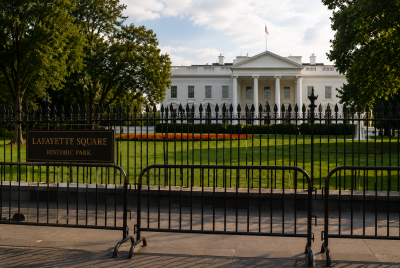
The plan would also set aside £290 million ($377 million) in the current fiscal year for renovations to the White House executive residence, an 866% increase compared to the £30 million ($39 million) spent in fiscal year 2025.
A $1.5 Trillion Defence Budget Built on Reconciliation Maths
The FY2027 defence budget is structured in two parts. The base discretionary request stands at £884 billion ($1.15 trillion), marking the first time base-budget defence spending has crossed the $1 trillion threshold. The remaining £269 billion ($350 billion) is earmarked to pass through budget reconciliation, a legislative process Republicans can advance without Democratic support using a simple majority vote.
The Pentagon is expected to release a more detailed breakdown of programme-level spending on 21 April. Broad priorities confirmed in the budget include funding 85 F-35 Joint Strike Fighter jets, expanding Columbia-class ballistic missile submarine procurement, restocking munitions depleted during the ongoing US-led war in Iran, and advancing a space-based missile defence system the administration calls the 'Golden Dome.' The budget also proposes pay increases of between 5 and 7% for military personnel, tiered by rank.
Senate Armed Services Committee Chairman Roger Wicker (R-Miss.) and House Armed Services Committee Chairman Mike Rogers (R-Ala.) issued a joint statement welcoming the request, saying it 'provides the resources needed to rebuild American military capability' amid what they described as 'the most dangerous global environment since World War II.' The White House summary characterised the request as approaching 'the historic increases just prior to World War II' and said it 'recognises the current global threat environment.'

White House Renovation Spending Draws Scrutiny Over Mandatory Classification
Buried within the budget submission are projections showing £290 million ($377 million) in FY2026 spending on repairs and renovations to the White House executive residence, with an additional £134 million ($174 million) projected for FY2027. The combined figure approaches £424 million ($551 million) across two fiscal years, a scale of White House spending with no modern precedent.
The administration has not specified which projects the funds would cover. An Office of Management and Budget spokesperson told Politico that the totals incorporate 'a number of renovations, not just the executive residence,' including unspecified security-related costs. Of the £290 million ($377 million) allocated for FY2026, £269 million ($350 million) has been classified as 'mandatory' spending, a designation typically reserved by Congress for programmes such as Social Security and Medicare, where disbursements are required by statute. That classification would effectively remove the funds from the annual Congressional appropriations debate.
The OMB spokesperson offered a partial explanation, noting that private donations made for East Wing renovation work are held at the National Park Service, though the budget document provides no further detail. The White House has not published a project schedule, contractor list, or itemised cost breakdown for the renovation spending.
NIH, NOAA and Community Grants Face Elimination
The proposed domestic cuts affect nearly every civilian agency. The Department of Health and Human Services faces a £12.2 billion ($15.8 billion) reduction, dropping its discretionary budget to £85.5 billion ($111.1 billion). Within that total, the National Institutes of Health would absorb a £3.8 billion ($5 billion) cut and see three of its 27 constituent institutes eliminated: the National Institute on Minority Health and Health Disparities, the Fogarty International Center and the National Center for Complementary and Integrative Health. Congress rejected a far steeper proposed cut of £13.8 billion ($18 billion) to NIH in the FY2026 budget cycle.
The National Oceanic and Atmospheric Administration faces a £1.2 billion ($1.6 billion) reduction, targeting its Office of Oceanic and Atmospheric Research for elimination and terminating what the budget labels 'Green New Scam' grants. The Department of Agriculture would lose 19% of its discretionary funding, including the elimination of the McGovern-Dole Food for Education Programme, £185 million ($240 million), and £507 million ($659 million) in Community Facilities Grant Earmarks. The Environmental Protection Agency's Environmental Justice Programme, HUD's Pathways to Removing Obstacles to Housing, and a Low Income Home Energy Assistance Programme drawing on £3.1 billion ($4 billion) in funding are all slated for elimination.
House Budget Committee ranking member Representative Brendan Boyle (D-Pa.) said in a statement that the budget 'represents America Last,' arguing it prioritises weapons procurement and White House renovations over health care, food assistance and housing for ordinary Americans. The proposal carries no force of law, and Congress retains full authority to reject, revise, or ignore its provisions. Lawmakers largely rebuffed similarly deep cuts when the administration submitted the FY2026 budget request, ultimately preserving NIH funding levels and blocking most proposed reductions to domestic science spending.
The budget arrives as the United States is engaged in active military operations against Iran, a conflict the administration has used to justify the pace and scale of defence appropriations. Speaking at a White House event on 1 April 2026, Trump said the federal government could not fund programmes such as day care, Medicaid and Medicare at the national level alongside an active war effort. 'We're fighting wars. We can't take care of day care,' Trump said, adding that such programmes should be the responsibility of individual states.
The budget does not project a path to deficit reduction. The federal government is currently running an approximately £1.5 trillion ($2 trillion) annual deficit, with the national debt exceeding £30 trillion ($39 trillion). The administration's own budget director, Vought, acknowledged in his transmittal letter to Congress that fiscal year 2026 marked the first real cut to discretionary spending in 12 years, though the proposed FY2027 defence increase would more than offset those savings in nominal terms.
As the administration's FY2027 blueprint heads to a divided Congress that rejected its most aggressive proposals last year, the central question is not whether every cut survives, but how far lawmakers are willing to go in funding both the largest military budget in American history and an eight-figure renovation of the building the president lives in.
© Copyright IBTimes 2026. All rights reserved.
- Recommended For You