

Trump Admits Only His Own Mind Can Stop Him As Biographer Labels POTUS 'Functionally A Psychopath'
Presidential historian calls for 25th Amendment or impeachment as Trump stokes political violence
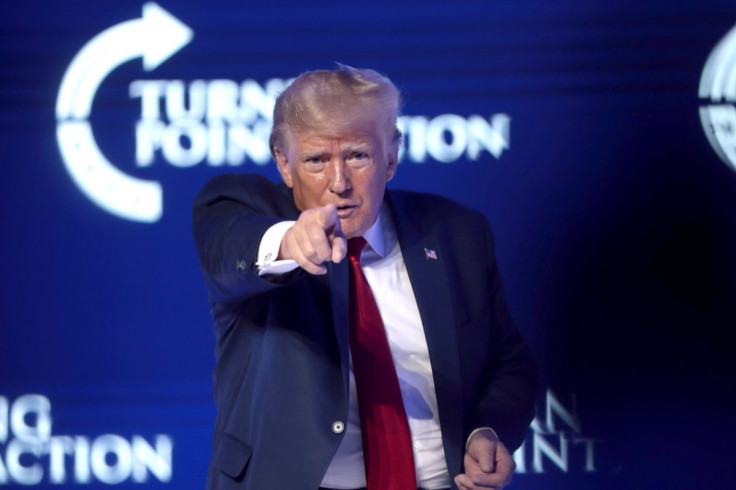
Donald Trump was branded 'functionally a psychopath' on Thursday night by one of his own biographers, who warned that only the president's mind, not the law or his advisers, now restrains him.
In a series of posts reacting to Trump's latest address and renewed election denial in Washington, presidential historian Seth Abramson argued that the United States had reached a point where the 25th Amendment or impeachment should be on the table, and claimed the president was deliberately stoking political violence.
Abramson's broadside followed another combative appearance by Trump in which he again questioned the legitimacy of the election and lashed out at his opponents. The president's refusal to accept political or institutional limits is not new, but critics say it has grown more brazen as legal and electoral pressures close in.
It can be recalled that earlier this year Trump was already facing open speculation, including from some of his own onetime supporters, about his mental fitness to serve.
Abramson, a former criminal defence lawyer who has written a trilogy of bestselling books alleging deep-rooted corruption in the Trump administration, framed the moment in chillingly personal terms. 'The most sober, terrifying thing I can say as a Trump presidential historian is that what happened tonight was not about you, me, or America,' he wrote.
'He's going to do what he's going to do based on how he convinces himself to do it. Nothing else matters. He's not listening to anyone,' Abramson added.
Coming from someone who has spent years immersed in Trump's record and rhetoric, it landed differently, and it immediately ricocheted around social media.
Trump Admits Only His Own Mind Can Stop Him
In case you missed it when it first happened, Trump himself has publicly described his internal world in ways that now read as ominous. Asked in January whether there were any limits to his global powers, the president replied, 'My own morality. My own mind. It's the only thing that can stop me.'
At the time, the line was treated in some quarters as swaggering bravado, one more flourish in a presidency full of them. In Abramson's retelling, it is closer to a confession of how Trump views the presidency and, more importantly, how insulated he believes he is from external checks.
According to Abramson, what is at stake is not simply a volatile political style but a deeper disturbance. He wrote that 'however it came to pass, childhood trauma, genetics, dementia, this US president is now functionally a psychopath.

He lives in his own reality. He converses only with himself. All America is now downstream from a madman who's not listening to anyone or anything but his own madness.'
The White House has not, issued any response to questions about the president's mental health. Previous formal health reports on Trump have described him as fit for office.
Even so, Abramson's choice of words reflects a broader unease that has been simmering for years. Mental health professionals have flagged what they describe as 'mental glitches' and 'red flags' in Trump's public behaviour, though many are cautious about diagnosing at a distance.
Political allies who once brushed off concerns as partisan have, in rare cases, broken ranks. Earlier in the year, Trump's threats against Iran prompted even hardline supporters like Alex Jones to call for his removal, accusing him of dementia and likening his behaviour to the 'madness of King George III.'
Calls For The 25th Amendment, And Warnings Of Violence
The remedies Abramson is now openly demanding are written into the US constitutional architecture but are rarely discussed in such direct, almost desperate terms by establishment commentators.
The 25th Amendment allows the vice president and a majority of the cabinet to declare a president unable to discharge his duties. Impeachment, of course, is the political trial mechanism familiar to anyone who lived through Trump's previous brushes with Congress.
It is a brutal assessment of an entire political class, and it taps into a fear that has dogged the Trump years, namely that the guardrails everyone assumed would hold simply have not. Critics inside and outside government have accused senior Republicans of acquiescing to the president's most extreme impulses or waiting for the storm to pass. So far, the system has bent, then bent some more.
Abramson's starkest concern, though, is not institutional decay. It is violence. He alleges that Trump is 'intentionally stoking 'violence' through his language and actions, and he claims the president is doing 'all he can to convince a large swath of America that violent rebellion is the only answer.'

Abramson is explicit about where he thinks that road leads. 'Violence would destroy America and leave no winners. You'll never see me support it but in self-defence,' he wrote, before warning that Trump's endgame was not negotiation or power-sharing.
Again, that is his interpretation, not an established fact. Trump has repeatedly denied intending or endorsing unlawful violence, and his defenders argue that his language is metaphorical or merely trolling the media.
Yet the polarisation is real, and so is the sense, for many Americans, that their politics is now orbiting one man's moods.
Whether Congress, the cabinet or the courts will ever act on the alarms being sounded is another matter. For the moment, the United States remains in the strange position Abramson describes, where the president himself once said 'my own mind' was the only brake on his power, and one of the people who knows his record best is now publicly asking if that mind is fit to be at the wheel at all.
© Copyright IBTimes 2026. All rights reserved.