

Trump's 'Human Printer' Allegedly Begged Him To 'Cuss Me Out' in Unhinged Secret Letters Found in His Room
Newly published letters from Nathalie Harp, found in Donald Trump's private quarters, reveal an aide whose devotion to the president veers into disturbing emotional dependence
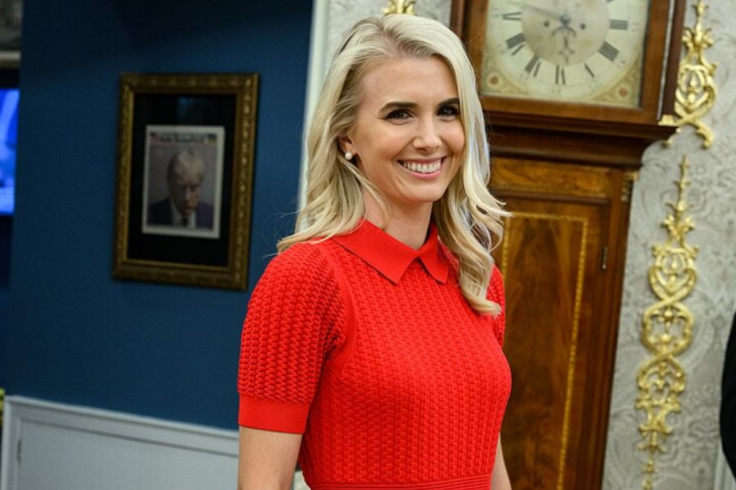
President Donald Trump's close aide Nathalie Harp allegedly left intensely personal handwritten letters for him to find in his private living quarters during a recent overseas trip, according to excerpts from journalist Michael Wolff's latest book.
The notes, written by the 35-year-old assistant and discovered in the president's room, paint a picture of a staffer consumed by devotion to the 80-year-old Republican leader and anxious about her standing in his eyes.
Harp has long been seen inside Trumpworld as more than a standard political aide. The former talk show host, who credits Trump's policies with giving her access to life-saving medical treatment, has become a constant presence at his side.
According to the account, her behaviour has unsettled parts of his inner circle, from senior staff to First Lady Melania Trump and even the Secret Service, who reportedly viewed her fixation as anything from unhealthy to flat-out alarming.
Nathalie Harp and the Apology Letter in Trump's Room
The new material on Harp comes from Wolff, a veteran Trump chronicler, who says he obtained two letters Harp wrote to the president and left for him to stumble upon in his most personal spaces. The first note, he reports, was essentially an extended apology for what sounds, in isolation, like a minor logistical hiccup.
Harp is said to have told Trump she 'panicked' over a transportation problem and contacted him directly instead of handling it quietly. Then the letter veered sharply into self-recrimination, with Harp fretting over whether she had embarrassed him while walking a golf course in Scotland.
'I also am sorry if I was an embarrassment walking the course in Scotland,' she wrote, explaining that she had been told there were no carts and that people were expected to walk. On the second day, she said, a senior figure at the course asked her to keep walking and to tell 'any other girls' to do the same to protect the grass from more carts.
The letter continued in the same raw, confessional tone. Harp apologised for any other 'trouble' she might have caused, mentioned complaints that she had not been replying to messages, and blamed international mobile issues, saying she had also been helping someone named John with technical problems on the plane.
From there, the note took a strikingly emotional turn. Harp wrote that she had been 'distracted all week,' forgetting to eat and sleep properly, and was consumed by grief over the death of her father. She linked that private pain to a very public obsession, voicing terror at losing Trump's esteem.
'I see myself being lowered in your eyes and good opinion,' she wrote, calling that her greatest fear. 'I never want to bring you anything but joy. I'm sorry I lost my focus. You are all that matters to me. I don't want to ever let you down. Thank you for being my Guardian and Protector in this Life.'
She closed the letter, Wolff says, by noting she had used a card to buy things for Trump and signing off 'with all my heart.' If that sounds more like a love letter than workplace correspondence, many people around Trump reportedly thought the same.
'Human Printer', Burnout and a Plea To 'Cuss Me Out'
The second letter, which Wolff says was also left in Trump's private space, moved beyond apology into something more reflective, and arguably more troubling. Harp framed it as the note she had really wanted to write, only after getting the mea culpa out of the way.
She described how the trip had forced her to step back from the frantic pace of her usual work as Trump's so-called 'Human Printer,' a nickname that captures the brutal grind of producing constant written material for a man who thrives on flurries of paper and praise.
Out on the course, she wrote, there were no machines, and they could lose track of time, and for once she did not have to live as the office workhorse.
Freed, briefly, from her usual role, Harp told Trump she had rediscovered the pleasure of conversation and long walks at sunrise and sunset. Yet all that thinking time had a 'slightly negative effect', she admitted, because it forced her to confront how close she was to burnout.
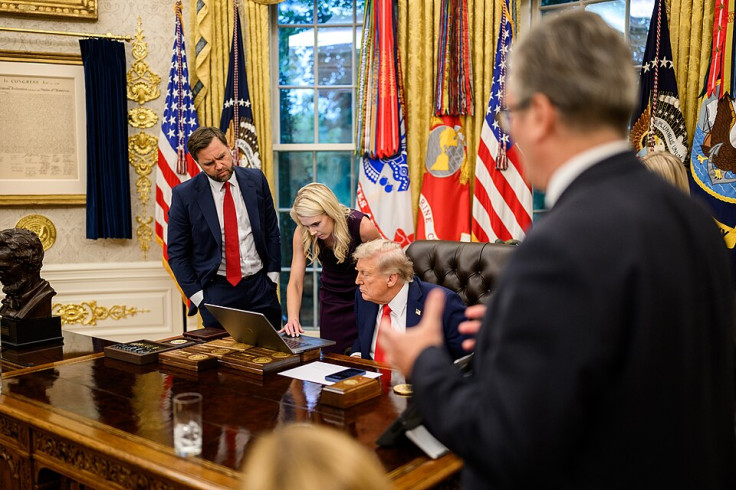
In a revealing passage, Harp confessed she was starting to envy the people around Trump whose 'only job seems to be to talk with you, and look pretty.' Then she added a line that, in any normal workplace, would set off every HR alarm going: 'I want that job!!'
She joked, half not joking, that she often looked like a 'hunchback' trying to keep up with the flood of material coming in for Trump, and said he at least knew 'what I should look like.'
She reminisced about the days when Trump used to ring her during her talk show era, and they would talk 'about everything and nothing,' saying she wanted to get back to that 'synergy' instead of talking about work all the time.
Harp described herself as stuck 'in between' staff and the people Trump chooses for easy company on his plane or at dinner, insisting that was who she had originally been to him when she was a 'Talkshow Host.' It reads like a plea not just for approval, but for a specific role in his life, somewhere between employee and confidante.
By the end of the second letter, the tone had shifted again, this time into something closer to self-abasement. Harp wrote that she needed to reunite her 'past self' with her current one to become a 'better version' who would make Trump proud. Then came a line that has been doing the rounds online because of how mad it sounds on the page.
'And please, when I fail, will you tell me? You have the absolute right to cuss me out, if need be, when I deserve it, because no one knows or cares about me more,' she wrote, effectively inviting the president of the United States to shout at her as an act of caring.

Harp ended by recalling a promise Trump supposedly made after her father's death and imagining how happy her father would be that she had visited Scotland and Ireland, trips he had always wanted for her. She finished with a twist on a classic line, writing: 'I could not have parted with you, to anyone less worthy,' before declaring: 'It is I who is unworthy.'
According to Wolff, Harp also noted that she was still recovering from the medical treatment she says was made possible by Trump's policies, a reminder of the origin story of her loyalty. Neither Harp nor the White House has publicly responded to the publication of the letters.
For all that, the portrait that emerges is stark. A president reliant on fierce personal loyalty, and an aide who appears determined to give him exactly that, even if it means forgetting to eat, sleep or, occasionally, draw a line.
© Copyright IBTimes 2026. All rights reserved.