

Trump Has 'Severe Daytime Somnolence' and May Have Slept Through Arlington Tribute, Doctor Warns
Dr Jonathan Reiner questions Trump's health after Arlington incident
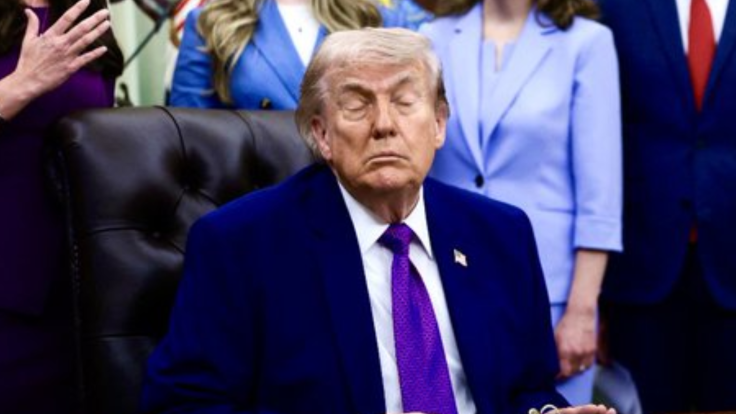
A prominent cardiologist who served as Dick Cheney's personal physician told CNN live on air that President Donald Trump has 'severe daytime somnolence' and expressed concern that the 79-year-old may have fallen asleep at Arlington National Cemetery during the country's most solemn tribute of the year.
The remarks came from Dr Jonathan Reiner, Professor of Medicine and Surgery at The George Washington University School of Medicine and director of the Cardiac Catheterisation Laboratories, speaking to CNN anchor Kate Bolduan on 26 May 2026.
Reiner made clear he had not personally examined Trump, but framed his concerns around a pattern of publicly documented incidents, and called on the White House to explain what medical evaluation, if any, had been done to investigate the president's repeated difficulty staying awake during daytime engagements. The remarks landed the day Trump, who turns 80 on 14 June, travelled to Walter Reed National Military Medical Centre for his fourth publicly disclosed physical of his second term.
Reiner's On-Air Assessment and the Pattern Behind It
Speaking on CNN, Reiner opened his assessment by saying the American people deserved a 'clear understanding' that Trump is 'fit for duty.' He then listed what he described as the president's visible health concerns: bruising on his hands, which the White House has attributed to frequent handshakes and regular aspirin use, and swollen ankles, a condition the administration previously linked to chronic venous insufficiency. He then turned to sleep.
'The president has severe daytime somnolence,' Reiner said on air. 'He falls asleep very often. He's fallen asleep in the Oval Office on multiple occasions with people talking to him in the cabinet room, and there was concern yesterday that he might have fallen asleep at Arlington National Cemetery during Memorial Day observances.'
Reiner was not making his first observation on this topic. In January 2026, he posted on X after Trump appeared to close his eyes for sustained periods during an Oval Office signing event: 'The president seems to be struggling with excessive daytime somnolence. Repeatedly falling asleep with a dozen people surrounding your desk is not normal. It needs to be evaluated.'
The president seems to be struggling with excessive daytime somnolence.
— Jonathan Reiner (@JReinerMD) January 15, 2026
Repeatedly falling asleep with a dozen people surrounding your desk is not normal. It needs to be evaluated. https://t.co/jt1ati3Z39
That post referenced C-SPAN footage of Trump during a healthcare pricing event involving a deal with Regeneron. A separate incident at a White House maternal health event on 11 May 2026 produced similar observations from attendees.
The Arlington Clip and the Dispute Over What It Shows
The Memorial Day incident at Arlington that prompted Reiner's comments occurred during the 158th National Memorial Day Observance on 25 May 2026. Footage circulating widely on social media showed Trump seated next to Vice President JD Vance during remarks by Defence Secretary Pete Hegseth, with his eyes appearing closed for an extended stretch. The clip accumulated millions of views within hours of being posted on X and Instagram.
Trump falls asleep as speakers talk about service members dying for their country on Memorial Day pic.twitter.com/QXq455Tmhq
— Headquarters (@HQNewsNow) May 25, 2026
The ceremony was among the most formal on the presidential calendar: a wreath-laying at the Tomb of the Unknown Soldier, a Missing Man formation flyover by four F-35s, and tributes to Gold Star families. Trump himself delivered a speech during the observance.
Conservative commentator Anthony Galli suggested on social media that the president was 'squinting hard to take in the patriotic message' due to sunlight. Independent political videographer Aaron Rupar characterised the moment as Trump having 'blinked' for a long time. The White House did not issue a formal response to the specific clip.
It's sunny so President Trump is squinting hard to take in the patriotic message. pic.twitter.com/bZMFMIcGDx
— Anthony Galli (@AnthonyGalli) May 25, 2026
What 'Severe Daytime Somnolence' Means Clinically and Why It Matters in an 80-Year-Old
Daytime somnolence, or hypersomnia, refers to an uncontrollable urge to fall asleep during waking hours. Reiner described it on CNN as a 'severe illness,' noting that chronic insomnia and its associated sleep disruption carry significant health consequences for older adults. He said the condition can increase the risk of dementia, reduce cognitive function, and is equivalent in its effect on cognitive ageing to adding three years to a person's existing age. He added that it can increase the risk of heart attack and contribute to depression.
Peer-reviewed research published in Alzheimer's and Dementia in December 2025, based on a 10-year longitudinal study of 618 adults, found that excessive daytime sleepiness was significantly associated with incident dementia in older adults and correlated with lower baseline cognitive scores. An earlier French prospective cohort study published in Alzheimer's Research and Therapy tracked 6,851 participants aged 65 and over and found that excessive daytime sleepiness was associated with a higher risk of all-cause dementia and Alzheimer's disease over a 12-year follow-up period.
'It's a real problem,' Reiner said on CNN. 'And the president appears to struggle to stay awake during the day. And I'd like to hear what the White House has done to evaluate why the president has this increased daytime somnolence and what they're doing to improve that.' No White House response to that specific question had been issued at the time of reporting.
For a president who spent years branding his predecessor as 'Sleepy Joe,' the footage now circulating from Arlington carries a particular political weight that no Truth Social post can straightforwardly address.
© Copyright IBTimes 2026. All rights reserved.
- Recommended For You


