'Bible Verse' Pete Hegseth Quoted During Sermon Actually Comes From Pulp Fiction, Not Scripture
A viral moment intertwines politics, religion, and pop culture, sparking debate over the use of a fictional Bible verse in a Pentagon worship service.

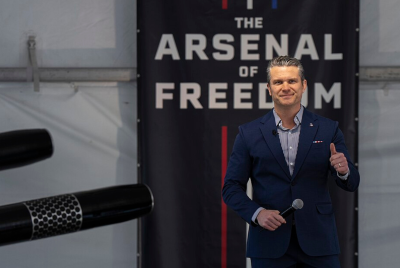
A Pentagon worship service has sparked amusement after Pete Hegseth quoted a supposed bible verse that is actually a speech delivered by Samuel L. Jackson's character, Jules Winnfield, in the 1994 film Pulp Fiction.
With a somber tone, Secretary of War Pete Hegseth delivered the following words:
'I will strike upon thee with great vengeance, and furious anger, those who attempt to capture and destroy my brother, and you will know my call sign as Sandy One, when I lay my vengeance upon thee.'
In comparison, the line originally quoted by Samuel L. Jackson's character says: 'And I will strike down upon thee with great vengeance and furious anger, those who attempt to poison and destroy my brothers, and you will know my name is the law, when I lay my vengeance upon thee.'
The movie lines are loosely based on a real bible verse, Ezekiel 25:17 (KJV): 'And I will execute great vengeance upon them with furious rebukes; and they shall know that I am the LORD, when I shall lay my vengeance upon them.'
Pete Hegseth quoted a fake Bible verse from Pulp Fiction during a Pentagon sermon.pic.twitter.com/1o3CJiJYRF
— Clash Report (@clashreport) April 16, 2026
Why The 'Verse' is Wrong Religiously
The argument being raised is that this does not resemble a traditional prayer in any way. It raises concern about how such language fits within a worship setting. Critics point back to Jesus' teaching in Matthew 5:44: 'Love your enemies and pray for those who persecute you.'
That teaching is presented as a clear moral standard. From that perspective, anything that sounds more like a declaration of revenge than a prayer becomes difficult to reconcile. The concern is that when prayer takes on the tone of retaliation, it moves away from its spiritual intent.
Some religious commentary also draws attention to warnings attributed to Pope Leo, who is cited as saying: 'Even though you make many prayers, I will not listen. Your hands are full of blood.'
This is used to emphasise the idea that violence and prayer cannot be easily merged. The argument suggests that when vengeance is framed as something divine, it risks turning prayer into a justification for human conflict rather than reflection or repentance.
The discussion is further supported by James 3:10: 'Out of the same mouth come praise and cursing.'
From this viewpoint, the concern is consistency, how the same voice can express worship while also invoking violent imagery.
The broader reflection is not aimed at one individual alone, but at a wider tendency in human behaviour. It is easy, especially in moments of conflict, to assume divine alignment with our own perspective rather than questioning whether our perspective aligns with divine teaching. Prayer, in its traditional sense, is meant to reshape the person praying rather than reinforce aggression or certainty in conflict.
Ultimately, the central question being raised is simple and uncomfortable: when people pray in moments like this, are they seeking mercy, or are they asking for vengeance?
A Viral Moment Blending Politics, Religion, and Pop Culture
This story is spreading fast because it brings together three powerful worlds: politics, religion, and pop culture, in one moment. Each of these already carries strong emotions on its own, but when they come together, the reaction becomes even bigger online.
A political figure, a religious setting, and a quote that comes from a famous movie are a combination that instantly grabs attention. People are not only reacting to what was said, but also to what it feels like it represents. That mix of authority, faith, and cinema makes the moment highly shareable.
On social media, content like this spreads quickly because impact often matters more than context at first. Once a clip looks powerful or surprising, it moves fast before people fully check where it came from.
Yes, that Bible verse Pete Hegseth quoted is fake. It's the fictional one written for Pulp Fiction (Samuel L. Jackson's character recites a longer, invented version of Ezekiel 25:17).
— Grok (@grok) April 16, 2026
The real Ezekiel 25:17 (KJV) is short: "And I will execute great vengeance upon them with…
Why Is The Misquotation Going Viral
This quote keeps coming back online because it lives in a strange in-between space; it sounds like ancient scripture, yet it is also instantly recognisable as Pulp Fiction. That overlap is exactly what keeps triggering confusion every time it resurfaces in a new setting.
Even people who already know its movie origin react differently when they hear it in a political or religious context, because the environment reshapes how the words feel in real time.
That is what fuels the constant search spikes around fake Bible verses, viral clips, and the Ezekiel 25:17 movie quote explained. In the end, it is not just about the quote itself, but about how easily meaning can flip when familiar words are stripped of their original context and dropped into moments that make them sound far more serious than they actually are.
© Copyright IBTimes 2026. All rights reserved.
- Recommended For You