Donald Trump Uncharacteristically Shuts Down After a Tense 2-Hour Meeting with Xi Jinping: Report
Trump's subdued response in Beijing raises questions amid Taiwan discussions with Xi Jinping.

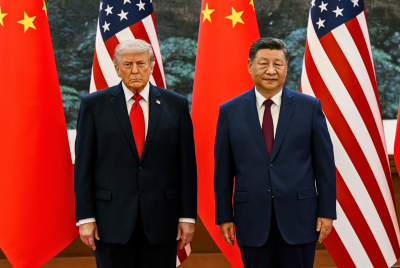
Donald Trump appeared unusually subdued in Beijing on Thursday after a private meeting with Chinese President Xi Jinping, with the US president offering only a brief answer to reporters after Chinese officials said Taiwan had featured prominently in the talks.
Trump had arrived in the Chinese capital on Wednesday night with senior administration officials and a group of Silicon Valley chief executives ahead of meetings with Xi on Thursday and Friday. The visit opened with all the ceremony expected of a state occasion, including a red carpet, a cannon salute, an honour guard and children waving flags, before the two men began their first round of talks at the Great Hall of the People.
Donald Trump Strikes A Different Tone In Beijing
Early on, the public optics were almost absurdly cordial. Xi told Trump that 'the whole world is watching our meeting' and asked whether China and the United States could 'meet global challenges together and provide more stability for the world.' Trump responded in familiar fashion, lavishing praise on his host and telling Xi, 'You're a great leader, I say it to everybody, you're a great leader.'
He did not sound like that afterwards.
🇺🇸🇨🇳⚡ President Donald Trump described talks with Xi Jinping as "great", after a nearly two-hour long high-stakes meeting in Beijing pic.twitter.com/BG1YrWFLCB
— Wolf Brief (@wolfbrief_) May 14, 2026
According to The Daily Beast, the first round of talks lasted roughly two hours and 15 minutes. When Trump later appeared with Xi outside Beijing's Temple of Heaven, he was asked how the meeting had gone. His answer was startlingly short by his own standards. 'It's great, a great place. Incredible. China is beautiful.'
That was it. No riffing. No improvised verdict on trade or diplomacy. No attempt to dominate the moment with one of the sprawling, combative answers that usually follow him around. Xi stayed silent, Trump said nothing more, and the two men moved inside as one reporter tried to ask a final question about Taiwan.
Trump and Xi's meeting erupts into chaos as hot mic catches fight break out https://t.co/pOLphOrrTV pic.twitter.com/n1j9eMLpX4
— UNILAD (@UNILAD) May 14, 2026
That odd little exchange is what gives the episode its charge. Trump is not generally a politician who retreats into understatement when the cameras are on. If anything, his instinct is usually the reverse. So when he suddenly has almost nothing to say, people notice.
CNN White House reporter Betsy Klein did exactly that, describing the president as 'uncharacteristically restrained' during the photo opportunity. She said Trump would usually have plenty to say on a subject like this and suggested his silence may have reflected the fact that he understood he was Xi's guest, or simply did not want to speak about Taiwan in public.
Why Donald Trump Faced Pressure Over Taiwan
That sensitivity is not hard to understand. The Chinese foreign ministry's readout of the private talks was blunt. A spokesperson said Xi had warned Trump that 'the Taiwan question is the most important issue in China U.S. relations' and cautioned that, if mishandled, the issue could lead to 'clashes and even conflicts,' placing the wider relationship in jeopardy.
It is a serious warning, and one delivered in language Beijing plainly wanted heard beyond the room. The talks were expected to cover trade, technology and broader geopolitical strains including Iran and Taiwan, but the Chinese account made clear which issue Beijing wanted to push to the front.
Trump-Xi summit: High-stakes meeting ends after two hours; Xi Jinping hails trade progress, but sends Taiwan a warning https://t.co/C9Jkg7mKq3
— Irish Independent (@Independent_ie) May 14, 2026
One unresolved flashpoint is a stalled US arms sale to Taiwan worth $14 billion. Congress has already approved it, but Trump has not formally moved ahead with the deal.
Before the Beijing talks, he had said he would discuss future arms sales to Taiwan with Xi, a move that threatens to unsettle a longstanding policy dating back to Ronald Reagan, under which Washington does not consult Beijing on such sales.
Pressure was already building before Air Force One landed. In a letter dated 8 May, a bipartisan group of senators urged Trump and his team to 'make clear that America's support for Taiwan is inviolable.'
The same letter pressed the administration to notify Congress formally over the $14 billion package and insisted that support for Taiwan should not become a bargaining chip in wider negotiations with China.
#NewsAlert | US President Donald Trump says 'trade will be totally reciprocal on our behalf' after meeting with China's Xi Jinping
— ET NOW (@ETNOWlive) May 14, 2026
"Trump, Xi discussed increased agriculture, oil trade... Both sides agreed Iran can never have a nuclear weapon," says White House official
From… pic.twitter.com/yCBmNo1HSX
None of that proves Trump was rattled by Xi behind closed doors, and there is no direct confirmation from the president himself that Taiwan was the reason for his restraint. Still, the image left behind is unusually stark.
A president who normally fills silence with bluster stood beside Xi Jinping in one of Beijing's most symbolically charged settings and reduced the whole spectacle to nine clipped words about the scenery.
© Copyright IBTimes 2026. All rights reserved.
- Recommended For You