Nancy Guthrie Case: FBI Finds 'Mystery People' In Home Security Images Before Abduction
Chilling thumbnail images recovered by federal agents suggest the 84-year-old's Arizona home was being 'mapped' for blind spots days before she vanished without a trace.

FBI investigators have recovered a series of 'mystery' thumbnail images showing unidentified individuals at the Arizona home of Nancy Guthrie in the days leading up to her disappearance, while the cameras appear to have captured nothing on the night she vanished, according to The Mirror US.
The images came from motion-activated cameras covering the pool, backyard and side yard at the 84-year-old's property, deepening questions about whether whoever took Guthrie knew the layout better than police first understood.
Investigators were unable to recover full video footage from the system. What they did obtain were thumbnail images generated when the cameras were triggered, and several people were seen in an unspecified period before Guthrie disappeared.
Images Point To Possible Reconnaissance
Ed Burnett, a security expert who spoke to The Mirror US on behalf of Cloudastructure, believes the clearest explanation may be the simplest one. Whoever was involved, he said, may have visited the home before the abduction to work out where the cameras could and could not see.
He put it more technically, saying the people spotted in earlier images may have been carrying out 'pre-operational surveillance to map the PIR (Passive Infrared) sensor range.' In plainer English, that means testing the edges of the system. Homes with consumer-grade cameras often look more protected than they are, and a determined intruder does not need to beat every camera. One blind patch can be enough.

Burnett said those earlier visitors may have been identifying 'dead zones' or 'blind spots' through pre-operational surveillance, then used a route that never triggered the motion sensors. It is an unsettling theory, implying patience and rehearsal rather than impulse. None of this is confirmed, though, and he was outlining possible scenarios rather than a forensic finding
Cameras Leave Investigators With Gaps
Burnett also laid out other scenarios, and they read like a catalogue of ways modern home security can fail at exactly the wrong moment. He said people with prior knowledge of a system might bypass sensors without touching the hardware at all. One option, he said, is signal interference.
'Many residential Wi-Fi cameras are susceptible to 'deauthentication attacks' or RF jamming,' Burnett said. 'A simple handheld device can disrupt the connection between the camera and the router, preventing the camera from uploading thumbnails or alerts to the cloud.'
Motion-activated cameras depend on triggers, and those triggers can be surprisingly fussy. Burnett said most residential systems rely on heat signatures. If intruders wore insulated clothing or moved very slowly, he said, they might not have generated enough thermal contrast to trigger the camera. It sounds almost too neat, but anyone who has watched a garden camera miss the obvious while faithfully recording a fox, a branch, or drifting rain will recognise the problem.
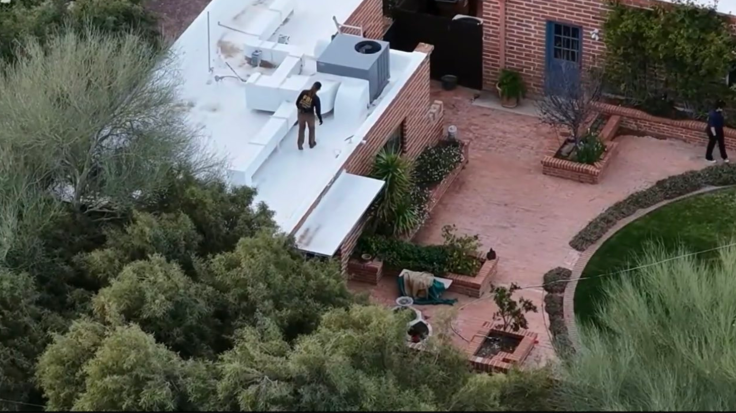
Another possibility is timing. Burnett noted that many battery-operated or cloud-based cameras use a 're-trigger delay' to preserve power. In other words, after one activation, the device can briefly go to sleep. If a stray animal or even a moving branch set it off shortly before the abduction, the camera may have been inactive during the critical window.
Then there is what Burnett called 'digital sabotage.' He said the real failure might not have been detection at all, but recording or storage. Cutting the home's exterior internet line or power could stop cloud-based cameras from transmitting data.

A denial-of-service attack on the home network, he added, might also have overwhelmed bandwidth and caused the cameras to drop offline at the wrong time. He even floated the possibility that someone gained access to the camera app or web portal and switched motion detection off remotely or placed the system into privacy mode for a limited period.
It followed another reported turn in the case involving a person said to have fled the neighbourhood soon after the kidnapping. But the sharper point is this. The cameras suggest the house may have been watched in advance, yet they recorded nothing on the night Nancy Guthrie disappeared.
© Copyright IBTimes 2026. All rights reserved.
- MOST POPULAR IN Trending