JonBenét Ramsey's Dad Warns Nancy Guthrie's Family Not to Rely on 'Obsolete' Police Search
John Ramsey advises Nancy Guthrie's family to push for advanced DNA techniques in ongoing investigation.

JonBenét Ramsey's father has urged the family of missing Arizona grandmother Nancy Guthrie not to 'assume the police are doing everything they can,' warning that traditional search methods and basic DNA checks are now 'obsolete' more than 100 days after she vanished from her Tucson home on 1 February 2026.
The news came after the 84-year-old's disappearance, initially treated as a high‑priority missing‑person case, hardened into a suspected abduction with no confirmed suspect, no clear timeline of what happened after she was last seen on 31 January, and only sketchy public updates from investigators.
For those who have not been following it, the Nancy Guthrie case has quietly grown into a national true-crime flashpoint in the US, raising awkward questions about transparency, technology, and how much trust families should place in law enforcement once the first frantic days of a search pass.
JonBenét's Father Steps Into The Nancy Guthrie Debate
John Ramsey, whose six‑year‑old daughter JonBenét was murdered in Colorado in 1996, spoke about Nancy Guthrie during an appearance on Brian Entin Investigates. His own case remains one of America's most disputed unsolved killings; DNA collected in 2003 reportedly excluded the Ramsey family as suspects, but no one has ever been convicted, and public suspicion has never fully ebbed.
Drawing directly on that experience, Ramsey told Entin that Guthrie's relatives should be wary of deferring entirely to detectives. 'Don't assume the police are doing everything they can do,' he said, likening a major crime investigation to an overwhelmed hospital emergency room where, in his words, 'you have to have an advocate.'
Ramsey's intervention resonated because he is not an armchair podcaster riffing on a stranger's tragedy. He is someone who spent years under a cloud of suspicion while trying to force movement in his daughter's stalled case. When he looks at the silence around Nancy Guthrie and calls parts of the standard playbook 'obsolete', it is hard to dismiss him as just another online commentator.
DNA And Technology At The Core Of The Nancy Guthrie Case
What clearly troubles Ramsey most is the handling of DNA in the Nancy Guthrie investigation. He singled out law enforcement's reliance on uploading samples into CODIS, the FBI's national DNA database, as no longer enough. 'Putting DNA into CODIS alone is obsolete now,' he said, urging the Guthrie family to push hard for the use of investigative genetic genealogy, or IGG, which builds extended family trees from crime‑scene DNA.
The basic science is not in dispute. According to the US Department of Justice, forensic genealogy has helped unlock more than 500 violent crime cases in the last decade. It is the same class of technique that has revived dozens of so‑called 'cold cases' which previously sat dormant for years.
In the Nancy Guthrie case, investigators have confirmed that unidentified DNA is under review and that state and federal laboratories are working on forensic evidence. Genetic genealogy testing was introduced in March 2026, according to public timelines. However, authorities have not said whether outside genealogy specialists are now embedded in the case, whether the DNA profile is robust enough for broad database comparison, or what priority this strand of work is receiving.
Beyond the laboratory work, the sheer scale of the data trawl is striking. Thousands of surveillance clips, traffic‑camera recordings, and doorbell videos have been collected and analysed since early February. A masked figure spotted near Nancy Guthrie's home in the first days of the search was initially treated as potentially important, then later ruled unrelated.
Digital records and phone data are still being combed. Public tips continue to be processed. Yet, officially, there is no suspect.
Pressure Mounts As The Nancy Guthrie Timeline Stretches
For context, the known timeline is brutally simple. Nancy Guthrie was last seen at her Tucson home on 31 January. She was reported missing the next day, after failing to make contact. Local police quickly launched a search, and the FBI joined in early February.
By late February, investigators were publicly acknowledging signs of a possible abduction. Through April and May, the case expanded into a multi‑agency effort across state and federal levels, but without a named person of interest.
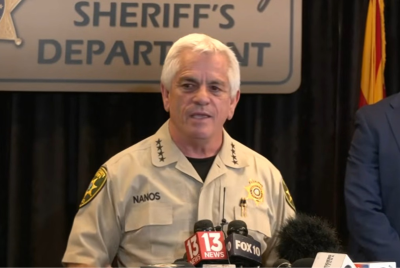
Pima County Sheriff Chris Nanos and his department now sit under a growing cloud of criticism from sections of the public following the case online. FBI Director Kash Patel has reportedly suggested that federal teams were not given enough operational freedom in the earliest phase, though the precise nature of that constraint has not been spelled out in statements so far. Officially, the investigation remains active, and authorities continue to say they are exploring every lead.
The brutal statistical backdrop does not offer much comfort. FBI records show more than 500,000 missing‑person reports filed annually in the United States. Most resolve quickly. The subset that involves suspected abductions is smaller but far more complex, draining resources and, too often, drifting into long‑term limbo.
Nancy Guthrie, at 84, does not fit the profile of a person likely to walk away voluntarily. Investigators have repeatedly said they believe she may have been taken against her will. Yet there is still no confirmation that she is alive or dead. With no body, no claimed ransom demand, and no public identification of a suspect, families are left with a void that official press conferences can never really fill.
Nothing in this case has been definitively resolved, and no suspect has been charged. Until that changes, all public theories remain speculative and should be treated with a degree of caution.
© Copyright IBTimes 2026. All rights reserved.
- Recommended For You