

Justin Bieber 2026 Coachella Performance Explained: Why Star Played Old YouTube Videos Instead Of Singing Live
Justin Bieber's Coachella throwback turned into a surreal reminder of what it costs an artist to sell off their own past.

Justin Bieber stunned fans at Coachella 2026 in California at the weekend when, instead of performing his biggest hits live, he sat behind a MacBook and played old YouTube videos of himself singing tracks such as 'Baby,' 'Favourite Girl,' 'Beauty and a Beat' and 'Never Say Never' despite reportedly being paid $10 million for the set.
Bieber sold his entire music catalogue in December 2022, handing over the rights to every song released before 31 September 2021 to Hipgnosis Songs Capital in a deal worth around $200 million (£162 million). That sale included publishing copyrights to his 290-song back catalogue and his share in the original master recordings. At the time, it looked like a straightforward mega-payout. At Coachella, it suddenly looked like a creative constraint.
Why Justin Bieber Turned To YouTube At Coachella
The new questions over Bieber's set began almost as soon as the familiar opening notes of 'Baby' rang out not from a live band, but from an old YouTube clip of a teenage Bieber projected on the festival screens. On stage, the 32-year-old sang along to fragments and hyped the crowd, but stopped short of delivering the songs in full.
According to the Daily Mail, the decision may not have been purely artistic. The paper claimed Bieber 'wasn't allowed' to perform his early hits live in full because he no longer owns the rights to that material after the 2022 sale. In other words, the YouTube workaround may have been a rights workaround.
On the face of it, the pattern fits. Songs from his newer albums, Swag and Swag II, released after the catalogue deal, were reportedly performed live and in full at Coachella. It was only the pre-2021 material that arrived via pre-existing YouTube footage of a younger Bieber.
Legally, catalogue deals are rarely that simple, and performance rights can be carved up in different ways. At this stage, though, the theory remains exactly that. Bieber has not confirmed that licensing restrictions forced him to lean on YouTube videos at Coachella, and no detailed contractual terms have been made public, so everything should be taken with a grain of salt.
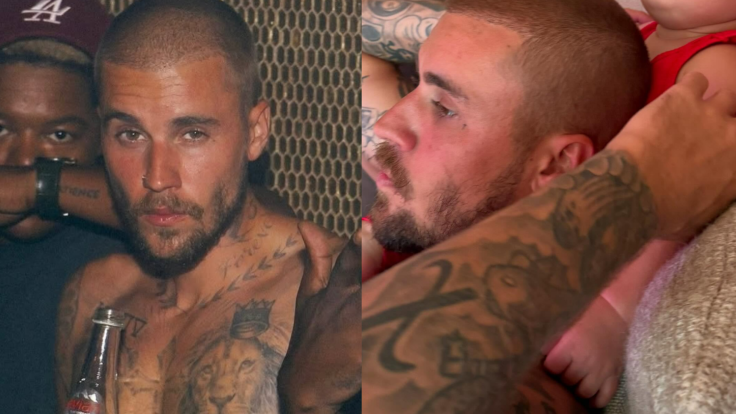
Money Troubles, A $200m Sale And A Very Expensive MacBook Set
The questions about Bieber's Coachella choices sit atop a separate, far more uncomfortable narrative about money.
In the documentary TMZ Investigates: What Happened to Bieber?, TMZ's executive producer, Harvey Levin, claimed the star did not cash out his music catalogue from a position of strength. Levin said Bieber 'had to sell his music catalogue because he was broke,' alleging that he was told by people on a call, including those on Bieber's side, that in 2022 the singer was on the verge of 'financial collapse.'
It is an extraordinary claim to attach to a performer who has long been seen as pop royalty. Levin further alleged that Scooter Braun, Bieber's manager at the time, advised the singer to hold off until January 2023 to complete the sale for a more favourable tax position, but that Bieber refused to wait. TMZ framed the move as urgent rather than strategic.

None of this has been acknowledged publicly by Bieber. Neither he nor his representatives has commented on the documentary's claims, on the tax-timing allegation involving Braun, or on whether the Coachella performance was shaped by rights he no longer controls. Without that, there is a thick fog over what is fact, what is informed speculation and what is simply convenient narrative.
What can be said with certainty is that Bieber exchanged long-term control of his early hits, the very songs that made him a global name, for a $200 million upfront payout. At Coachella, he then reportedly took home $10 million to DJ his own legacy from behind a laptop, half-singing over the ghosts of his teenage self.
For fans who grew up with those songs, the spectacle looked odd. It was loud, nostalgic and meticulously produced, but the absence of full live performances of 'Baby' and the rest felt like a missing limb. For the music industry, it looked uncomfortably like a live case study in what happens when an artist cashes in their past and then tries to revisit it on the biggest possible stage.
Nothing about the exact restrictions on his catalogue or the real reason for his Coachella set-up has been officially confirmed.
The unanswered question is whether Bieber's Coachella workaround will become his new normal when it comes to pre-2021 hits, or whether this was a one-off experiment in how far you can stretch nostalgia when the paperwork is no longer on your side.
© Copyright IBTimes 2026. All rights reserved.