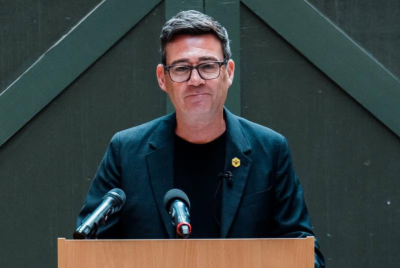
Andy Burnham at 97% to Become Prime Minister as Prediction Markets React to Starmer's Resignation
Andy Burnham leads prediction markets following Keir Starmer's resignation as UK Prime Minister
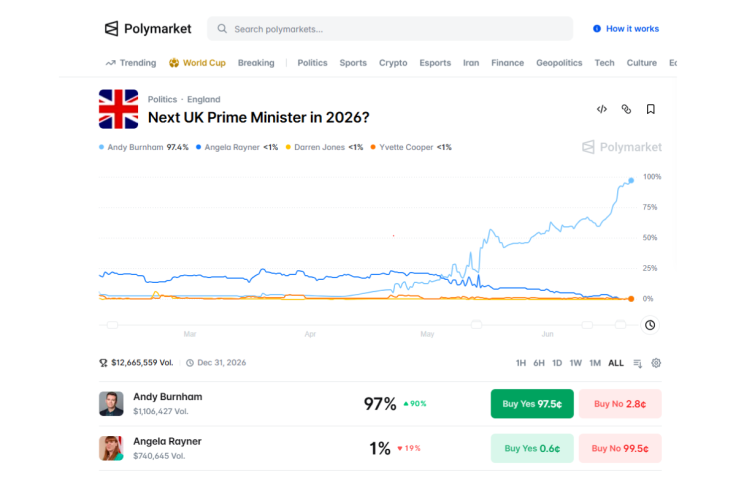
Prediction markets moved swiftly on Monday after Keir Starmer announced his resignation as British prime minister, with Andy Burnham surging to a 97 per cent probability of succeeding him on Polymarket, the world's largest prediction market platform. The 'Next UK Prime Minister in 2026?' market had drawn over $12 million (£9.45 million) in trading volume, with Burnham's odds climbing sharply in the hours following Starmer's televised statement outside Downing Street.
Speaking to reporters, Starmer said his party had asked 'whether I am best placed to lead us into the next general election,' adding: 'I have heard the answer of my parliamentary party to that question, and I accept that answer with good grace.' He confirmed he had informed King Charles III of his decision and would remain in post as caretaker until a new Labour leader is chosen.
Burnham Moves Quickly
Burnham confirmed his candidacy within hours of Starmer's announcement. In a post on X, he said Starmer's resignation 'marks the beginning of a transition and it is important that this process is conducted in an orderly and responsible way. I will put myself forward as part of this process.'
The move came just days after Burnham won the Makerfield by-election with a reported 54.8 per cent of the vote on 18 June 2026, securing a 20-point lead over the Reform UK candidate and clearing the final hurdle to mount a leadership challenge. He was sworn in as a Member of Parliament on the same morning Starmer delivered his resignation, arriving in London by train from Manchester to considerable media fanfare.
Streeting Steps Aside
The path to an uncontested leadership appeared to open further when former Health Secretary Wes Streeting, previously considered a likely challenger, announced he would not enter the race and instead backed Burnham. In a statement on 22 June 2026, Streeting said he was convinced Burnham could 'win the fight of our lives against the forces of nationalism.'
Starmer said nominations to replace him will open on 9 July and close when Parliament breaks for its summer recess on 16 July. If no challenger emerges, a new leader could be in place shortly after. The Eurasia Group, a political risk firm, predicted Burnham would take office on 18 or 19 July.
BREAKING: Former Manchester Mayor Andy Burnham projected to become the next prime minister of the U.K. following Keir Starmer's resignation.
— Polymarket (@Polymarket) June 22, 2026
97% chance. pic.twitter.com/CudE8ORGaQ
What Awaits at No 10
Despite the near-unanimous market confidence, analysts have cautioned that Burnham will inherit a deeply challenging political landscape. Political commentator Polly Toynbee said the new prime minister faces a difficult road ahead: 'The headwinds are enormous — heavy debt, very difficult to raise more tax, our public services are threadbare.' She added: 'For Labour, Burnham will be the last throw of the dice.'
Prediction market platform Kalshi similarly placed Burnham at a 97.3 per cent implied probability of becoming the next occupant of No 10, reflecting a rare convergence of market sentiment around a single outcome. Whether that confidence holds once the realities of governing take hold remains to be seen.
Burnham's expected ascent would make him Britain's seventh prime minister in a decade, a figure that speaks to the sustained political turbulence the country has endured since 2016. The speed at which prediction markets moved to near-certainty reflects not just confidence in Burnham personally, but widespread relief that a prolonged and destabilising leadership contest may be avoided. The nomination window opens on 9 July and closes on 16 July — if no challenger comes forward, a new leader could be confirmed before Parliament rises for the summer recess.
© Copyright IBTimes 2026. All rights reserved.
- Recommended For You