

Prince William Accused of Becoming a 'Celebrity Royal' Like Harry and Meghan After 'Pointless' Travis Kelce Podcast
Prince William's appearance on Travis Kelce's podcast sparks debate over whether he is adopting a 'celebrity royal' approach.
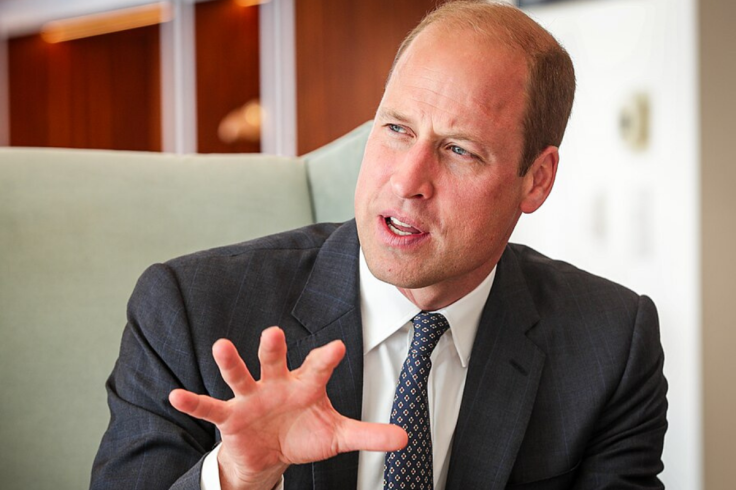
Prince William has been accused of drifting into 'celebrity royal' territory after appearing on Travis Kelce's New Heights podcast, a move that aired shortly before Kelce's high-profile wedding to Taylor Swift and has prompted questions about the future king's public role.
The Prince of Wales joined the American football star and his brother Jason Kelce for a roughly 30-minute conversation centred on sport, but critics, including a former royal insider, have questioned why he took part at all.
For context, William's media appearances have traditionally been tied to charitable campaigns or official engagements. His latest outing, however, stood apart. There was no clear patronage, initiative, or cause attached, just what listeners described as relaxed conversation and light-hearted exchange. That difference has become the story.
Prince William Podcast Appearance Sparks 'Celebrity Royal' Debate
Grant Harrold, who served as King Charles' butler for seven years and previously looked after both William and Prince Harry, was among those raising eyebrows. Speaking on behalf of OLBG, Harrold argued the podcast lacked purpose, a notable departure from established royal practice.
'This is similar to celebs going on chat shows for a general catch-up,' he said. 'William hasn't associated it with any charity, there is no real motive to it. This is different from anything the royals have done before. There is no point to it.'
That assessment cuts to the core of the criticism. Senior royals, particularly under Queen Elizabeth II, were expected to attach meaning to visibility. Public appearances were typically linked to diplomacy, philanthropy, or national messaging. Even informal moments tended to serve a broader institutional goal.
Harrold contrasted that legacy with what he sees as a shift underway. 'With everything the late queen did, there was always a point to it. This is just a bit of banter and humour for Prince William,' he said, adding that the approach signals movement 'from the royals always having a point to something more like becoming celebrities.'
Online reaction has reflected that divide. Some royal watchers praised William's ease and relatability, noting that podcast audiences skew younger and more global, precisely the demographic the monarchy struggles to reach.
Others were less convinced, questioning whether casual media appearances risk diluting the gravitas that has long underpinned the institution. One recurring sentiment across social platforms is simple enough: if everything becomes content, what remains distinctly royal?
Is Prince William Following Harry And Meghan's Path?
Harrold went further, drawing a direct comparison with Prince Harry and Meghan Markle, whose post-royal careers have leaned heavily into media and entertainment.
'I describe Harry and Meghan as 'celebrity royals,' and this is very much what William and Kate are also starting to do,' he said. 'This really goes to show that their approach is vastly different to anything we've seen before, and the transition is in full swing.'
It is a striking claim, not least because William has often been positioned as the counterweight to the Sussexes' media strategy. Yet the lines may be less rigid than they once appeared. Podcasts, social media, and cross-industry collaborations are now central to how public figures build influence, and the monarchy is not immune to that shift.
Harrold suggested this could reflect a longer-term recalibration rather than a one-off experiment. 'This could be what the royal family has to be in the future, a hybrid of celebrity and royal,' he said, warning that 'they've already lost a lot of the mystery' that once defined royal life.
That loss of mystique is not necessarily accidental. William has signalled, in various ways, a desire to modernise the monarchy, making it more accessible and more in step with contemporary culture. Still, accessibility comes with trade-offs. The more familiar a royal becomes, the harder it is to maintain the sense of distance that historically reinforced their symbolic role. It is a delicate balance, and not everyone thinks it is being handled well.
There is also a generational dimension. 'A lot of the traditionalists won't like this,' Harrold said. 'They will think this isn't how the late queen or King Charles would do things, but they are young and modern. They are much more aware of the power of podcasts and social media, and they use them to their advantage.'
William's connection to the Kelce brothers did not emerge in isolation. He has known Taylor Swift since 2013, when they famously joined Bon Jovi on stage at a charity gala to perform 'Livin' on a Prayer.'

More recently, he attended Swift's Eras Tour concert in London in 2024 with Prince George and Princess Charlotte, with backstage photos shared widely online. Those moments, while informal, were still anchored in public-facing events. The podcast, by contrast, felt different, less structured, more like pure exposure.
And that is the tension now sitting at the heart of the debate. Is this smart adaptation or a slow drift into something else entirely? The monarchy has survived by evolving, but it has also survived by knowing where to draw the line. Where that line sits in 2026 is, perhaps, less clear than it used to be.
© Copyright IBTimes 2026. All rights reserved.