'Tone-Deaf' Trump Praises Precision Of Tomahawk Missiles Following Deadly Strike On Iranian Girls' School That Killed Hundreds
Report finds the US was at fault.

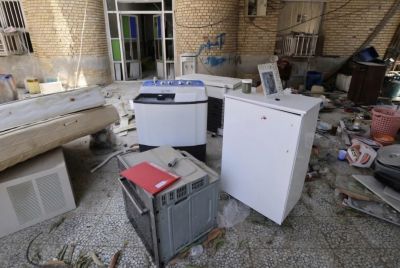
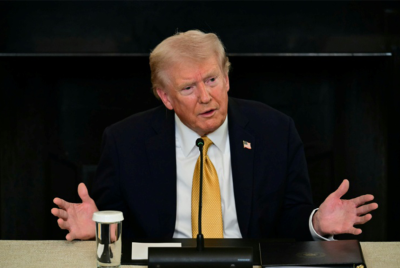
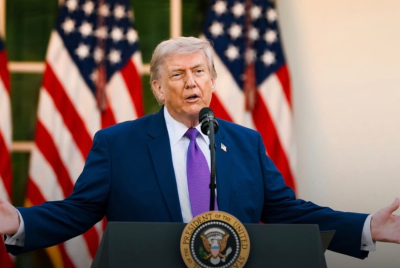
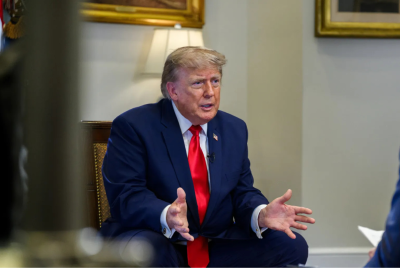
On Monday Donald Trump said that every Tomahawk missile fired 'hit perfectly' even though a report found that the US is at fault for the strike on an elementary school that killed 175 people; most of them children.
Trump Denies Striking the School
'In my opinion, based on what I've seen, that was done by Iran,' Mr Trump told reporters on Air Force One on 10 March. 'They're very inaccurate, as you know, with their munitions. They have no accuracy whatsoever. It was done by Iran.'
Defence Secretary Pete Hegseth was asked by the BBC on 4 March about the strike and said: 'All I can say is that we're investigating that. We, of course, never target civilian targets.'
Republican Senator John Kennedy, on the other hand, admitted the US was at fault: 'Other countries do that sort of thing intentionally, like Russia. We would never do that intentionally. I'm sorry. I'm just so sorry it happened. It was a mistake.'
Report Finds US at Fault
An initial report from the military said that the US was at fault for the school strike and not Iran as the president suggested.
'Officers at U.S. Central Command created the target coordinates for the strike using outdated data provided by the Defense Intelligence Agency, people briefed on the investigation said,' according to The New York Times.
Under International Humanitarian Law (IHL), 'the general rule of precautionary measures—which the US accepts as custom—requires combatants to take "constant care" to spare the civilian population, civilians, and civilian objects. While the US has not ratified the instrument, Articles 57(1) and 57(2)(a) of the First Additional Protocol to the Geneva Conventions are also understood as customary law and are therefore binding on the United States,' according to Human Rights Watch.
According to the Department of War's own Law of War Manual: '[A]n object dedicated to civilian purposes (such as a place of worship, a house or other dwelling, or a civilian school) is a civilian object and may not be made the object of attack, unless the available information evaluated in good faith indicates it is a military objective in the circumstances,' according to Human Rights Watch.
For the strike to be officially labeled a war crime 'a court would need to find both that it was committed with intent (either willful or reckless) and that it infringes a rule protecting important values and involves grave consequences for the victim,' according to Human Rights Watch.
The school was directly adjacent to buildings that form the local Islamic Revolutionary Guard Corps (IRGC) naval barracks and support buildings.
Former Military Officials Speak Out
'The current US position strikingly departs from the standard response,' said Lt Col Rachel E VanLandingham, a retired Judge Advocate General in the US Air Force and former senior legal adviser at US Central Command during the wars in Iraq and Afghanistan, speaking to the BBC
'Administrations in the past at least demonstrated fidelity and a commitment to the law of war,' said VanLandingham, who argued that what was 'missing' from the administration's statements was a commitment to accountability and, 'importantly, to ensure this doesn't happen again.'
'But this is a case where... it's unusually opaque in that I can tell from the situation it's actually not that complicated,' the former official, who asked not to be identified due to the sensitivity of the subject matter, told the BBC.
'Normally, the Pentagon would take immediate, or relatively fast, responsibility and then probably require a longer period of time to provide all the details, so to me it's problematic,' the former official continued.
© Copyright IBTimes 2026. All rights reserved.
- Recommended For You