

From Seizing Voting Machines to Troops at Polls: Lawfare Warns of Donald Trump's Alleged 2026 Playbook
Legal scholars warn that Trump and his allies are openly discussing a 2026 midterm 'playbook' that could drag the US military into election disputes.
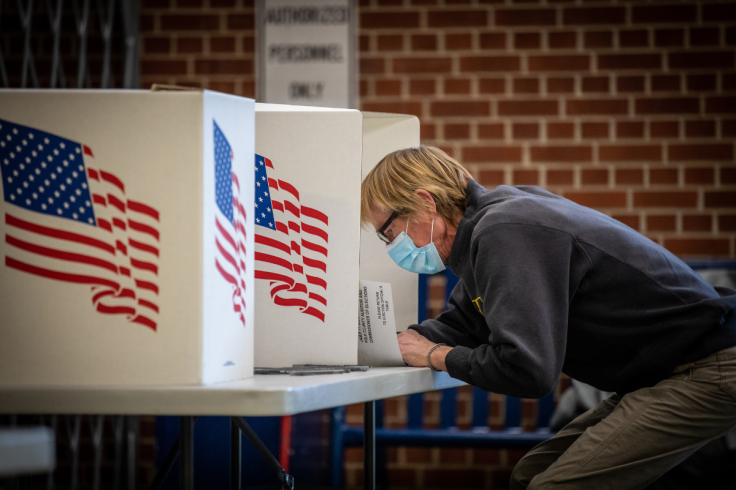
Donald Trump is reportedly eyeing a provocative 2026 midterm elections strategy involving the US military, prompting legal scholars to warn that the deployment of troops at polling stations could undermine democratic norms. A detailed analysis suggests that while the US Constitution provides robust safeguards, executive overreach remains a significant concern for the upcoming vote.
In a detailed examination of election and military law, the legal blog Lawfare argued that Trump and his allies have openly floated ideas that would drag troops into the heart of domestic politics. The warning centres on the 2026 midterms in particular, which Republicans are described as quietly panicking about losing. While any such move would collide with more than a century of legal precedent, experts say it cannot simply be dismissed as wild talk. For those who thought the battle over 2020 was the end of it, the alleged Trump 2026 playbook suggests otherwise.
How Trump's Own Words Fuel Fears Of A 2026 Playbook
In their analysis, Lawfare's Natalie K Orpett, Molly Roberts and Loren Voss pointed to Trump's own words this year as an early indicator of intent. 'Just this year, President Trump said he regrets that he did not order the National Guard to seize voting machines after the 2020 elections,' they wrote.
According to Lawfare, Trump loyalists have spoken openly about going much further. The trio highlighted a comment from Steve Bannon, who urged Trump to 'call up the 82nd and 101st Airborne' in 2026 to 'get around every poll' and, in his telling, ensure only citizens were voting.
Another figure, Secretary of Defence Pete Hegseth, was cited as dodging a direct question about whether he would refuse an order to deploy troops to polling places during the midterms.
Instead, Hegseth 'avoided answering, and falsely claimed that troops were deployed to polling places in 15 states under Joe Biden,' Lawfare reported.
How Lawfare Sees Trump's 2026 Military Playbook
Lawfare stresses that the US Constitution was built around state control of elections, not presidential micromanagement backed by soldiers.
The scholars noted that 'the Constitution mostly reserves to the states the authority to administer elections, with a role for Congress', an arrangement anchored in what is known as the Elections Clause. On paper, it looks straightforward. In practice, they say, it leaves gaps a 'sufficiently creative person' could try to exploit.
Lawfare put it this way. The Elections Clause defines the states' power to 'prescribe' the 'Times, Places and Manner of holding Elections' and gives Congress the power to 'make or alter such Regulations.'
It says nothing explicit about other forms of interference that might affect an election, such as 'ensuring security.' The absence of a clear line, they argue, could tempt a president intent on blurring one.
Crucially, though, the Lawfare authors underline that 'neither the Constitution nor any founding-era law affirmatively authorises the president to involve the military in U.S. elections.'
The handful of statutes that touch the issue 'prohibit it in most circumstances.'
The Posse Comitatus Act And The Limits On Troops At Polls
The authors walked through how US law evolved to keep the military away from everyday domestic law enforcement. They traced the history from the founding era through the early republic, the Jacksonian years and the fallout from the Civil War and Reconstruction, before landing on a key statute that still shapes the debate, the Posse Comitatus Act.
'The Posse Comitatus Act (18 U.S.C. § 1385), enacted in 1878, ensured that the military could be used for law enforcement only in a set of drastic situations explicitly defined in law,' Lawfare wrote.
By the late 1880s, they added, 'all major cities had civilian police forces.' The clear intent was to stop presidents from casually using federal troops to police domestic disputes.
Today, Lawfare said, the Posse Comitatus Act is 'widely regarded as the critical limitation on domestic military deployment.'
The current statute bars using 'any part of the Army, Navy, Marine Corps, Air Force, or Space Force "as a posse comitatus or otherwise to execute the laws".'
The term 'posse comitatus', they explained, literally means the 'power of the county' and, in legal terms, refers to groups of people called up by officials such as sheriffs to enforce the law or maintain order. The act exists to ensure that the role is filled by civilians, not troops.
The rule is not absolute. The scholars acknowledged that the act itself contains exceptions, including the Insurrection Act, which can allow more direct domestic military involvement.
Lawfare argued that Congress has gone even further when it comes to elections, specifically. The military is barred from following illegal orders to interfere with domestic elections, they wrote, describing the statutes as an 'affirmative statement of the law' and evidence that 'Congress gives elections a special status.'
Lawmakers apparently concluded that the standard limits on using troops inside the country were not enough, so they passed three separate laws to shield elections more directly.
Those laws have held for more than 160 years and across about 80 election cycles, Lawfare noted.
According to the blog, the Justice Manual sets out particular procedures for enforcing one of the key provisions, 18 USC § 592, and a 2018 Defence Department directive on 'Defense Support of Civil Authorities' forbids Defence Department personnel and National Guard forces in a specific legal status from 'conduct[ing] operations at polling places' and tells them to steer clear of activities that resemble those banned by 18 USC §§ 592-594.
'Chilling Effect' Fears If Trump Sends Troops To 2026 Polls
Legal concerns are only one part of the alleged Trump 2026 playbook. Voting rights advocates are already focused on how even the threat of troops at polling stations could warp turnout.
Speaking in June, Pooja Chaudhuri, senior counsel and deputy legal director at Democracy Defenders Fund, said that simply talking about military or immigration authorities around voting sites can have a serious 'chilling effect.'
Chaudhuri, who specialises in voting rights and election law litigation and advocacy, said: 'I think there are two things to consider. One is that the election is made up of voters, and so the outcome depends on people turning out to the polls and voting. The problem is ... the chilling effect on voters.'
She pointed to scare tactics that have already surfaced in recent years, including rumours that immigration enforcement officers might be sent to polling places and last-minute changes to postal voting rules.
'When voters hear that ICE may be deployed to the polls, that mail-in voting rules are changing close to the election, a lot of voters might say, "I'm just not going to go out and vote,"' Chaudhuri said.
That hesitation, she suggested, could be especially stark in mixed-status families, where US citizens with non-citizen relatives might decide: 'I'm not going to vote.'
'No Respect For Democratic Norms': What Critics Say Is Really Driving Trump's 2026 Strategy
Democracy advocates have been watching Trump's broader moves around elections with mounting suspicion, long before Lawfare set out its reading of the law. They argue that the alleged 2026 playbook, from talk of seizing voting machines to fantasies of elite units 'around every poll', fits a familiar pattern.
Dan Vicuña, senior policy director for voting and fair representation at Common Cause, a non-profit focused on government accountability, described the trend as an effort to pre-cook the midterm results.
'What they all add up to is a desire to avoid any accountability to the voters in the midterm elections, to ensure, to preordain the outcome of a midterm that he thinks is going to go badly for him,' Vicuña said.
He connected the current warnings to Trump's past behaviour, referring to 'the Big Lie of the 2020 election' and the encouragement of 'a violent revolt to overthrow a free and fair election.'
In his view, this shows Trump 'has no respect for democratic norms, for the voice of the people.'
Instead, Vicuña argued, 'This is entirely about his own power and his own ego. He will even invest in protecting that ego and protecting his power at the expense of the needs of the public. People are suffering with high gas prices and affordability issues, and he does not care. All that matters is protecting his power, and he has no interest in whether he does that through democratic means.'
Vicuña added that the overall effect of these tactics, if they are pursued in 2026, would be to make sure Trump's party 'stays in power' and that his scope 'to attack vulnerable communities' remains 'intact.'
The concern did not appear out of thin air. It can be recalled that Trump has repeatedly revisited the 2020 defeat, often describing steps he now says he wishes he had taken then. These comments have become raw material for legal scholars trying to stress-test the US system against a second Trump term and a new round of elections. The 2026 midterms, sitting halfway through a potential presidency and already framed by his allies as a fight for survival, are now a focal point.
© Copyright IBTimes 2026. All rights reserved.