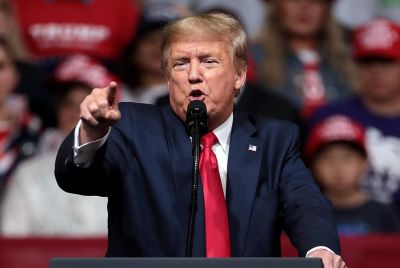
Trump Tells His Own Party 'I'm the President and You're Not' as Republicans Bristle at His Latest Moves
Trump's recent actions spark internal GOP conflict, testing party loyalty before upcoming elections.

Donald Trump's latest clash with congressional Republicans has turned a familiar boast of presidential power into a warning sign for party discipline before the 2026 midterms.
The line at the centre of the dispute, 'I'm the president and you're not,' was reported by The Wall Street Journal, which attributed it to people familiar with Trump's recent conversations with political allies who offered strategy advice.
The private remark cannot be independently verified from public transcripts, but the surrounding record is unusually well documented. Public bills, congressional action logs, and named Republican criticism show a president testing how much resistance his own party will tolerate.
A Private Retort Meets Public Frustration
According to the WSJ report, Trump has used the phrase when allies and advisers raised objections to recent decisions on Iran, intelligence leadership, and the party's midterm posture.
The White House defended his style through spokeswoman Olivia Wales, who told the Journal that 'No President has worked harder or delivered more than President Trump' and pointed to immigration, the economy, and national security. Because the remark came from private conversations, it remains credible but externally unverifiable.
The most visible anger came after Trump backed an interim understanding with Iran that critics said softened US demands after months of war. Senator Bill Cassidy of Louisiana said in a public statement reported by The Guardian that 'Reagan is rolling over in his grave' and called the agreement 'the worst foreign policy blunder in decades.'
Senator Roger Wicker of Mississippi, chair of the Senate Armed Services Committee, said the memorandum 'negotiates away the victories of Operation Epic Fury' and was 'completely out of step' with Trump's stated goals, according to a report that quoted his statement.

Trump's response sharpened the split rather than calming it. In a Truth Social post quoted by The Times, he dismissed critics who said he had not been tough enough on Iran as 'jealous, bad people, or stupid' while citing the stock market and falling oil prices.
Vice President JD Vance urged Republicans to trust the president, saying at a White House briefing quoted by the Journal that 'the idea that he is going to strike a deal that's been bad for the American people' was 'preposterous.'
Surveillance Powers Become A Bargaining Chip
The fight over the Foreign Intelligence Surveillance Act has given the dispute a concrete legislative shape. Congress's record for the Reforming Intelligence and Securing America Act shows that Public Law No. 118-49 reauthorised Title VII of FISA for two years on 20 April 2024.
The Congressional Research Service summary says Section 702 covers the acquisition of communications of non-US persons believed to be abroad, while US person information may be incidentally acquired and later queried under defined circumstances.
That authority has now become entangled with Trump's election agenda. The Guardian reported that the House failed on 11 June 2026 to pass a short-term extension of Section 702, after Democratic opposition and Republican divisions over Trump's decision to install housing official Bill Pulte as acting director of national intelligence. Trump then said he would not support FISA renewal unless it moved with the SAVE America Act, a voting measure that has passed the House but stalled in the Senate.
The SAVE Act is not an abstract slogan. The H.R. 22 record on Congress.gov shows the bill passed the House on 10 April 2025 by 220 to 208 and was received in the Senate the same day.
Its text would bar states from processing a federal voter registration application unless the applicant presented 'documentary proof of United States citizenship.' That gives Trump a clear policy demand, but Senate math gives Republican leaders a clear obstacle.
Intelligence Nomination Exposes Senate Limits
The intelligence fight widened when Trump delayed Jay Clayton's path to confirmation as director of national intelligence. A Guardian account of the 17 June 2026 dispute reported that Trump posted that 'we are cancelling the Senate Hearing RE: DNI today,' although Senate committees control their own hearings.
Senator Tom Cotton, the Republican chair of the Intelligence Committee, first said the hearing would proceed unless Trump directed Clayton not to appear or withdrew the nomination, then said the hearing had been 'unfortunately postponed' after Trump intervened.
The manoeuvre left Republican senators managing two sensitivities at once. They had to respond to concern over Pulte, whose background is housing finance rather than intelligence, while avoiding a public breach with a president who still dominates the party's voter base.
It also kept pressure on Senate Majority Leader John Thune, who has faced Trump's frustration over the stalled voter legislation and the refusal of Senate rules to yield to presidential preference.
The sequence matters because it shows how Trump is linking unrelated decisions into one power test. Iran diplomacy, FISA reauthorisation, the SAVE Act, and a Cabinet-level intelligence nomination have become one argument over whether congressional Republicans will follow the president when they see political risk.
Trump has often thrived by forcing allies to choose between private concern and public loyalty, but the 2026 version carries legislative costs.
© Copyright IBTimes 2026. All rights reserved.
- Recommended For You