GOP Insider Warns Trump's 'Young Henchmen' Are Plotting Permanent Power: 'The Deep State Firings Have Begun'
Conservative commentator William Kristol urges Democrats and dissenting conservatives to use every lever of power to resist what he calls a 'maximum authoritarian threat.'
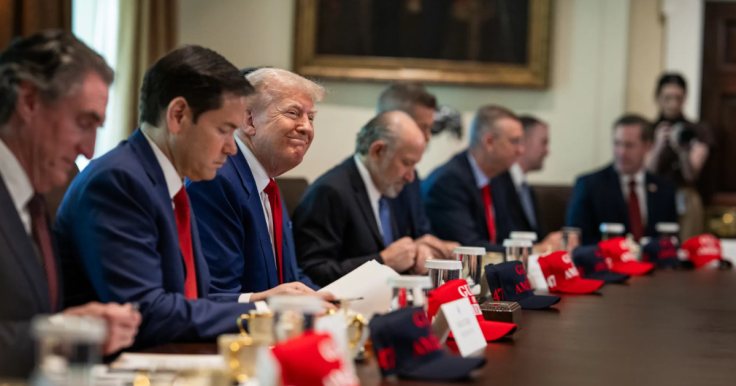
President Donald Trump's increasingly 'erratic behaviour' and a cadre of 'young henchmen' inside his administration are fuelling what one veteran Republican strategist describes as a drive for 'power without limits' in Washington, according to a stark fresh warning from conservative commentator William Kristol.
Writing about Trump, now 80, Kristol argues that while the President himself may be too old and distracted to engineer a full authoritarian takeover, the younger loyalists around him are already moving fast to reshape the US government and purge dissent.
Trump's 'Impending Mortality' And The Young Henchmen
Kristol paints a portrait of Trump that will sound familiar to anyone who has watched the past few years of his presidency. The President, he writes, has 'lost a step.' He is 'even more willful and erratic than he once was.' His 'self-indulgence and narcissism are even more out of control.'
The sense that time is running out, Kristol adds, has made Trump 'even more unhinged than ever.'
The twist in Kristol's argument is that this decline does not make Trump less dangerous. Trump's instincts, he says, are still authoritarian, still hostile to scrutiny, still contemptuous of a peaceful transfer of power.
What has changed is that he has surrounded himself with younger men who are 'hale and hungry', and who appear fully committed to hard-wiring those instincts into the machinery of the state.
Kristol lists them. Acting director of national intelligence Bill Pulte is 38 years old. White House deputy chief of staff Stephen Miller is 40. Secretary of Defence Pete Hegseth, Secretary of Homeland Security Markwayne Mullin and FBI director Kash Patel are all 46. Office of Management and Budget director Russell Vought is 50. Acting attorney general Todd Blanche is 51.
These are not, in Kristol's telling, bored caretakers marking time to retirement. They are 'young men in a hurry to reshape our government and our country.'
Deep State Firings And A Purge Mentality
The most vivid example, in Kristol's view, is Pulte at the Office of the Director of National Intelligence. Trump installed him in an acting capacity, fully aware that a permanent confirmation would face resistance, even from some Republicans.
According to Kristol, that never really mattered. Pulte's core mission was not to build trust with Congress; it was to execute a rapid purge of officials deemed insufficiently loyal to the president.
On Monday, a source said that 'the deep state firings have begun', describing the removal of career intelligence staff and senior figures seen as obstacles.
Kristol argues that Pulte is now 'following in the footsteps' of Hegseth at the Pentagon, Blanche at the Department of Justice and Patel at the FBI, each using their agencies' personnel systems to weed out internal critics and install ideological allies.
Looking across these patterns, Kristol warns that the United States is 'entering a period of maximum authoritarian threat, one that makes Watergate look like child's play.'
In his estimate, that period will last for the next two and a half years, while Trump and his lieutenants are still in office and while norms around independent law enforcement and non-partisan intelligence work are being aggressively tested.
There is, at this stage, no independent government tally of the total number of firings or reassignments framed as 'deep state' house-cleaning, and many of the internal decisions remain shielded by confidentiality rules.
IBTimes UK cannot independently verify all of Kristol's claims about the intent behind each staffing change.
Why Kristol Says The Threat Outlasts Trump
On paper, Kristol admits, Trump himself might not have 'the patience to carry out a thoroughgoing subversion of the rule of law' or the institutional capacity to pull off 'a full-scale authoritarian takeover of the US government.' But, he adds pointedly, 'there's no doubt he would like to see such a takeover.'
The real concern lies with the younger cohort he calls Trump's 'henchmen.'
According to Kristol, they share several traits. They are 'as determined as the old man they work for not to hand their positions over to anyone other than fellow loyalists after their terms in office, if they intend to leave office at all.' They are equally unwilling, he says, 'to step aside from their powers and allow political opponents to look into what they have done.' And they 'aren't committed to the peaceful and democratic transfer of power after an election, or to the political norms or lawful procedures of a liberal democracy.'
Kristol writes that 'none of these men should be in a position of power and authority in the government of the United States.'
Yet, he notes, there they are, 'hiring and firing at will, abusing their authority and politicising their agencies in unprecedented ways.'
No agency has publicly accepted Kristol's characterisation of their internal moves as 'purges', and Trump allies typically counter that they are simply clearing out a hostile bureaucracy and implementing the policies they were elected to pursue.
A Republican Veteran Urges Resistance To Trump's Young Henchmen
Faced with what he sees as a rolling attempt to lock in one-party control, Kristol is now urging Democrats, civil servants and constitutional conservatives to act less politely and more aggressively.
He calls on Trump's political opponents to use 'all means at their power' to slow or block the agenda of the president and his young henchmen.
He suggests tactics such as holding up unrelated legislation, stalling normally routine appropriations bills and encouraging dissent and whistleblowing from within the executive branch.
William Kristol is not a liberal alarmist parachuting in from the sidelines. He is a lifelong Republican operative, a former chief of staff to Vice-President Dan Quayle and now editor at large of The Bulwark.
Kristol's warning arrives amid a series of personnel moves and acting appointments that critics say concentrate power in the hands of loyalists.
He lists a string of officials in their late 30s to early 50s — including the acting director of national intelligence and senior White House aides — and argues these younger figures combine zeal with what he calls a willingness to flout norms, making the threat more durable than a single president's temperament.
© Copyright IBTimes 2026. All rights reserved.
- Recommended For You