From Tariffs to Birthright Citizenship, Trump's Own Court Appointees Rule Against Him in 6-3 Split
Supreme court's 6-3 ruling upholds birthright citizenship, challenges Trump's executive power
The US Supreme Court struck down Donald Trump's executive order on birthright citizenship on Tuesday in a 6-3 ruling that leaves him with no viable path to reverse through executive action alone. It was the second time in four months that the court handed Trump a defining defeat in a 6-3 split. And on both occasions, Chief Justice John Roberts wrote the majority opinion.
The pattern makes Tuesday's ruling more than a routine legal setback. The court carries a 6-3 conservative majority that includes three justices Trump personally nominated: Neil Gorsuch, Brett Kavanaugh and Amy Coney Barrett. Barrett sided against Trump in both rulings. Gorsuch joined the majority against the tariffs in February but dissented on birthright citizenship on Tuesday. Kavanaugh dissented on the tariffs but joined the majority on birthright citizenship, each of Trump's own picks ruling against at least one of his signature policies.
The February Blow: Tariffs Struck Down
The first rupture came on 20 February 2026, when the court ruled 6-3 in Learning Resources, Inc. v Trump that the International Emergency Economic Powers Act, the legal basis Trump used for his sweeping 'Liberation Day' tariffs, does not grant the president the authority to impose tariffs.
Roberts was direct in his majority opinion. 'Based on two words separated by 16 others in IEEPA — "regulate" and "importation" — the President asserts the independent power to impose tariffs on imports from any country, of any product, at any rate, for any amount of time,' he wrote. 'Those words cannot bear such weight.' He added that 'IEEPA contains no reference to tariffs or duties' and that 'until now no President has read IEEPA to confer such power.'
The Tax Foundation estimated the struck-down IEEPA tariffs would have generated $1.4 trillion (£1.09 trillion) in revenue between 2026 and 2035. All tariffs imposed under the legislation were terminated by 24 February 2026 following the ruling.
Tuesday's Ruling: Birthright Citizenship Upheld
Tuesday's decision in Trump v Barbara addressed the executive order Trump signed on the first day of his second term in January 2025, which sought to strip birthright citizenship from children born to undocumented migrants or those on temporary visas.
Roberts again anchored the majority opinion in constitutional history, citing the court's own 1898 ruling in United States v Wong Kim Ark. 'Citizenship, then and now, was the right to have rights — to freely participate in our political community,' he wrote. 'The Framers of the Fourteenth Amendment extended that promise to "every free-born person in this land." We keep that promise today.'
Kavanaugh joined the majority but diverged on reasoning. 'In my view, the Executive Order does not violate the Fourteenth Amendment,' he wrote. He argued instead that creating new exceptions to birthright citizenship is a matter for Congress, not the presidency.
Justices Thomas, Alito, and Gorsuch dissented. Alito called Tuesday's ruling 'one of the most important decisions in the history of the Court,' adding: 'In my judgment, the Court has made a serious mistake.' He argued the decision hands citizenship to what he termed 'birth tourists, women who come here solely for the purpose of giving birth to a child and then promptly return home.'
Trump Pivots to Congress
Trump had telegraphed his expected defeat before Tuesday's ruling. In a Truth Social post in May, he wrote that 'a negative ruling on Birthright Citizenship, on top of the recent Supreme Court Tariff catastrophe, is not Economically sustainable for the United States of America.'
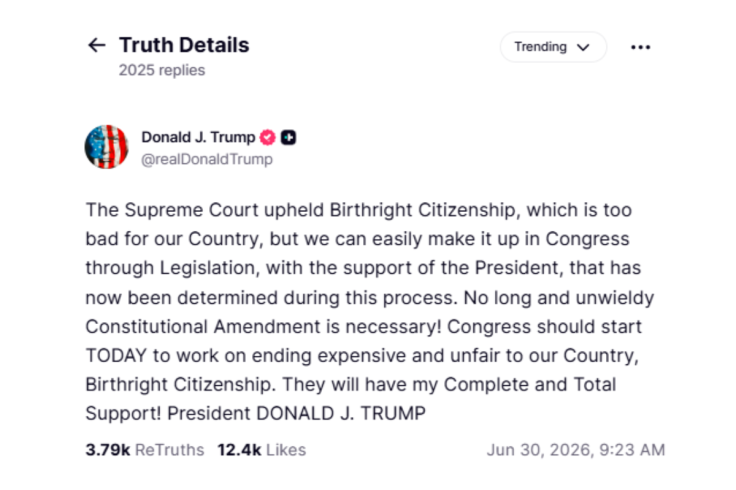
After the ruling, he redirected to Congress. 'The Supreme Court upheld Birthright Citizenship, which is too bad for our Country, but we can easily make it up in Congress through Legislation,' he wrote. 'No long and unwieldy Constitutional Amendment is necessary! Congress should start TODAY to work on ending expensive and unfair to our Country, Birthright Citizenship. They will have my Complete and Total Support!'
House Speaker Mike Johnson said he was 'disappointed,' though acknowledged birthright citizenship 'has been grossly abused in recent years.'
Trump's birthright order had never come into force, blocked by lower courts almost immediately after he signed it. Research by the Migration Policy Institute and Penn State's Population Research Institute estimated that approximately 255,000 children born in the US each year would have been affected.
Amending the Constitution — the only remaining route to permanently reverse either ruling's constitutional logic — requires a two-thirds majority in both chambers of Congress, a threshold achieved only 27 times in American history.
© Copyright IBTimes 2026. All rights reserved.
- Recommended For You