

The Death of Anonymous Browsing? Trump's AI Deal Could Force Millions to Prove Their Identity Just to Browse Online
The measures face sharp resistance from free-speech groups who argue it hands FTC power to crush opposition

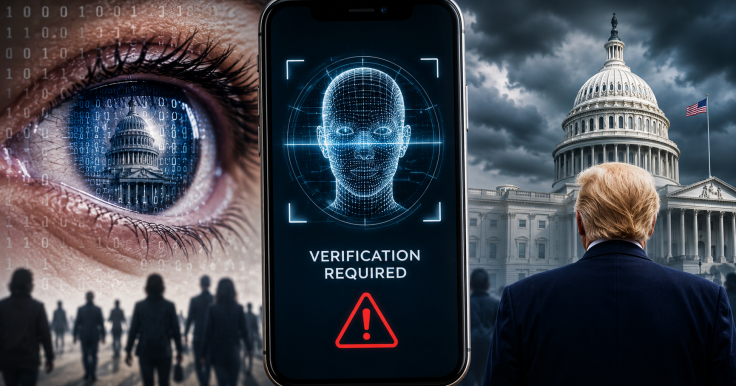
The days of browsing the internet anonymously could be numbered.
Millions of Americans may soon have to prove their age before accessing parts of the web under a controversial White House-backed plan that critics say would dramatically expand government influence over online activity. While supporters insist the measures are designed to protect children, opponents warn they could fundamentally change the internet as we know it and make private browsing a thing of the past.
The White House Plan for National Internet Constraints
American internet users face new federal constraints on their online speech under a developing agreement between Congress and the White House.
Axios reports that the Trump administration is hammering out a grand bargain with leading senators to advance a massive piece of legislation. Under the terms of the deal, individual states would lose their power to regulate artificial intelligence for three years, clearing the way for sweeping national restrictions on digital speech.
There has already been intense discussion surrounding the Trump administration's active campaign to strip individual states of their authority to regulate artificial intelligence. White House officials and their allies consistently pitch these measures as vital for 'safety' and 'national security'.
However, the timeline tells a different story, unfolding precisely as progressive state leaders attempt to curb the construction of massive AI data hubs and legally penalise technology firms for any damage their models inflict.
The High-Stakes Trade-Off for Age Verification Mandates
What makes this arrangement so underhanded is the fundamental compromise driving it.
Axios notes that a group of federal legislators, led by Republican Marsha Blackburn, are effectively giving up their authority to oversee artificial intelligence. In return, they are demanding the passage of three national censorship measures: the Kids Online Safety Act, the NO FAKES Act and a nationwide requirement for age verification.
Although the language used in these three pieces of legislation suggests reasonable digital oversight, campaigners argue they would establish a sweeping system of suppression that directly undermines democratic principles.
Conservative Backlash Against Sweeping Digital Oversight
In a sharp critique, the First Amendment organisation Foundation for Individual Rights and Expression (FIRE) cautions that 'taken together, these bills would fundamentally change the internet as we know it'.
The intervention is particularly notable because FIRE receives financial backing from conservative private groups linked to billionaire Charles Koch, highlighting how Donald Trump is clashing directly with influential figures within the American political establishment.
How New FTC Powers Could Restrict Everyday Downloads
For instance, the Kids Online Safety Act (KOSA) would compel major social media firms to curb legal expression in accordance with guidelines set by the Federal Trade Commission.
FIRE objects that this approach gives Washington excessive authority to penalise networks such as Meta for their shortcomings — an intervention that many observers would argue is already long overdue.
Nevertheless, because a tiny handful of conglomerates control the vast majority of web hosting and social platforms, KOSA would hand the Trump-managed FTC significant leverage to shape the internet to its liking.
To understand the sheer scale of this authority, monitoring a single platform such as Meta's Instagram would directly affect the lives of the 71 per cent of Americans who are active on the app.
The Death of Anonymous Browsing and Online Freedom
In short, it is a devastatingly powerful weapon.
According to a report by Futurism, everything comes down to whose hand is on the trigger. Futurism argues that if Washington succeeds in pushing KOSA through, browsing the web without tracking or tracing could become a thing of the past, while simultaneously handing Trump the perfect tool to hunt down and outlaw left-wing political opponents across the country.
The survival of this deal hinges entirely on whether the Trump administration can pull off enough political horse-trading to win over Capitol Hill.
Yet the situation highlights a deeply frustrating paradox in how the US approaches technology. While the public is practically begging for tighter guardrails on AI, the reality of the current administration means the supposed fix could ultimately prove far more dangerous than the problem itself.
© Copyright IBTimes 2026. All rights reserved.