

'The Great Sync Up': Women Are Convinced Something Happened the Night Lindsey Graham Died
A Threads post ignites discussion on the link between menstrual cycles, astrology, and cosmic events.
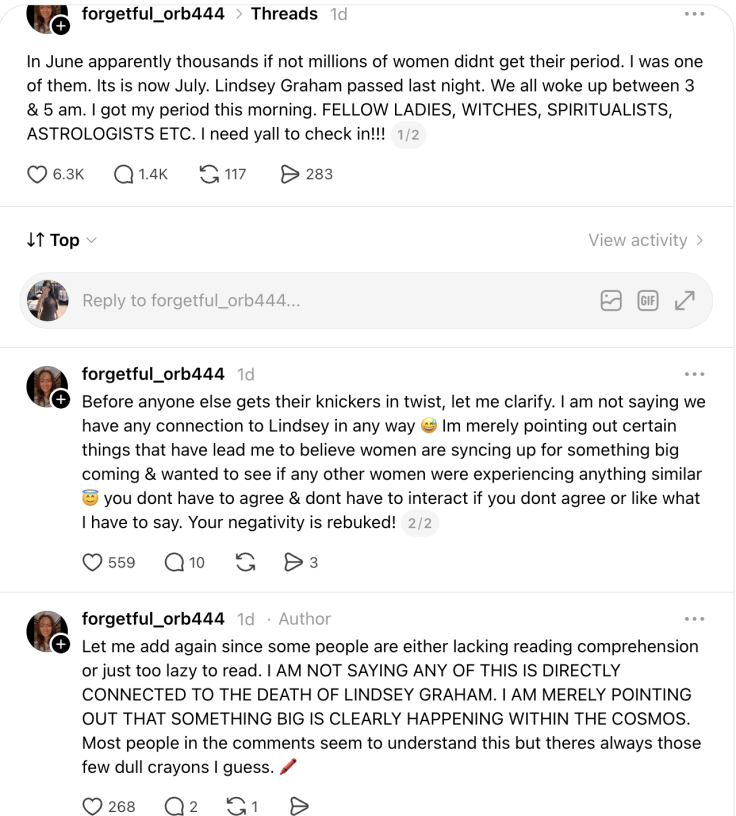
A single Threads post has pulled thousands of women into a debate about coincidence, biology and the cosmos. The post, from user @forgetful_orb444, describes waking between 03:00 and 05:00 on the night Senator Lindsey Graham died and getting her period that same morning, after missing it entirely in June.
She frames it not as a claim about Graham himself, but as evidence that 'something big is clearly happening within the cosmos.' The post has drawn hundreds of replies from women reporting similar timing, alongside pointed pushback from readers unconvinced that any of it is more than chance.
What The Viral Post Actually Says
The Threads user is explicit that she is not proposing a direct link to Graham, who died in the early hours of 12 July 2026. 'I am not saying we have any connection to Lindsey in any way,' she wrote, adding a follow-up clarification: 'I AM NOT SAYING ANY OF THIS IS DIRECTLY CONNECTED TO THE DEATH OF LINDSEY GRAHAM.'
Her claim, instead, is that his death and the reported wave of periods arriving that same night are two visible symptoms of one larger, unspecified shift, an argument she addresses to 'fellow ladies, witches, spiritualists, astrologists' rather than to scientists.
The post follows weeks of similar chatter that began in June, when thousands of women online compared notes on periods that arrived late, skipped entirely, or came twice in one month. That earlier wave, often called 'the great sync up' by participants, produced no confirmed data from menstrual tracking platforms and was widely attributed by commentators to selection bias: the tendency for people who experienced something to comment while those who didn't simply scroll past.
The Moon-Period Myth, and What the Astrological Calendar Actually Shows
The belief that menstrual cycles are tied to lunar phases is centuries old, rooted partly in the fact that the words 'menstruation' and 'month' share Latin and Greek roots referencing the moon. A frequently cited 1986 survey found that roughly 28% of 826 women reported bleeding during the new moon phase, a figure folk-astrology writers still lean on despite the coincidence that both an average lunar month and an average menstrual cycle run close to 28 to 30 days.
The astrological calendar for July 2026 does contain real, verifiable events that some commentators have folded into this narrative. Astrologer Grace McGrade, writing for Dazed, noted that Mercury has been retrograde in Cancer, the sign ruled by the moon and associated with emotional sensitivity and cyclical rhythms, since late June and into 23 July, a transit she described as bringing 'delays, miscommunications' and a moody, clingy energy.
McGrade also pointed to a rare alignment of Pluto, Neptune, Uranus and Jupiter on 18 July, which the late French astrologer André Barbault identified as the most important celestial event of the 21st century, marking the start of a new cycle of collective transition running until 2029. None of this constitutes evidence of a biological effect; it is the calendar that believers are reading meaning into, not a scientific mechanism.
What Reproductive Health Experts Actually Say
Mainstream reproductive science firmly rejects the idea that periods synchronise between unrelated people. Experts at the University of Sydney addressed the concept directly, explaining that the original 1971 study behind the popular belief in menstrual synchrony has never been successfully replicated and suffers from serious methodological flaws. The wide natural variability in individual cycle length makes overlapping periods statistically inevitable among any group of women.
The International Federation of Gynecology and Obstetrics has similarly worked to debunk the period-syncing myth, noting that apparent synchrony is better explained by chance and the human tendency to notice coincidences that confirm what we already suspect.
Where the science does back up something real is stress. Research on the body's stress-response system shows that cortisol released during periods of acute or prolonged stress can disrupt the hypothalamic-pituitary-ovarian axis, the hormonal pathway that governs ovulation and menstrual timing, delaying or skipping a cycle altogether. Cycle disruption tied to collective stress events, including national elections and pandemics, has been documented before, with women describing widespread, simultaneous period delays during periods of shared political and social anxiety.
© Copyright IBTimes 2026. All rights reserved.