Donald Trump Bragged Grocery Costs Are 'all Coming Down' but Only Egg Prices Dropped Last Month
The burden is not evenly distributed as the average US household spends about 12% of its income on food

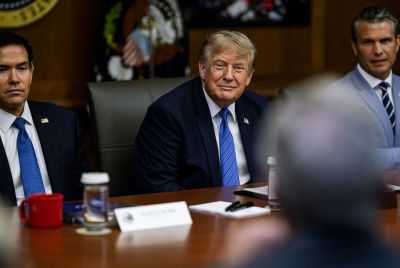
Donald Trump on Tuesday claimed that grocery costs in the United States are 'all coming down,' crediting his administration for what he described as sharply improving household budgets, even as official data shows most food prices are still rising.
The string of similar boasts from Trump at rallies and public appearances in recent months. On 27 July in Michigan, he told supporters that 'eggs are much lower than they were when we first started,' insisting the same was true 'with everything else.'
He repeated that line in Pennsylvania on 23 June and earlier on Air Force One on 6 February, turning supermarket prices and eggs in particular into a recurring motif in his economic pitch.
Donald Trump's Grocery Boast Meets the Inflation Data
In his latest appearance, Trump told anchor Trace Gallagher that his administration had tamed inflation at the tills.
'I inherited very, very high costs, and they're all coming down now,' he said. 'The food, the groceries, it's all coming down. We've done a great job. You know, I think we should be given an A+ on the economy.'
On the narrowest of technicalities, there is a sliver of support for part of that argument, but it falls far short of the sweeping story he is selling. What Trump is almost certainly leaning on is the latest Consumer Price Index report, published on 24 July, which shows that egg prices fell 0.8% between May and June and were 27.9% lower last month than in June 2025.
That sounds dramatic until you remember where egg prices started. They had spiked to historic highs in early 2025, driven largely by avian flu outbreaks that tore through poultry flocks.
A collapse from a once-in-a-generation peak is not the same as a generalised fall in food prices. Put bluntly, the data shows that eggs are cheaper. Virtually everything else in the supermarket is still getting more expensive.
The White House did not respond to a request for comment on Trump's claims, leaving the mismatch between his rhetoric and the published statistics hanging unchallenged from within his own administration.
Richard Volpe, a professor in the agribusiness department at California Polytechnic State University and a former economist at the USDA's Economic Research Service (ERS), is unambiguous about the underlying trend.

'Food prices going down almost never happens,' he told HuffPost. 'But it's worth reiterating that they are going up both faster than normal and faster than they did last year.'
Eggs, he noted, are something of an attention-grabber because of how omnipresent they are.
'Eggs are the headline-grabbing CPI category because they're ubiquitous everybody buys eggs; they're perishable,' Volpe said. 'As an overall share of our grocery spending, they're relatively small.'
Inflation Reality: Eggs Fall as Other Prices Climb Under Donald Trump
The ERS forecasts that, across 2026, grocery prices will rise by about 2.7%, while food bought from restaurants or takeaways will go up by roughly 3.5%. That may sound modest, but the agency's July report stresses that in eight of the 15 food categories it tracks, prices are expected to increase faster this year than the 20-year historical average.
Only three major groups are forecast to fall in price: eggs, and fats and oils. The rest offer little comfort for families trying to stretch a pay cheque.
The biggest squeezes so far this year have come in the meat and produce aisles.
The ERS figures show beef and veal prices in June 2026 were 11.8% higher than in June 2025, with a total increase of 10.7% expected over the year. Pork was about 2.4% more expensive in June than a year earlier, and is forecast to be up 1.6% for 2026 as a whole.
Fresh vegetables have climbed 9.9% year-on-year, with a 6.8% rise projected for the full year. Fruit prices dipped slightly between May and June, but still sit 2% above June 2025 levels and are expected to increase another 2% by December.
Packaged sugar and confectionery, including chewing gum, are set for a 7.2% price rise this year. Non-alcoholic drinks were 2.9% more expensive in June than a year before and are forecast to end 2026 around 3.9% higher.
In everyday terms, that means the core of a typical shop meat, vegetables, fruit, drinks and sweets is becoming steadily more expensive, even as the egg aisle offers a rare pocket of relief.
The problem, as Volpe points out, is that eggs are a relatively minor line on most receipts.
According to the USDA's breakdown of the Consumer Price Index, eggs account for about 0.8% of the 'relative importance' of an average grocery basket. Beef weighs in at 4.7%, while fruit and vegetables together make up about 10%.
Even a dramatic fall in egg prices barely nudges the total. At the current ERS forecast range of a 2.7% to 3.9% rise in food costs in 2026, a household that spent $100 on groceries in 2025 will now spend between $102.70 and $103.90 for the same items, Volpe said.
For a family of four, the USDA estimates average monthly grocery spending of $1,000 to $1,400, meaning roughly an extra $40 a month.
'If you told folks their internet bill was going up $40 a month, they wouldn't be happy about it,' Volpe noted.
The burden is not evenly distributed. The average US household spends about 12% of its income on food.
For lower-income families relying on programmes such as the Supplemental Nutrition Assistance Programme or Women, Infants, and Children, that share rises to between 20% and 25%, according to Volpe. In those households, a quiet 3% rise in grocery prices is not an abstraction but a weekly decision about what to leave behind at the till.
So when Trump insists it is 'all coming down,' the official data suggests something closer to the opposite. Egg prices, inflated by a one-off shock, have finally retreated. The rest of the supermarket is still marching upwards.
Nothing is fully settled, and all projections are subject to change, so the outlook should be taken with a grain of salt. But for now, the numbers do not match the A+ report card the president is busily writing for himself.
© Copyright IBTimes 2026. All rights reserved.
- Recommended For You