

Ex-Starbucks President Enters Mental Health Clinic Amid Anxiety And 'Retirement Depression': 'I'll Be Back Soon'
Howard Behar shares his battle with anxiety and retirement depression, highlighting the mental health challenges faced by retirees
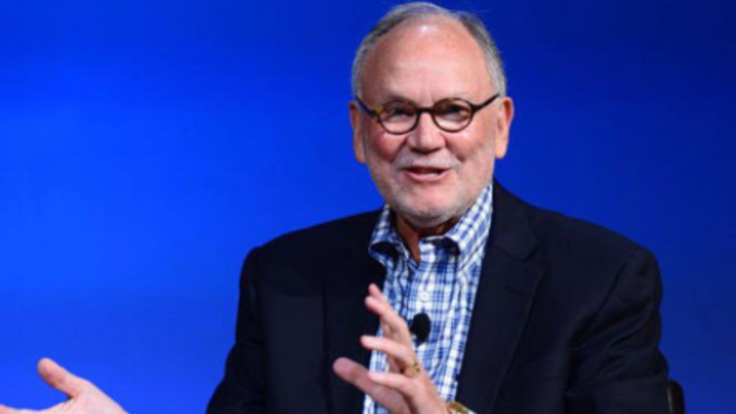
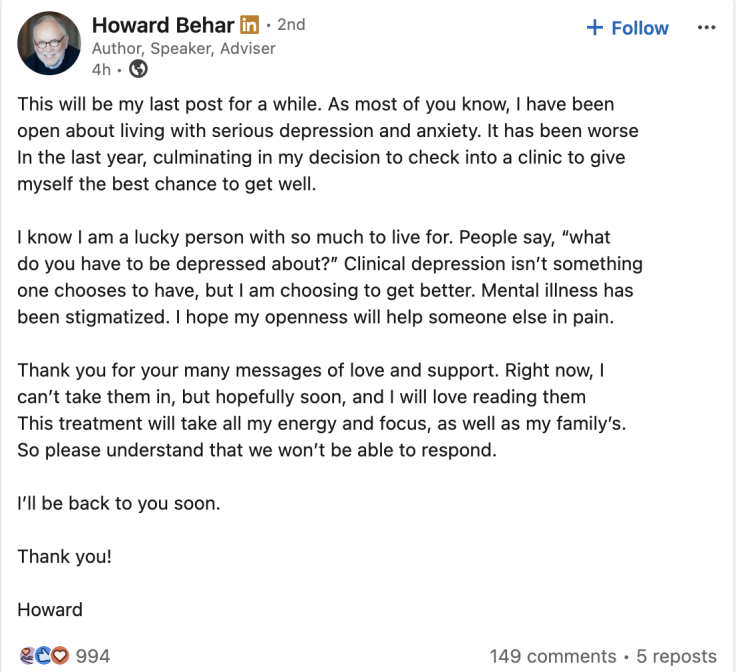
Howard Behar, who served as president of both Starbucks North America and Starbucks International during a career that helped grow the coffee chain from 28 stores to more than 15,000 locations, disclosed in a LinkedIn post that he had checked himself into a mental health clinic to treat anxiety and what he described in previous posts and interviews as 'retirement depression.'
'I'll be back soon,' Behar wrote.
Behar further revealed that the condition had worsened significantly over the past year and that he had made the decision to check into a clinic to give himself the best chance of recovery.
'People say, "what do you have to be depressed about?" Clinical depression isn't something one chooses to have, but I am choosing to get better. Mental illness has been stigmatized. I hope my openness will help someone else in pain,' Behar posted on LinkedIn.
Behar is one of the most recognised names in American business leadership, the man who, as president of Starbucks North America and Starbucks International, helped turn a Seattle coffee company into a global institution. He joined Starbucks in 1989 as vice president of sales and operations, taking a pay cut from roughly $300,000 (£225,000) a year at a furniture company to about a third of that salary.
Behar was named president of Starbucks Coffee International in 1995 and opened the chain's first store outside North America — in Tokyo — the following year. After a two-year hiatus, he returned as president of Starbucks North America, a role he held until retiring in March 2007. He also served twelve years on the board of directors.
Starbucks today generates $37.2 billion (£27.9 billion) in annual revenue and operates more than 40,000 stores across 87 countries.

A Lifelong Battle With Anxiety
The clinic disclosure was not Behar's first public reckoning with mental health. In an interview with NAMI Seattle, he said his anxiety took root in his mid-20s, when the pressures of wanting to perform for colleagues while running on little sleep began to compound.
'I think that's the time when I really knew I had a problem,' Behar told the organisation. 'That's when I started to get help.'
Finding the right support took years. 'I saw lots of different counselors, some helped me better than others, and over time I found people that I really related to and that has helped me the most,' he said.
Retirement depression was something else entirely. After walking away from over two decades at Starbucks, Behar lost the structure, community and daily purpose that had defined his working life. He told the Leap Academy podcast in November 2024 that the experience forced him to reconsider what his life was actually for. He had been, by every conventional measure, extraordinarily successful. The absence of work opened a gap that wealth alone could not close.
He concluded his real calling was to serve and uplift others, title or not. But arriving at that clarity required the kind of professional support he had first sought decades earlier.
The Wider Cost Of Retirement On Mental Health
Behar's experience fits a pattern clinicians have documented for years. According to HelpGuide, retirement can trigger clinical depression and anxiety even among people who spent years looking forward to it. One ongoing study cited by the organisation found that people in their first year of retirement are roughly 40 per cent more likely to suffer a heart attack or stroke than those who continue working.
Professional identity is often the fracture point. For senior executives whose sense of self was built around a company they helped scale from a handful of shops into a publicly traded multinational, the separation can be devastating. The paycheques stop. The calendar empties. The phone rings less.
HelpGuide also notes that many retirees feel guilt about drawing a pension without directly earning it and find their closest relationships strained by a routine that no longer exists. Financial anxiety can deepen the spiral, even when savings are substantial, as income shifts from active earnings to drawdowns from pension and investment accounts.
Behar, who coined the Starbucks philosophy 'We aren't in the coffee business serving people, we are in the people business serving coffee,' is the author of two leadership books — It's Not About the Coffee and The Magic Cup. He continues to speak publicly and mentor business leaders as an advocate of the Servant Leadership model.
His message on LinkedIn was short: he would get the help and he would be back.
If you or someone you know is struggling with mental health, reaching out to a professional is never a sign of weakness. It is, as Behar's own story shows, one of the bravest things a person can do. In the US, contact the 988 Suicide and Crisis Lifeline by calling or texting 988. In the UK, call the Samaritans on 116 123. International resources are available at findahelpline.com.
© Copyright IBTimes 2026. All rights reserved.