

Russia's New Weapon Against Ukraine? Powerful Jammers Designed to Cripple Elon Musk's Starlink
Moscow's electronic warfare units aim to counter Ukraine's drone advantage by targeting Starlink satellite connections.
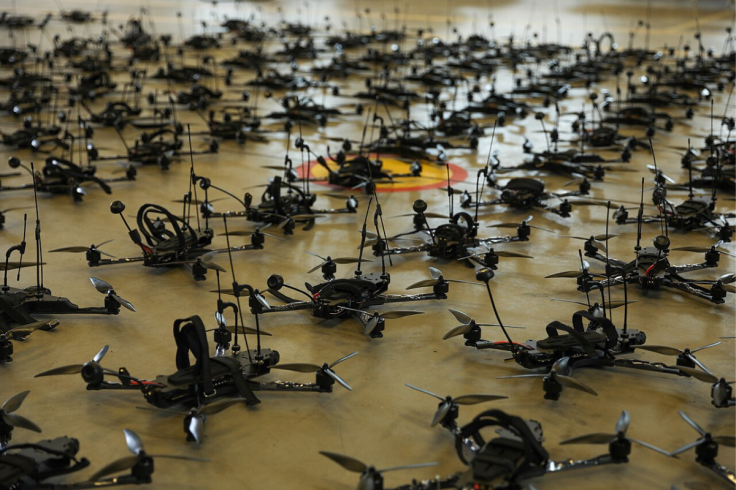
Russia has begun deploying powerful new jamming systems designed to knock out Elon Musk's Starlink satellite network — the lifeline Ukraine's drone operators rely on to strike deep behind enemy lines.
Ukrainian commanders say Russian forces have started rolling out electronic warfare units built specifically to disrupt the satellite service on which many of Kyiv's drones depend, in a direct attempt to blunt Ukraine's escalating long-range attacks.
The move comes after Ukraine's growing use of so-called 'mid-strike' drones allowed it to hit Russian targets dozens of kilometres behind the front lines, putting supply routes, fuel depots and command centres in compromising positions.
Russia Targets Starlink-Powered Drone Operations
Starlink has become a vital tool for Ukraine since the early stages of the war, providing internet access for military communications and allowing drone operators to maintain stable links with aircraft flying deep into Russian-held territory. It is precisely that advantage Moscow is now trying to strip away.
Many of Ukraine's mid-strike drones are operated through Starlink, enabling forces to carry out relatively low-cost attacks against supply lines, fuel storage facilities, air defence systems and command centres. The campaign has disrupted Russian logistics and has even contributed to fuel shortages in Russian-occupied Crimea.
Until recently, Starlink was widely regarded as difficult to jam. But Ukrainian commanders now say Russia has begun deploying more advanced electronic warfare systems to challenge that advantage.
One of the most notable is the Volna Kupol Garant system, designed to interfere with Starlink signals. According to Ukrainian defence ministry adviser Serhii Beskrestnov, around 10 of the systems have already been detected.
Each unit is capable of destabilising Starlink connections across an area of roughly 20 square kilometres. Ukrainian commanders told a news outlet the jamming systems have been installed near towns and military facilities, where they can interfere with drone operations targeting Russian positions.
The jammers form part of Russia's wider effort to counter Ukraine's expanding drone campaign, which has become one of the country's most effective battlefield tools.
But for all their reach, the jammers have proven far from invincible. Ukraine has responded by making the electronic warfare systems targets themselves. The 422nd Unmanned Systems Regiment has taken part in operations to destroy two Volna Kupol Garant installations, including one struck only hours after it was detected, in a joint mission with Ukraine's SBU security service.
One commander, using the callsign 'Dyryhent', said Starlink-equipped drones were able to fly 'without problems' after one of the installations was destroyed, suggesting the jamming system had been successfully neutralised.
The battle over electronic warfare has become almost as important as the fighting on the ground. Every jammer that remains operational can interfere with drone missions, while every destroyed system helps restore Ukraine's ability to carry out precision strikes.
Ukraine Hunts Down the Jammers As Russia Changes Tactics
It is not only its jamming technology that Russia has had to adapt. With Starlink-guided drones exposing its supply lines to repeated strikes, Moscow is also rethinking how it moves and protects military supplies.
Ukrainian commanders say fuel shipments are now being disguised in civilian vehicles, including water tankers and trucks painted to resemble milk delivery vehicles. Supplies are also being transported in smaller convoys protected by pick-up trucks with mounted machine guns and routed along less visible roads to avoid surveillance.
According to Ukraine's military intelligence, Russian forces are increasingly using civilian cars, motorbikes and quad bikes to transport fuel, ammunition and provisions closer to the front. Fuel and supplies are also reportedly being hidden in camouflaged dugouts, abandoned buildings, agricultural structures and even civilian petrol stations to reduce the risk of drone attacks.
The contest over Starlink itself, though, cuts both ways. Musk has already prevented Russian forces from using Starlink for their own drone operations, leaving Moscow to focus instead on disrupting Ukraine's access to the satellite network rather than gaining one of its own.
Rob Lee, a senior fellow at the US-based Foreign Policy Research Institute, said Ukraine's mid-strike drone campaign has been one of the most important battlefield developments this year. However, he warned that if Russia expands production of its Starlink-jamming systems, it could make Ukraine's drone operations increasingly difficult — a warning that hangs over everything Ukraine has achieved with the technology so far.
© Copyright IBTimes 2026. All rights reserved.