US Fighter Pilot Claims 'Alien' Drones in 'Jellyfish Formation' Swarmed Jet Before Iran Crash
US intelligence officials are split over whether the concussed airman glimpsed a new Iranian capability or a mirage in the chaos of war.
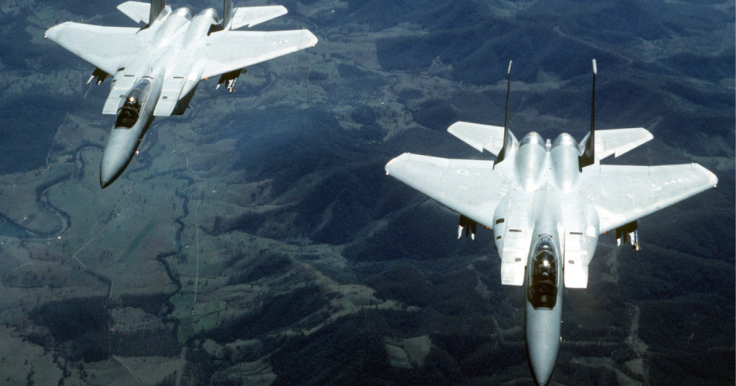
A US fighter pilot rescued after his F-15E Strike Eagle was shot down over Iran in April has reported a chilling encounter in the moments before his crash, claiming he witnessed a dense cluster of drones flying in a formation that resembled a jellyfish. The previously unreported account, shared during post-mission debriefings, has ignited a firestorm of speculation within the intelligence community regarding the sophistication of Tehran's drone warfare programme.
The airman, whose aircraft was downed on 3 April, told officials he observed multiple drones interconnected and moving in unison, with smaller units positioned beneath larger ones in a manner that defied standard aerial manoeuvring. Sources familiar with the debriefing described the formation as a 'minefield of drones' moving as a single, coordinated organism.
'Alien' Drones And A Jellyfish In The Sky
According to sources, the US fighter pilot reported seeing a dense cluster of Iranian drones moving as a single organism in the seconds before his jet was hit.
One source said the pilot described 'multiple drones interconnected and moving as one with smaller drones below the bigger drones like legs', likening the sight to a giant jellyfish pulsing through the sky. Another source quoted the airman calling it 'real alien s***.'
This was not the pilot's first brush with disaster. Two sources said he had already been shot down once before in the same war, when Kuwaiti friendly fire brought down his aircraft early in the conflict.
Some officials have suggested the 'fog of war' may explain at least part of what he thought he saw.
US Fighter Pilot Account Fuels Fears Over Iran's Drone Swarms
The pattern described by the US fighter pilot closely matches what drone specialists call 'one‑to‑many meshed networking.'
A source said some analysts viewed the formation as an aerial 'minefield of drones', a moving trap that could channel or overwhelm incoming aircraft. Initial internal reporting raised the possibility that the swarm helped Iran target or track the F‑15 before it was downed, although there is still no definitive finding on how the jet was actually brought down.
Russia and China are widely believed to possess integrated drone networking capabilities. Iran, until now, was not generally assessed as having reached that level, even though its Shahed‑type drones have become a staple of conflict zones from the Middle East to Eastern Europe.
US officials have been examining intelligence suggesting that Tehran may have received technical assistance from Moscow and Beijing, including in networked swarms.
Drone warfare expert Emma Bates, who founded the defence modernisation firm Cachai, told investigators and policymakers that a mature version of the capability would be a nightmare to counter.
She warned that forces would 'spend huge, huge dollars, like a lot of blood and treasure, protecting ourselves from something that can coordinate like that.' If a swarm can maintain a rigid shape, carry explosives and hold some drones in reserve, she argued, that is 'a very capable approach' to attacking high‑value targets.
One US official pointed out that meshed networks can theoretically provide temporary internet coverage in remote areas with no infrastructure. It is the weaponisation, however, that has everyone's attention.
Daring Rescue, Unanswered Questions
The US fighter pilot's testimony only emerged after a rescue operation that sounded, even to seasoned officers, almost reckless. After the F‑15 went down, American forces scrambled what one internal tally described as an all‑hands mission involving 155 aircraft, including 64 fighter jets, 48 refuelling tankers, 13 rescue planes and three helicopters.
The pilot, who had landed in rugged, mountainous terrain, reportedly trekked around 70 miles over 36 hours inside Iranian territory before being extracted.
At one point, US planners used intelligence channels to feed false information to Iranian forces, suggesting the airman had already been pulled out, in order to mask the real search area.
Several aircraft involved in the effort had to be abandoned and destroyed on the ground before rescuers could fly back to safety, according to operational accounts.
President Donald Trump publicly hailed the mission as 'a breathtaking show of skill and precision, lethality and force', praising the weapons systems officer in particular for scaling cliffs, treating his own wounds and keeping contact with US forces until he was found.
'It was like finding a needle in a haystack,' he said, adding that in his view 'God was watching us.' Some military leaders, he admitted, had opposed the operation, arguing it put hundreds of lives at risk.
The Pentagon has not released the names of the crew or given a detailed public narrative of what happened in the air over Iran. The US Air Force has referred questions to US Central Command, which has not addressed the specifics of the jellyfish‑like swarm.
The Office of the Director of National Intelligence has given no public comment either.
The F‑15 went down in Iranian territory in April during the ongoing Iran war, marking the first time a US aircraft had been shot out of the sky over the country in the current conflict. Both crew members, a pilot and a weapons systems officer, ejected before impact.
US special forces pulled the pilot out within hours, while the weapons officer evaded capture in the mountains for more than a day before he too was recovered.
A separate A‑10 aircraft crashed during the rescue effort, with that pilot ejecting safely outside Iran.
© Copyright IBTimes 2026. All rights reserved.
- Recommended For You