Trump Refuses to Commit to Defending Taiwan After Xi Raises It Directly at Beijing Summit
US-China relations face strain as Trump avoids direct response on Taiwan defence

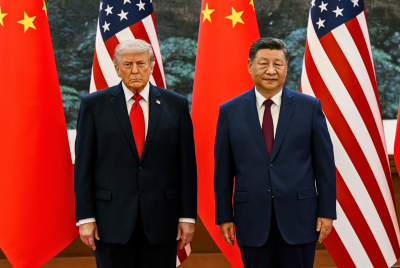
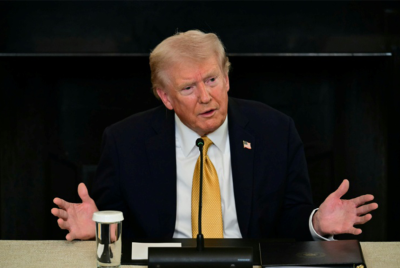
Donald Trump declined to say whether the United States would defend Taiwan if China attacked, after Chinese President Xi Jinping raised the question directly during their two-day summit in Beijing. Speaking to reporters aboard Air Force One on the flight back to the US, Trump confirmed Xi had put the question to him — and that he gave no direct answer. 'That question was asked to me today by President Xi. I said, "I don't talk about that,"' Trump told reporters.
The exchange laid bare one of the most consequential fault lines in US-China relations and reignited debate over whether Washington's longstanding posture of strategic ambiguity is holding — or quietly eroding under Trump.
Xi's Blunt Warning
Xi called the Taiwan question 'the most important issue' between Beijing and Washington, warning that the broader relationship could be put in jeopardy if it was mishandled. 'If it is handled properly, the bilateral relationship will enjoy overall stability,' Xi said. 'Otherwise, the two countries will have clashes and even conflicts, putting the entire relationship in great jeopardy.'
The warning came during a highly choreographed summit in Beijing, where the two leaders sought to project warmth even as they confronted some of the most contentious issues in the US-China relationship. Xi greeted Trump outside the Great Hall of the People before the two leaders reviewed an honour guard, as a 21-gun salute rang out across Tiananmen Square.

Schumer Blasts Trump as 'Mute'
The silence from the White House on Taiwan drew an immediate and sharp response from Senate Minority Leader Chuck Schumer. 'Just hours in, and Xi Jinping has already threatened to, quote, collide or even clash, unquote, with the United States if we continue our support for Taiwan. Trump apparently didn't say anything in response. He was just mute,' Schumer said. 'For the sake of democracy and the stability of the global economy. Trump must not sell out Taiwan.'
The criticism reflected broader anxiety in Washington and Taipei over whether Trump, known for his transactional approach to foreign policy, might use Taiwan as leverage in a wider deal with Beijing. Retired US Navy Rear Admiral Mark Montgomery said he worries that 'we have a transactional president and a transactional opportunity could arise, and then we would have a challenge.'
Rubio Steps In
Secretary of State Marco Rubio moved quickly after the summit to reassure allies. 'US policy on the issue of Taiwan is unchanged as of today and as of the meeting that we had here today,' Rubio said in an interview with NBC News following the summit. He added that the US always makes clear that 'anything that would compel or force a change in what we have now would be problematic.'
Rubio also sought to minimise the Taiwan portion of the talks, saying US arms sales to Taiwan 'did not feature prominently' in Thursday's discussion. He separately warned that any Chinese attempt to take Taiwan by force 'would be a terrible mistake.'
Taiwan's Reaction
Taiwan's government, while expressing concern, took some comfort in Washington's public assurances. Taiwan's government Cabinet spokesperson Michelle Lee said Taipei is grateful for the firm US support of the island, adding that 'the US has also repeatedly reiterated its firm and clear position of support for Taiwan.'
Reporter: Would the US defend Taiwan if it came to it?
— Clash Report (@clashreport) May 15, 2026
Trump: I don't want to say that. I'm not going to say that.
That question was asked to me today by President Xi. I said, “I don't talk about those.”
Reporter: He asked you if you would send troops?
Trump: He asked me if… pic.twitter.com/xYQND5jqKP
Taiwan's Foreign Ministry spokesperson Hsiao Kuang-wei said in a written statement that 'Taiwan is committed to maintaining the status quo and ensuring that the security of the Taiwan Strait is not threatened,' adding that 'the only destabilising factor in the Taiwan Strait is China's authoritarian expansionism.'
Analysts noted a stark contrast in how both sides approached the summit. Bryce Barros, an associate fellow at the GLOBSEC think tank, said the talks demonstrated 'a widening mismatch between Beijing's highly strategic and security-centric framing of the bilateral relationship in comparison to Washington's more transactional, economically oriented approach.'
Taiwan sits at the centre of one of the world's most volatile geopolitical flashpoints. Washington maintains defence ties with the island but has not formally stated whether it would defend Taiwan if China attacked — an approach known as strategic ambiguity. Under the decades-old Taiwan Relations Act, Washington is bound by law to provide Taiwan with the means to defend itself. Trump's refusal to answer Xi's direct question, combined with the White House's brief post-summit readout that made no mention of Taiwan, has left Taipei and its allies watching closely for any shift in US commitment.
© Copyright IBTimes 2026. All rights reserved.
- Recommended For You